
Last Updated: July 2026 | Author: Munir Ardi
The United States is facing an unprecedented waste management crisis. For decades, the primary strategy for municipal waste was simply burying it in massive landfills or exporting it overseas. In 2026, those options are rapidly disappearing. Domestic landfills are reaching maximum capacity, and international markets have severely restricted the importation of American plastic waste. The only sustainable path forward is a total transition to a “Circular Economy”—a system where materials are continuously recovered, processed, and repurposed.
However, transitioning a city from a “throwaway” culture to a circular economy requires massive industrial infrastructure. Purchasing heavy-duty balers, optical sorting machines, fleets of collection trucks, and building modern Material Recovery Facilities (MRFs) can cost tens of millions of dollars. Because local municipalities and nonprofits cannot shoulder this burden through tax revenue alone, the federal government has unlocked historic levels of funding. Understanding how to secure these grants for recycling is the ultimate key to solving the local waste crisis.
Before you begin drafting a proposal for multi-million dollar industrial equipment, you must ensure your organization is legally and bureaucratically equipped to manage massive federal capital. Anchor your operational strategy by reviewing our master pillar: Government Grants for Nonprofit Organizations & 501(c)(3) Opportunities.

Transitioning a community to a circular economy requires massive industrial infrastructure. The EPA’s SWIFR grant program provides the non-dilutive capital needed for nonprofits and municipalities to purchase heavy recycling machinery and collection fleets.
Phase 1: The Federal Giant (EPA SWIFR Program)
If you are searching for massive capital to build or upgrade a recycling facility, your primary target is the Environmental Protection Agency (EPA). Fueled by the Bipartisan Infrastructure Law, the EPA operates the most lucrative waste management grant in the country: the Solid Waste Infrastructure for Recycling (SWIFR) grant program.
The SWIFR program is designed to transform the nation’s recycling infrastructure from the ground up. The EPA distributes hundreds of millions of dollars across three distinct grant pipelines:
- Grants for States and Territories: To develop statewide solid waste management plans.
- Grants for Communities: Directed at local municipalities and counties to physically upgrade their MRFs, buy new collection bins for residents, and purchase modern sorting technology (like AI-driven robotic arms).
- Grants for Tribes and Intertribal Consortia: Specific set-asides to build waste management infrastructure on tribal lands.
Note: While 501(c)(3) nonprofits are often not the primary direct applicants for the massive infrastructure construction grants (which usually go to municipal governments), nonprofits frequently partner with cities as sub-recipients to execute community education and specialized collection programs funded by SWIFR.
Pro-Tip: Decoding EPA Recycling Grants
Navigating the EPA’s massive infrastructure grants requires a deep understanding of federal priorities. The EPA does not fund generic ideas; they fund projects that directly divert tonnage from landfills. To understand the exact mechanics of the SWIFR program and how successful municipalities structure their proposals, watch this official breakdown featuring the EPA and recent grant recipients: Lessons Learned from Recycling Grant Recipients:
Phase 2: E-Waste & Specialized Recycling
General plastic and cardboard recycling is only one part of the equation. The fastest-growing waste stream in the world is Electronic Waste (E-Waste). Discarded smartphones, laptops, and appliances contain highly toxic heavy metals like lead and mercury, as well as highly volatile lithium-ion batteries, which are notorious for causing catastrophic fires inside recycling facilities.
Because E-waste is a severe environmental and physical hazard, state environmental departments and the EPA offer highly specialized grants specifically for organizations that safely collect, dismantle, and recycle electronics. If your organization’s mission focuses on intercepting toxic materials before they reach a landfill, you must synergize your efforts by exploring our broader guide on How to Get Government Grants for Environmental Projects.
Phase 3: Community Composting & Food Waste
Food waste is an invisible crisis. When organic matter is dumped into a traditional landfill, it decomposes anaerobically (without oxygen), releasing methane—a greenhouse gas that is exponentially more destructive than carbon dioxide.
For smaller nonprofits that do not have the millions of dollars required to build an industrial plastic recycling plant, Community Composting is the ultimate entry point. The USDA and the EPA jointly offer the Community Compost and Food Waste Reduction (CCFWR) grant. This program provides micro-grants and mid-tier funding to local municipalities and nonprofits to set up neighborhood compost collection hubs, buy commercial compost turners, and redirect food waste from landfills to local community gardens.
Phase 4: The Bureaucratic Shield (Proposal & Compliance)
Federal agencies are managing taxpayer dollars. They will not award $500,000 for a new fleet of recycling trucks simply because you have a noble mission. You must project absolute corporate and data-driven legitimacy.
The Data-Driven Proposal
When applying for grants for recycling programs, your “Statement of Need” cannot rely on emotion. It must rely on tonnage. A winning proposal explicitly states the mathematics: “Our municipality currently sends 50,000 tons of recyclable material to the landfill annually. By utilizing this $2 million SWIFR grant to purchase a dual-stream optical sorter, we will divert 20,000 tons of material in the first 24 months, generating $500,000 in secondary market revenue.” To master the precise architecture of these mathematical pitches, you must study How to Write a Government Grant Proposal.
Post-Award Tracking
If you win a massive EPA grant, the celebration is brief; the audit is immediate. The federal government will mandate quarterly reporting. If an auditor discovers you used grant funds to buy office furniture instead of the approved baler machine, they will demand the money back. To survive federal scrutiny, you must abandon spreadsheets and deploy professional Grant Tracking Software for Nonprofits.
Phase 5: The Muslim Perspective (Cleanliness, Riba, Gharar, and Zakat)
For Muslim-led environmental nonprofits and community leaders in the United States, managing a recycling or waste diversion initiative is not merely an ecological project; it is the ultimate fulfillment of a divine mandate. However, building the heavy industrial infrastructure required to process waste introduces severe financial and ethical traps that must be navigated with strict adherence to Islamic jurisprudence (Shariah).
Cleanliness and Environmental Stewardship (Khalifah fil Ardh)
A core tenet of Islamic faith is cleanliness. The Prophet Muhammad (?) explicitly stated, “Cleanliness is half of faith” (Sahih Muslim). Furthermore, humans are designated as Khalifah fil Ardh (Stewards of the Earth). Allowing toxic batteries to leach into groundwater or burying communities in plastic waste is a violation of this stewardship. Establishing a recycling infrastructure is essentially a Fardu Kifayah (a communal obligation). If no one in the community steps up to manage the waste responsibly, the entire community bears the sin of negligence.
The Trap of Riba in Heavy Machinery
The cost of modern recycling equipment is astronomical. A commercial cardboard baler can cost $80,000, and a specialized collection truck can easily exceed $300,000. When government grants fall short, commercial banks aggressively pitch “Equipment Financing Loans” to bridge the gap.
For a Muslim-led organization, taking out a loan that requires the payment of compounding interest is explicitly Riba, which is strictly Haram (forbidden) and eradicates the spiritual Barakah (blessing) from the environmental effort. A Muslim board of directors must adamantly refuse these loans.
This is why securing EPA Grants (Hibah) is a religious necessity—because grants require no repayment, they are 100% Halal capital. If grants are insufficient, the organization must seek Mudarabah (profit-sharing partnerships) with Halal investors or utilize Islamic Murabaha (cost-plus financing) to purchase the heavy machinery without engaging in Riba.
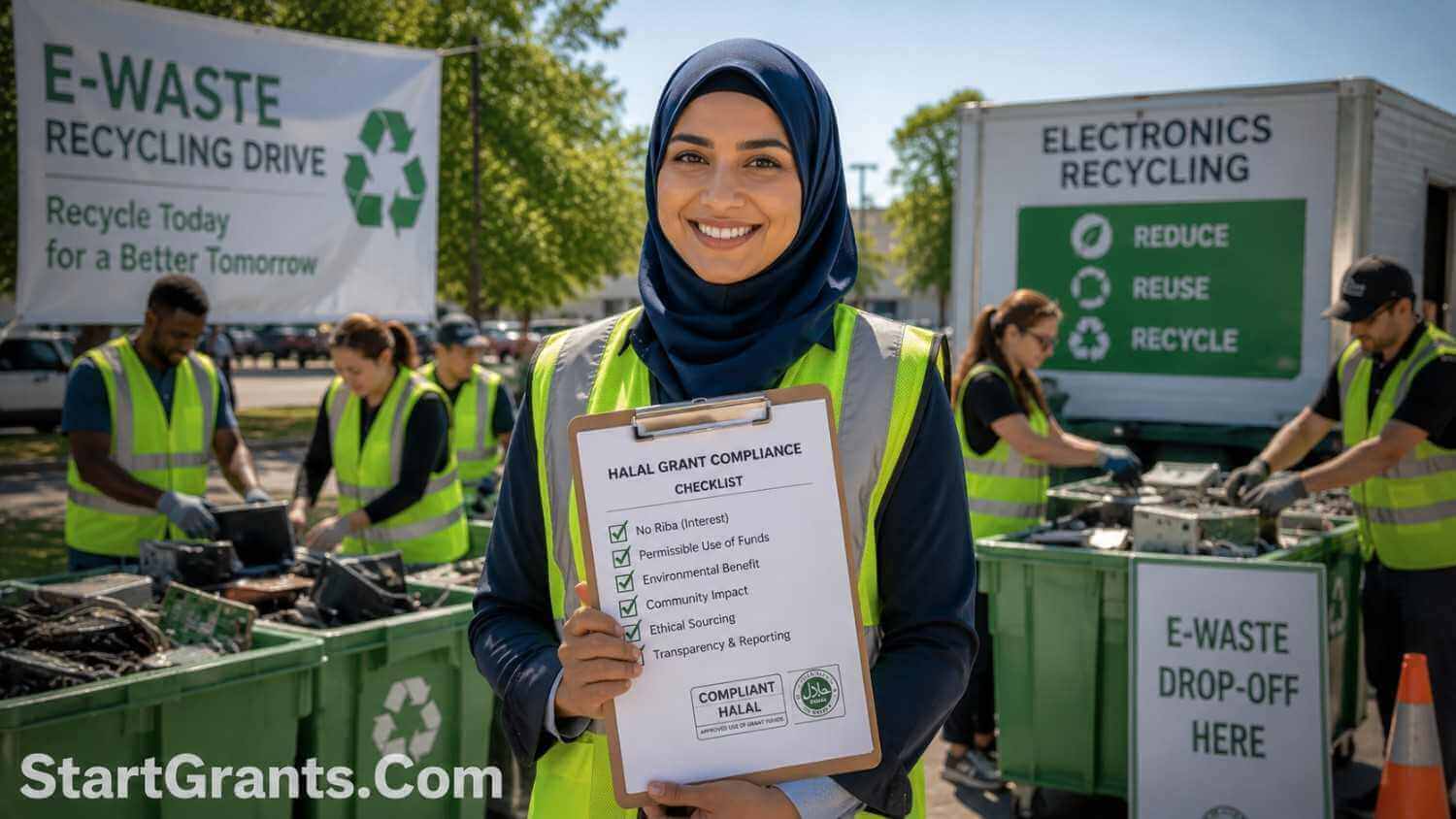
In Islam, environmental stewardship and cleanliness are acts of faith. By utilizing government grants (Hibah) instead of Riba-laced commercial loans to purchase recycling equipment, Muslim-led nonprofits ensure their eco-initiatives remain spiritually pure.
Gharar and Industrial Insurance
Operating a Material Recovery Facility (MRF) or a fleet of garbage trucks is inherently dangerous. Workers face risks of amputation from balers, and facilities face massive fire hazards from improperly discarded lithium-ion batteries. Consequently, federal grants and municipal contracts legally mandate that the organization carries extensive Commercial General Liability and Workers’ Compensation Insurance.
Traditional commercial insurance contains Gharar (excessive uncertainty) and elements of gambling. Ideally, Islamic organizations should utilize Takaful (cooperative insurance). Because commercial industrial Takaful is virtually non-existent in the U.S. market, contemporary Islamic scholars apply the principle of Dharurah (legal and operational necessity). This permits the organization to purchase the heavily mandated commercial policies to protect the workers, shield the community from lawsuits, and satisfy grant laws, provided the intent is survival and protection, not speculative profit.
Zakat vs. Sadaqah Jariyah (The Infrastructure Rule)
When an Islamic community raises funds to build a recycling center, a massive theological error frequently occurs regarding the misuse of Zakat.
In Islamic law, Zakat is a divine tax strictly restricted to eight specific human categories (the Asnaf), primarily the absolute poor. It is strictly Haram to use Zakat money to buy a garbage truck, purchase a commercial baler, or build a recycling facility. These are fixed assets.
Environmental infrastructure must be funded exclusively through government grants (Hibah) or Sadaqah Jariyah (continuous voluntary charity). Building a recycling center that protects a community’s health for decades is a profound act of Sadaqah Jariyah, but it must never be funded using restricted Zakat money intended to feed the poor.
Conclusion
Securing grants for recycling requires a highly organized, data-driven approach. By targeting massive federal pipelines like the EPA’s SWIFR program for heavy infrastructure, and leveraging USDA CCFWR grants for grassroots composting, municipalities and nonprofits can access the non-dilutive capital required to build a true circular economy.
For the Muslim environmentalist, leading this ecological revolution must be executed with impeccable ethical standards. By fulfilling the mandate of Khalifah fil Ardh, fiercely rejecting Riba-laced equipment loans in favor of Halal Hibah, navigating insurance mandates via Dharurah, and strictly isolating Zakat from infrastructure purchases (Sadaqah Jariyah), your environmental initiative will protect the Earth while radiating absolute divine Barakah.
Frequently Asked Questions (FAQs)
Q1: Who is eligible to apply for EPA SWIFR recycling grants?
A: The Solid Waste Infrastructure for Recycling (SWIFR) program has specific grant tracks. The massive infrastructure grants are typically restricted to states, territories, political subdivisions (municipalities/counties), and federally recognized tribal governments. However, 501(c)(3) nonprofits are often highly encouraged to partner with cities as sub-recipients to execute community education or specialized collection programs.
Q2: Does the government provide grants to start a private, for-profit recycling business?
A: Generally, no. Direct federal EPA grants are usually restricted to public entities and nonprofits. However, for-profit recycling and agritech businesses can often secure Small Business Innovation Research (SBIR) grants if they are developing new, patented recycling technology, or they can apply for SBA-backed loans to purchase equipment.
Q3: What kind of recycling equipment will these grants pay for?
A: SWIFR and similar federal grants are designed to fund major capital expenditures. This includes optical sorters, commercial balers, magnetic separators, fleet vehicles (like collection trucks), and the physical construction or expansion of Material Recovery Facilities (MRFs) and community composting hubs.
Q4: Why is it Haram for a Muslim-led NGO to use a commercial bank loan to buy a recycling truck?
A: Commercial bank equipment loans require the borrowing organization to pay back the principal amount plus a percentage of compounding interest over time. In Islamic finance, intentionally engaging in a contract that stipulates the payment of interest is classified as Riba, which is strictly forbidden (Haram), even if the loan is used for noble environmental purposes.
Q5: Can Zakat funds be used to build a community recycling center?
A: No. In Islamic jurisprudence, Zakat is a divine, obligatory tax strictly restricted to specific human recipients (the Asnaf), primarily the absolute poor. Zakat cannot be used to purchase physical infrastructure or fixed assets for an organization (like recycling trucks, land, or sorting machines). Those capital expenses must be paid using Sadaqah Jariyah (continuous voluntary charity) or government grants.
Disclaimer: The information provided in this article is for educational and informational purposes only. We are not a federal environmental agency, an infrastructure planning firm, or a religious fatwa council. EPA SWIFR grant cycles, Bipartisan Infrastructure Law funding availability, and state waste mandates are subject to frequent legislative changes. Always consult directly with the EPA or your state’s Department of Environmental Protection for official grant guidelines, and seek guidance from a qualified Islamic finance scholar regarding Halal institutional structuring, avoiding Riba, and strict Zakat accounting rules.