
Last Updated: | Author: Munir Ardi
There is no standing federal grant that simply pays anyone to start an aquaponics farm. Federal support does exist, but the closest matches are usually competitive research grants, urban-agriculture projects, conservation assistance tied to an eligible practice, disaster or risk-management benefits, and repayable farm loans. The right route depends on who is applying, what the project will accomplish, where it will operate, and whether the current funding notice allows the proposed costs.
Aquaponics combines aquaculture with hydroponic plant production. That makes it relevant to several federal program areas, but it does not make a project automatically eligible. Start with our broader urban farming grants and funding guide, then use this page to evaluate the narrower aquaponics options.

Aquaponics projects may combine fish production, hydroponic crops, water recirculation, and controlled-environment equipment. Funding eligibility depends on the specific program and project.
Federal Aquaponics Funding at a Glance
The table separates true grants from loans and other forms of assistance. A program’s existence does not mean that it is open, that every aquaponics applicant is eligible, or that it will pay for a commercial facility.
| Program or route | Type | Verified status | Best fit and limits |
|---|---|---|---|
| NIFA Special Research Grants for Aquaculture Research | Competitive research grant | FY 2026 closed June 15, 2026, at 5:00 p.m. Eastern Time | Applied aquaculture research addressing specified industry priorities; not ordinary startup capital |
| NIFA Urban, Indoor, and Emerging Agriculture | Competitive research, education, or Extension grant | FY 2026 closed July 27, 2026 | Projects advancing the urban, indoor, or emerging-agriculture value chain; not unrestricted facility financing |
| USDA Urban Agriculture and Innovative Production | Project grants and technical resources when announced | No open national UAIP grant notice was verified on the program page at this update | Community-oriented urban food projects; do not assume it will fund a private warehouse buildout |
| NOAA Sea Grant funding | Research, demonstration, and partnership grants when announced | No open Sea Grant funding opportunity was listed on the national page at this update | Usually tied to a defined marine or aquaculture research priority; not a general freshwater aquaponics startup grant |
| Sustainable Agriculture Research and Education | Regional research and education grants | Cycles and applicant rules vary by SARE region | Farmer-led trials, demonstrations, or education; generally not routine startup, construction, or operating costs |
| NRCS Environmental Quality Incentives Program | Conservation contract with technical and possible financial assistance | Applications accepted continuously; state ranking dates apply | Only approved practices addressing documented resource concerns; not a blanket aquaponics grant |
| USDA Farm Service Agency farm loans | Interest-bearing loan | Applications handled through FSA offices | Potential equipment, supplies, and operating financing for eligible land-based aquaculture operations; repayment and credit rules apply |
| FSA disaster and risk programs | Disaster or risk-management benefit | Enrollment, notice, and application deadlines depend on the program and loss year | May cover eligible crops, farm-raised fish, or qualifying losses; not money to launch a system |
The Strongest Federal Match: Applied Aquaculture Research
NIFA Special Research Grants for Aquaculture Research
The most explicitly aquaculture-focused federal opportunity reviewed for this article is NIFA’s Special Research Grants Program for Aquaculture Research. The FY 2026 notice offered an estimated $1,813,840 in total program funding, awards from $50,000 to $300,000, an anticipated six to seven awards, a 24-month project period, and no matching requirement. The deadline was June 15, 2026, at 5:00 p.m. Eastern Time, so that competition is closed.
This was an applied research competition. Its priorities included genetics and genomics, disease, production or management technology that can improve profitability, and economic research. Applicants had to explain how the work would improve U.S. aquaculture production or profitability and involve the aquaculture industry. Results also had to be publicly disseminated. An aquaponics operator proposing a controlled experiment may fit; a business asking only for tanks, pumps, rent, or working capital generally does not match that purpose.
The FY 2026 notice allowed a broad set of applicants, including certain institutions, private organizations or corporations, individuals who met the stated U.S. status rules, and groups of eligible entities. That does not eliminate the research, application, registration, and award-management requirements. For context on this agency’s competitive programs, see our USDA NIFA grants and eligibility overview.
NIFA Urban, Indoor, and Emerging Agriculture
The FY 2026 UIE competition was also relevant to controlled-environment agriculture, but it closed July 27, 2026. NIFA listed $4 million in estimated program funding, an award range of $50,000 to $500,000, and no matching requirement. The eligible project categories centered on research, education, and Extension across the urban, indoor, and emerging-agriculture value chain. A commercial aquaponics farm should not interpret that language as a promise that ordinary construction or operating costs will be funded.
Do not reuse either FY 2026 deadline for a future cycle. Monitor the official NIFA funding pages and read the new Notice of Funding Opportunity before preparing an application.
NOAA and Sea Grant: Relevant, but Usually Not Startup Capital
NOAA supports aquaculture research and development through programs that can involve universities, Sea Grant institutions, companies, states, and coastal communities. Its funding pages discuss subjects such as recirculating systems, environmental monitoring, new species, and demonstration projects. However, the national Sea Grant funding page listed no open opportunities when this article was updated.
A freshwater aquaponics business should not assume that producing fish is enough to qualify for a NOAA competition. Read the exact geographic, species, partnership, research, and cost rules. Also distinguish a grant from the NOAA Fisheries Finance Program, which provides loan financing and must be repaid.
Can EQIP Pay for an Aquaponics Facility?
EQIP is not an unrestricted construction grant. NRCS works with an agricultural producer to identify a natural-resource concern, develop a conservation plan, and select eligible practices. Applications are accepted continuously, but funding decisions follow state-specific ranking periods.
A common online claim says EQIP’s High Tunnel Initiative will pay for a greenhouse containing aquaponic grow beds. That is misleading. NRCS guidance for Conservation Practice Standard 325 requires crops to be grown in the natural soil profile or permitted permanent raised beds; it excludes hydroponic crops grown on tables, benches, or in containers. Because the plant side of aquaponics is hydroponic, applicants should not budget an aquaponics high tunnel as though it automatically qualifies under Practice 325.
Other conservation practices may be relevant to a particular site, resource concern, or state payment schedule. Ask the local NRCS office to evaluate the actual project before purchasing equipment or beginning work. Starting a practice before written authorization can make a cost ineligible.
Farm Loans and Risk Assistance
For an operating business that needs tanks, pumps, filtration, supplies, or other eligible farm expenses, FSA financing may be more realistic than a grant. FSA Operating Microloans are interest-bearing loans of up to $50,000, and Direct Operating Loans can reach $400,000 under current program pages. Eligibility, credit, experience, repayment ability, and permitted-use rules apply. Our farm equipment grants and financing guide explains why equipment searches often lead to loans or cost-share programs rather than cash grants.
FSA also lists risk-management and disaster programs that can apply to eligible aquaculture or crops. The Noninsured Crop Disaster Assistance Program and Emergency Assistance for Livestock, Honey Bees, and Farm-Raised Fish are benefits tied to covered production and qualifying losses. They do not finance a startup, and their enrollment, notice-of-loss, documentation, and application deadlines must be checked with FSA.
Aquaponics, Hydroponics, and Organic Claims
Aquaponics uses hydroponic plant beds connected to an aquatic-animal production system. Applicants should keep the fish-production and crop-production components clear in budgets, permits, food-safety plans, and grant narratives. Readers comparing plant-only systems can use our hydroponic farming grants and funding guide.
Do not market an aquaponics system as automatically USDA organic. USDA’s organic regulations do not categorically prohibit hydroponic crop production, so the plant operation may be certified if an accredited certifying agent determines that it complies with all applicable requirements. But USDA currently has no organic standards for aquatic animals. Fish from the same system therefore cannot be represented as USDA organic or carry the USDA Organic seal.
How to Build a Fundable Aquaponics Project
- Define the project, not just the shopping list. State the problem, research question or conservation concern, beneficiaries, measurable outputs, and why the proposed method fits the program.
- Choose the correct applicant. Some notices permit individuals or businesses; others favor universities, nonprofits, public agencies, or formal partnerships. Never create an LLC solely because an article says it is universally required.
- Verify allowable costs. Tanks, buildings, fish, feed, labor, land, utilities, indirect costs, and equipment can receive different treatment. A cost that is necessary for the farm is not automatically allowable under a grant.
- Prepare an evidence-based operating plan. Address species selection, stocking density, water quality, disease prevention, backup power, mortality response, plant nutrient management, food safety, waste handling, and market demand.
- Map every deadline and registration. A federal notice may require Grants.gov, a Unique Entity Identifier, an active SAM.gov registration, or other profiles. Those steps apply when the specific opportunity requires them; they are not universal prerequisites for every loan, benefit, state program, or local award.
- Get local answers early. Contact Cooperative Extension, the state department of agriculture, the local USDA Service Center, and relevant fish, water, zoning, building, and health authorities.
Save This Aquaponics Funding Checklist
- [ ] Separate the fish, plant, building, energy, and research costs in the budget.
- [ ] Confirm that the current notice is open and record its deadline and time zone.
- [ ] Match the applicant type and project purpose to the official eligibility section.
- [ ] Ask whether purchases made before approval are ineligible.
- [ ] Document water sources, discharge, fish-health controls, backup power, and mortality procedures.
- [ ] Verify zoning, building, water, aquaculture, food-safety, and sales requirements.
- [ ] Confirm whether the award requires matching funds, reimbursement, reporting, public results, or repayment after noncompliance.
- [ ] Keep copies of the notice, submitted application, budget, approvals, receipts, and award agreement.
Common Mistakes and Grant Scams
- Treating every federal program as a grant. FSA farm loans carry interest and repayment obligations; disaster benefits compensate qualifying losses; EQIP is conservation assistance under a contract.
- Applying to a closed notice. Old USDA and NOAA pages can remain searchable after a competition ends. Confirm the year, status, deadline, and application link on the official page.
- Paying someone who promises approval. Federal agencies do not guarantee awards in exchange for a processing fee. SAM.gov registration itself is free.
- Claiming environmental outcomes without evidence. Quantify water use, discharge, energy demand, survival, yield, and nutrient recovery using project-specific measurements or credible research.
- Ignoring award conditions. A grant can restrict spending, require progress and financial reports, mandate public dissemination, or require return of unspent or misused funds.
A Muslim Perspective: Evaluating Aquaponics Funding Terms
A Muslim applicant may distinguish a nonrepayable award from an interest-bearing loan, but the label alone is not enough. Read the actual agreement for restrictions, reimbursement rules, matching obligations, reporting, default provisions, and possible clawbacks. A conditional government award may still be useful, yet it should not be described as an unrestricted gift.
FSA farm loans and other conventional financing may raise riba concerns because they charge interest. Depending on the project’s scale and circumstances, alternatives could include retained earnings, a genuine interest-free loan, preorders, donations or crowdfunding with transparent terms, or properly structured equity or profit-sharing. Each option has legal, tax, governance, and Shariah implications.
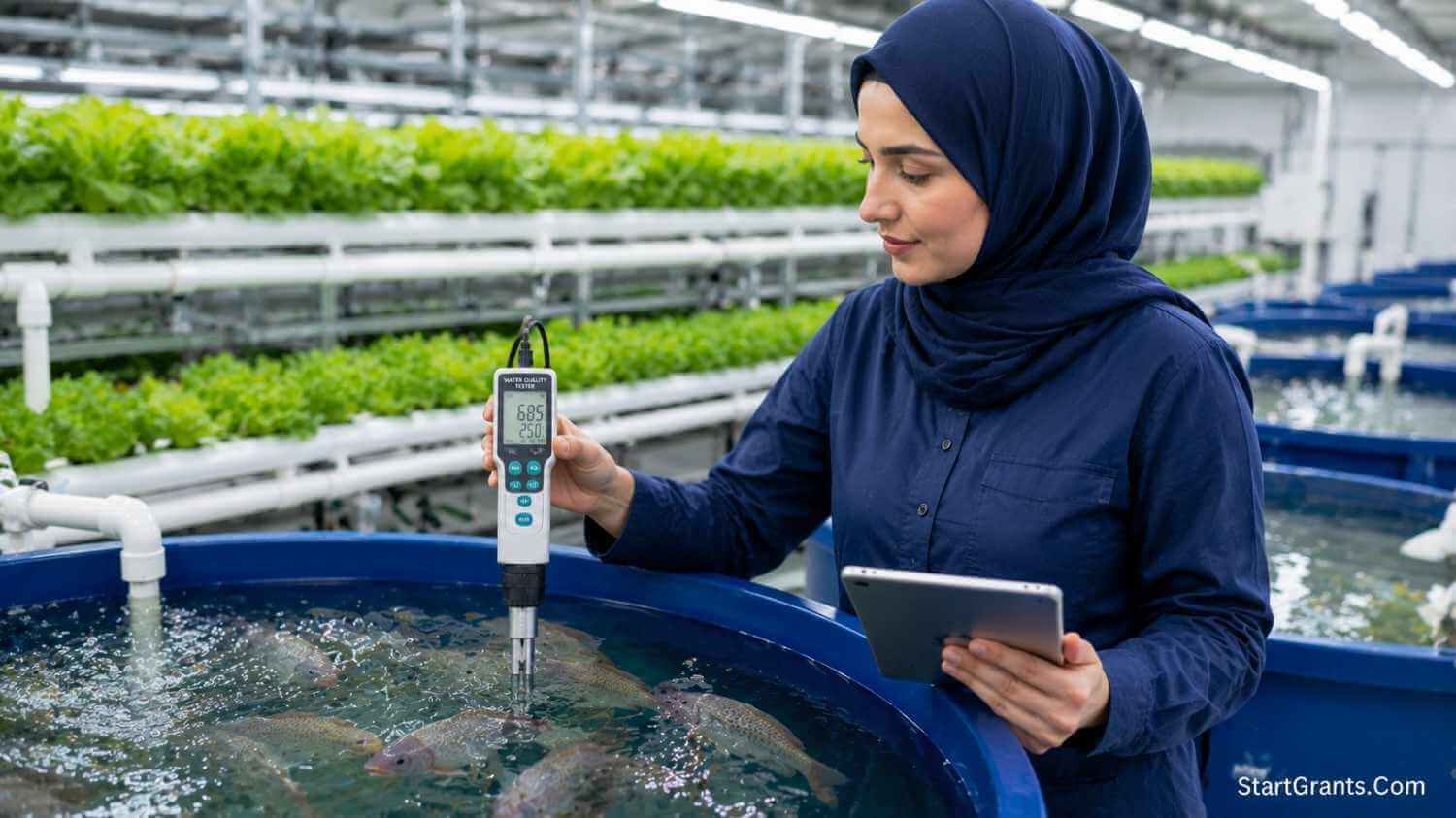
Muslim aquaponics operators can review financing, insurance, partnership, and zakat questions using the actual contracts and business facts rather than relying on a funding label.
Insurance requirements and zakat treatment also depend on facts that a general article cannot resolve. The treatment of crops, fish held for sale, cash, receivables, debts, harvest timing, nisab, and hawl may differ by circumstance and scholarly approach. Review the actual financing and insurance documents with a qualified Islamic finance scholar, and consult an attorney, accountant, or tax professional as appropriate. This section is not a fatwa.
Frequently Asked Questions
Are there federal grants specifically for aquaponics?
There is no universal federal startup grant reserved for aquaponics. An aquaponics project may fit a competitive aquaculture research, urban agriculture, sustainable agriculture, or conservation program when the applicant, activities, location, and costs satisfy the current rules.
Is the 2026 NIFA Aquaculture Research competition still open?
No. The FY 2026 competition closed on June 15, 2026, at 5:00 p.m. Eastern Time. Its notice offered applied research grants rather than unrestricted money for opening or expanding a farm.
Could an individual apply for the 2026 NIFA aquaculture research grant?
Yes, the FY 2026 notice included eligible individuals who were U.S. citizens, nationals, or permanent residents, along with specified institutions, organizations, corporations, and groups. Every applicant still had to meet the research priorities and all application requirements.
Will a USDA urban agriculture grant pay to build a private aquaponics warehouse?
Do not assume it will. USDA urban agriculture competitions fund defined projects under a current notice, and eligible costs vary. The FY 2026 NIFA UIE program focused on research, education, and Extension, while no open national UAIP grant notice was verified at this update.
Does NOAA provide startup grants for freshwater aquaponics farms?
NOAA and Sea Grant sometimes fund aquaculture research, demonstrations, and partnerships, but they are not general startup-funding programs for every fish-growing business. No open opportunity was listed on the national Sea Grant funding page at this update.
Can EQIP pay for a high tunnel over aquaponic grow beds?
NRCS High Tunnel Practice 325 excludes hydroponic crops grown on tables, benches, or in containers, so an aquaponic crop bed does not automatically qualify. Ask the local NRCS office whether another approved practice can address a documented resource concern at the site.
Can an FSA loan finance aquaponics equipment?
Potentially. FSA says eligible land-based aquaculture operations may use operating financing for qualifying equipment, supplies, and expenses. These are interest-bearing loans with eligibility, credit, security, use-of-funds, and repayment requirements.
Do I need an LLC, farm number, UEI, or SAM.gov registration?
Not in every case. The required business form and registrations depend on the program. NRCS generally requires a farm number for its financial assistance process, while federal grant notices may require a UEI and active SAM.gov registration. Read the current application instructions before registering or changing the business structure.
Can aquaponic vegetables and fish both be USDA organic?
No. A hydroponic crop operation may be certified when an accredited certifier determines that it complies with USDA organic requirements, but USDA currently has no organic standards for aquatic animals. Fish cannot be represented as USDA organic or use the USDA Organic seal.
Does federal aquaponics funding have to be repaid?
It depends on the funding instrument. A compliant grant normally is not repaid, but unspent or misused funds may have to be returned. Loans must be repaid with interest, while conservation contracts and disaster benefits carry their own eligibility, documentation, and compliance terms.
Conclusion
The most credible path is to match a clearly defined aquaponics project to a current program—not to search for a generic promise of free startup money. Research teams can monitor NIFA and regional SARE competitions; community projects can watch USDA urban-agriculture notices; eligible producers can discuss conservation practices with NRCS and financing or risk programs with FSA. Verify the official notice before relying on any deadline, award figure, or allowable cost.
Important disclaimer: StartGrants.com is an independent information portal. It is not a government agency, grantmaker, application administrator, lender, law firm, tax adviser, aquaculture regulator, organic certifier, or religious authority. StartGrants.com does not issue grants, loans, disaster benefits, conservation contracts, certifications, legal advice, tax advice, financial advice, or fatwas. Program availability, deadlines, eligibility, award amounts, loan limits, fees, matching requirements, benefit levels, and terms can change. Verify every opportunity with the responsible agency or sponsor and seek qualified professional guidance for your circumstances.