Last Updated: | Author: Munir Ardi
Automated external defibrillator grants can help eligible organizations obtain AEDs, but the right funding route depends on your location, organization type, and ability to maintain the equipment. Schools and nonprofits should check equipment donations, local health-system programs, and foundation funding. Eligible fire and EMS organizations have a separate federal route through FEMA.
Assistance may be a donated device, a restricted equipment award, or a purchase discount. None guarantees approval or covers every operating cost. Start with a written quote and a plan for placement, training, and replacement supplies.
For broader organizational funding options, visit our medical research and institutional grants directory. This page focuses on AED funding for facilities and community organizations, rather than personal medical bills or implantable heart devices.
An AED analyzes heart rhythm and delivers or advises a shock when appropriate. It does not replace calling 911, CPR, or emergency medical care. See the American Heart Association guidance on cardiac arrest response.
Compare AED Funding Options
| Program | Type of help and potential fit | Status on October 23, 2026 |
|---|---|---|
| Hopey’s Heart Foundation | AED donation for qualifying nonprofits and government entities, including public schools | Not accepting applications now; the application page says to apply again in April 2027. |
| Firehouse Subs Public Safety Foundation | Lifesaving equipment funding; AEDs are a listed example | Official program and new portal verified; current intake window not confirmed. |
| Franciscan Health Revive & Survive | AED placement and training for eligible nonprofits in eight Indiana counties | Official page provides an application route; confirm remaining availability. |
| FEMA Assistance to Firefighters Grants (AFG) | Restricted federal funding for eligible fire/EMS applicants and state fire training academies | FY 2025 application cycle closed June 22, 2026. |
| Kansas CPR/AED funding | State assistance for eligible school and community entities | Current program page says applications are closed. Watch for a reopening notice. |
Program pages and application windows can change independently. Follow the official sources below before preparing a submission or buying equipment.
AED Grants for Schools, Nonprofits, and Community Centers
Hopey’s Heart Foundation: Check Again in April 2027
The official application page currently asks applicants to return in April 2027. Treat the program as unavailable for a new application now, even though its general overview describes quarterly reviews.
The published program rules identify 501(c)(3) organizations and government entities, including public schools and school districts, as potential applicants. This is an AED donation, not unrestricted cash. Selection requires a signed donation agreement, and the recipient assumes responsibility for its AED program and applicable requirements.
Prepare your organizational documentation, proposed location, and maintenance plan while waiting. Recheck eligibility and the application instructions when submissions resume. The foundation was named for founder Tina Charles’ late aunt, Maureen “Hopey” Vaz, as explained in its official history.
Firehouse Subs Public Safety Foundation
The foundation lists AEDs among its lifesaving equipment funding examples. That does not mean every school, nonprofit, or public building qualifies, or that a large multi-site request will be funded.
Use its current U.S. application portal to check the live cycle, applicant rules, geographic criteria, request limits, and quote requirements. The portal’s current intake status could not be confirmed for this review, so this guide does not label it open.
Ask whether installation, training, accessories, and taxes may be included. Do not purchase first and assume the foundation will reimburse you. Keep a copy of the rules applicable to the cycle you enter.
Franciscan Health Revive & Survive: A Regional Option
Franciscan Health’s Request an AED page serves eligible 501(c)(3) sites in Benton, Carroll, Clinton, Fountain, Montgomery, Tippecanoe, Warren, and White counties in Indiana. Hospital-owned or government-funded agencies do not qualify under the posted rules.
Selected sites may receive one to three AEDs, an alarmed cabinet, and CPR/AED training for up to five people per AED. Recipients must complete a site assessment, develop procedures, maintain trained responders, perform monthly checks, and report device use. The page provides an online application route; confirm current availability rather than treating a request as an award.
State and Local Programs
Ask your state health department, school district, local hospital foundation, or community foundation about current AED initiatives. Programs may have narrow service areas or require an approved cardiac emergency response plan.
Kansas illustrates why a current application page matters. Its Cardiac Emergency Response Plans page now says applications are closed and will reopen if additional funding becomes available. Do not rely solely on the earlier announcement of an April 30, 2027 deadline: that announcement also made funding availability a condition.
FEMA Funding for Fire and EMS Organizations
The FY 2025 federal program notice identifies eligible fire departments, nonaffiliated EMS organizations, and state fire training academies. The application period ran May 19 through June 22, 2026 and is closed. A nonprofit community center does not qualify simply because it wants an AED.
For eligible agencies, equipment requests must meet the applicable notice and activity rules. Neither rural location nor volunteer status guarantees selection. Do not assume funding for every vehicle, or that all organizations described as first responders qualify.
Use our AED grants for fire departments guide for that specialized route. Keep any unrelated fire-prevention or canine project separate instead of adding it to an AED application without an eligible purpose.
Is an AED Discount the Same as a Grant?
No. A donated device, a cash award, a discount, a lease, and a loan have different costs and obligations. Ask what your organization must pay and who owns the device.
For example, AEDGrant.com describes a corporate buy-down program. Evaluate the written net price, included accessories, and service terms instead of assuming the word “grant” means a free AED.
The American Red Cross AED program describes purchasing, leasing, training, and implementation support. That page is not an offer of a nationwide free-AED grant. If you found it by searching “American Red Cross AED grants,” ask about pricing and local arrangements without assuming a donation is available.
Budget for a Working AED Program
There is no single reliable price for every AED package. Obtain an itemized quote based on the model, intended users, placement, accessories, and support services. Compare the full cost rather than a headline device price.
- Device and compatible supplies: Include appropriate pads, batteries, and pediatric capability if needed for the population served.
- Placement: Price the cabinet or mounting system, signs, and any necessary installation or environmental protection.
- Training: Identify who needs instruction, the accepted course format, and renewal costs.
- Ongoing readiness: Plan for consumables, inspections, replacements after use, and the eventual replacement of the device.
- Program administration: Check whether your location requires registration, medical oversight, or other services, and whether the funder covers them.
Use the FDA information on approved AEDs and accessories when selecting equipment. Confirm compatibility and manufacturer support before accepting a donated or refurbished unit. Follow the device instructions and labeled expiration dates; pads and batteries do not share one universal replacement interval.
Training and Renewal
The AHA Heartsaver CPR AED course provides a completion card valid for two years after all course requirements are met. This is a specific course rule, not proof that every training product meets your workplace or grant requirements. Confirm the required practical skills component and maintain a renewal calendar.
Ask the funder which training expenses are eligible. It may cover the device only, include a limited number of trainees, or require your organization to arrange training separately.
Check Deployment Rules and Responsibilities
The AHA AED implementation guide (PDF) recommends checking state and local requirements and obtaining appropriate legal review. Rules about medical direction, EMS notification, training, and liability vary. Do not assume there is a universal registration fee, a universal insurance mandate, or unconditional protection from lawsuits.
Before installation, agree on an accessible location, who checks readiness, how supplies are replaced after use, and how emergency responders find the device. Write down responsibilities and practice the response plan. Use manufacturer instructions and applicable requirements to set inspection frequency.
Review award conditions for purchasing, ownership, reporting, and continued use. An unused but properly maintained AED does not automatically trigger repayment. However, misuse of funds or failure to meet award terms can have financial consequences. Confirm the agreement rather than treating every grant as an unconditional gift.
How to Prepare an AED Funding Request
- Document the need. Describe the facility, people served, operating hours, current AED access, and proposed placement. Use real information rather than invented incident counts.
- Verify eligibility and status. Check organization type, geography, application dates, and whether existing equipment affects eligibility.
- Prepare documents. Gather requested nonprofit or public-entity documentation, an authorized contact, a vendor quote, and any required site assessment.
- Show how the program will operate. Name the person responsible for readiness checks, training coordination, and replacing supplies.
- Identify the funding gap. Separate the amount requested from your contribution and recurring expenses. Ask before using another award as a required match.
- Submit through the official route. Keep confirmation and follow-up correspondence. Share only the information required, and avoid including identifiable patient stories without permission.
If funding is unavailable, ask local donors or businesses to sponsor a defined equipment package. Describe both the purchase and future upkeep honestly. Avoid buying on credit in anticipation of an unapproved grant, and do not bill the same expense to two funders.
A Muslim Perspective
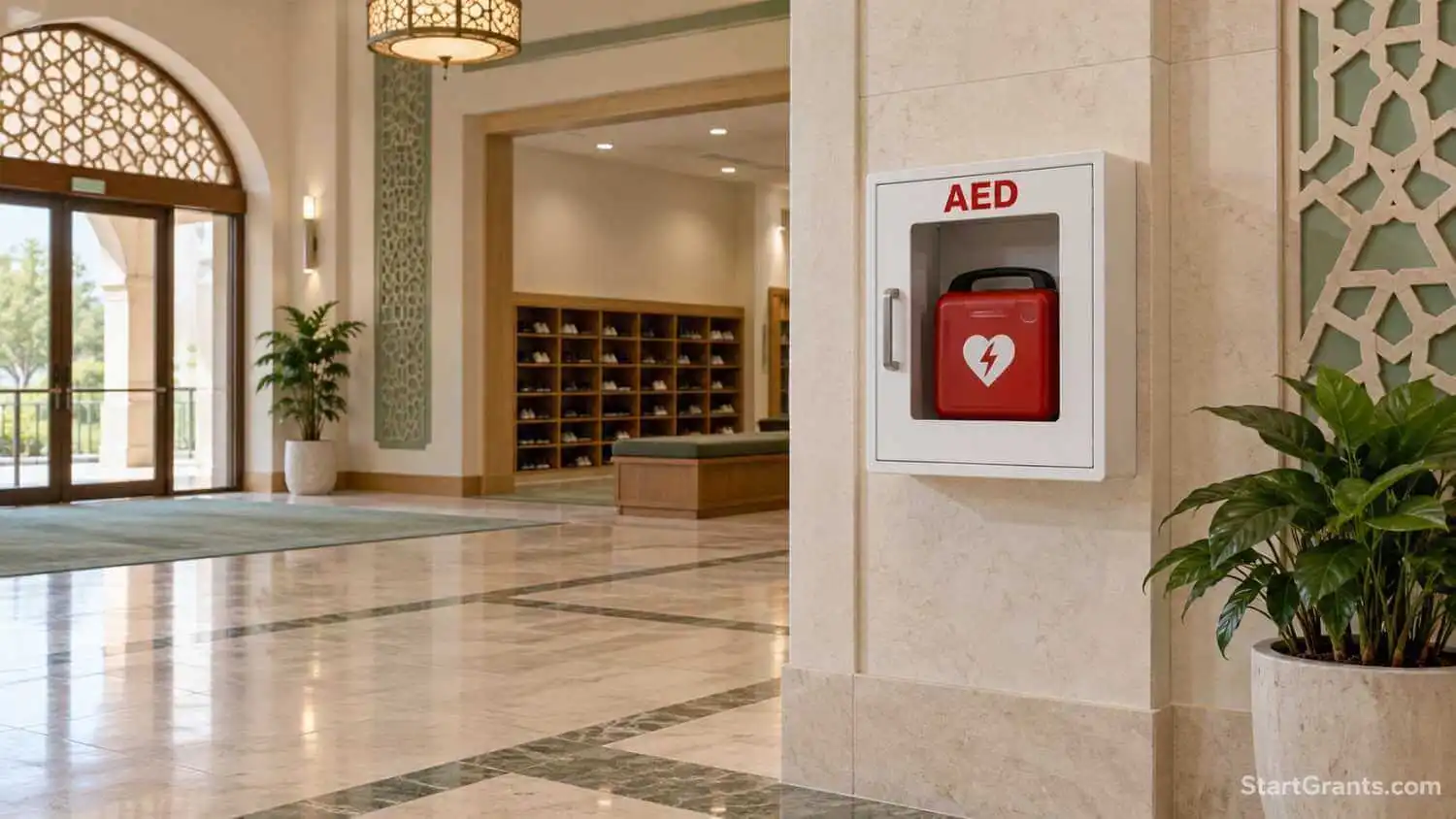
A mosque or Muslim-led nonprofit can plan AED access as part of responsible care for building users. Trustees should assess practical needs, use funds for their agreed purpose, and maintain equipment after the initial donation.
Grants and voluntary donations may reduce reliance on interest-bearing borrowing, but the funding label alone does not establish religious suitability. Review the actual terms. A documented qard hasan arrangement may be another option to discuss with qualified advisers, with repayment responsibilities made clear.
Do not assume restricted zakat funds may be used for a facility AED. Ask a qualified scholar about the proposed use and follow donor restrictions. Discuss insurance and financing questions using the actual contract rather than a blanket ruling. This guide does not promise spiritual rewards or classify every funding arrangement as halal or haram.
Frequently Asked Questions
Can a school or community center get a free AED?
Possibly, through an eligible equipment donation or funding program. Availability, location, and organizational requirements vary. Confirm whether training, accessories, and future maintenance are included.
Is Hopey's Heart Foundation accepting applications now?
As of October 23, 2026, its application page asks applicants to apply again in April 2027. Do not treat the older quarterly-review description as an open application window.
Does the American Red Cross offer free AED grants?
The national AED program reviewed here describes purchase, lease, training, and implementation options, not a nationwide free-AED grant. Ask about any specific local opportunity and its written terms.
How long does CPR and AED certification last?
The AHA Heartsaver CPR AED completion card is valid for two years. Confirm the course, practical skills requirements, and renewal rules accepted by your employer and funder.
Do all AED grants require a physician or liability insurance?
Requirements depend on the location, program, and agreement. Check applicable deployment rules and obtain appropriate legal or medical guidance rather than assuming a universal requirement.
Must we repay a grant if the AED is never used?
Lack of emergency use alone does not automatically require repayment. Your organization must still meet the award conditions, including maintenance and reporting. Misuse or noncompliance can lead to recovery of funds or equipment.
Disclaimer: StartGrants.com is an independent information portal, not a grantmaker, government agency, or medical provider. Confirm current funding terms with the official program. Consult qualified medical, EMS, or legal professionals about AED deployment requirements and a qualified Islamic scholar about religious questions. This article does not replace CPR/AED training or emergency care.