Last Updated: | Author: Munir Ardi
There is no single federal “green home grant” that pays every homeowner to build or remodel an eco-friendly house. What does exist is a patchwork of state-administered rebates, free weatherization services, utility incentives, targeted rural repair aid, and financing programs. Each uses its own rules, approved products, income limits, contractors, and application sequence.

If you are comparing several kinds of upgrades, begin with our broader guide to energy-efficiency grants and assistance for homeowners. Then use this page to separate genuine public assistance from tax credits that have expired, ordinary loans, and sales pitches dressed up as grants.
What “Green Home Assistance” Actually Means
Programs use different definitions of an eligible project. A state rebate may focus on modeled or measured energy savings. Weatherization providers select cost-effective measures after an audit. A rural repair grant focuses on health and safety hazards. A utility may reward a particular appliance or demand-response feature. A certification program evaluates the whole building.
| Type of help | How it works | Repayment? | Main caution |
|---|---|---|---|
| Grant | Funds are restricted to a defined purpose and population. | Usually no, if all terms are met | Some grants have occupancy, resale, or recapture rules. |
| Rebate | Reduces or reimburses an eligible project cost through a participating program. | No | Preapproval, approved equipment, and approved contractors may be required. |
| Direct service | A local agency arranges and pays for approved work. | No | The household normally does not receive unrestricted cash. |
| Tax credit | Reduces federal income tax under the law for the installation year. | No | Federal residential §25C and §25D credits ended after 2025. |
| Loan or assessment | Finances work that must be repaid, sometimes through a mortgage or property-tax assessment. | Yes | Compare total cost, interest or fees, lien priority, and sale/refinance consequences. |
A green label alone does not create eligibility. The safest question is not “Is my house green?” but “Which active program serves my address, household, housing type, and proposed upgrade?”
Federal Residential Energy Tax Credits Changed in 2026
Many older websites, contractor handouts, and even government pages still display the pre-2026 schedule. Current IRS guidance is controlling for federal tax purposes.
- Section 25C: The Energy Efficient Home Improvement Credit covered certain qualifying improvements placed in service through December 31, 2025. The current IRS page does not extend it to 2026 installations.
- Section 25D: The Residential Clean Energy Credit covered qualifying solar, battery, geothermal, wind, fuel-cell, and solar-water-heating property installed through 2025. The IRS Taxpayer Advocate’s current home-credits guidance limits qualifying installation dates to 2022 through 2025.
- Section 45L: This was a business credit for an eligible contractor, not a cash award to the buyer. The IRS says no credit is allowed for a home acquired after June 30, 2026. The current DOE Efficient New Homes program remains a voluntary certification program even though the credit deadline has passed.
If qualifying property was installed in 2025, ask a tax professional about the 2025 return and required documentation. Do not let a 2026 salesperson subtract an expired 30% federal solar credit from the price when presenting your “net cost.” A state tax credit or utility incentive may still exist, but that is a separate program.
Home Energy Rebates: Current, but Not Nationwide in the Same Form
The U.S. Department of Energy says Home Energy Rebates are available in select states. States, territories, and Tribes manage their own launches, eligible products, income verification, contractor networks, and reservation procedures. Check the DOE Home Energy Rebates status page and then follow the official link for your location. Do not rely on a contractor’s statement that “every household gets $14,000.”
Home Efficiency Rebates
This whole-home program ties the rebate to modeled or measured energy savings and household income. The federal framework allows larger maximum rebates for households below 80% of area median income (AMI), including a modeled-project maximum of up to $8,000 for a qualifying project expected to save at least 35%. That amount is not automatic: the local program can impose project-cost caps, approved modeling or measurement methods, income documentation, contractor rules, and funding limits.
A HERS Index rating may be useful, but it is not a universal federal prerequisite for every rebate. Your program may use its own approved audit, modeling software, measured-savings method, or contractor workflow. Start with the administering agency before paying for an assessment.
High-Efficiency Electric Home Rebates (HEEHR)
DOE renamed the state and territory program “High-Efficiency Electric Home Rebates” in 2026. Under the federal framework, households below 80% AMI may receive up to 100% of an eligible project cost, while households from 80% to 150% AMI may receive up to 50%, subject to per-item caps and a $14,000 household maximum. The eligible federal list includes qualifying heat pumps, heat-pump water heaters, heat-pump clothes dryers, electric cooking equipment, electrical panels, wiring, insulation, air sealing, and ventilation. The local program decides what it will offer.
A standard refrigerator is not on the federal HEEHR eligible-technology list. If that is the appliance you need, look instead for utility recycling/replacement programs and local nonprofit help in our guide to free refrigerator assistance for low-income families.
Weatherization Assistance: Free Work, Not a Cash Grant
The Department of Energy’s Weatherization Assistance Program (WAP) funds state, territorial, Tribal, and local providers to improve eligible homes. Under DOE guidelines, households at or below 200% of the federal poverty level or receiving Supplemental Security Income may be income-eligible; an administrator may instead use the LIHEAP standard of 60% of state median income. Local rules, priorities, waiting lists, and funding still apply. Homeowners and renters may apply, although rental work requires owner permission.
If selected, a provider assesses the home and chooses cost-effective measures. Work may include air sealing, insulation, duct work, heating-system safety or efficiency work, and other approved measures. The household does not receive a blank check or choose unlimited upgrades. Apply through the official DOE state weatherization map.
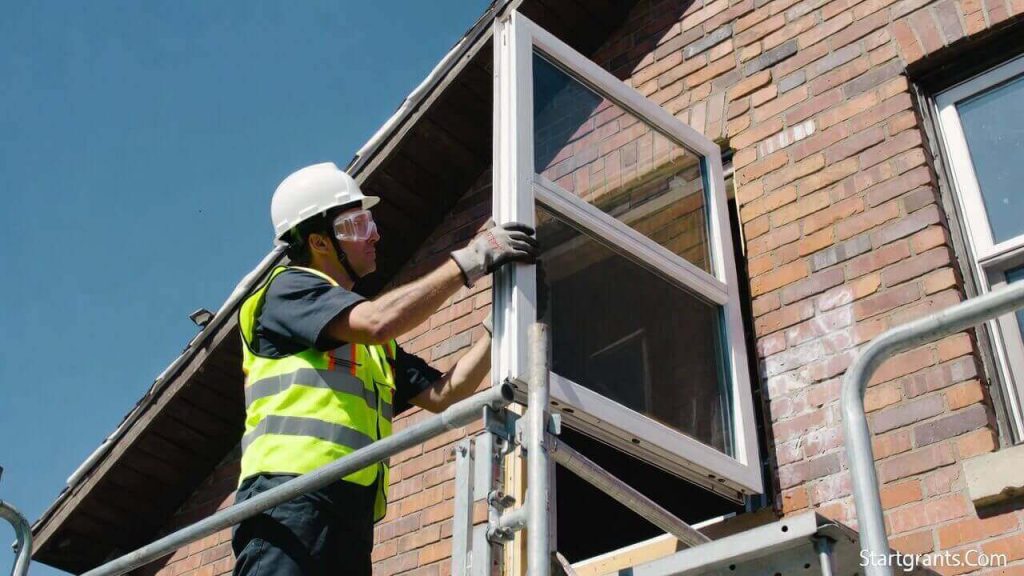
For a deeper look at specific envelope improvements, see our guides to home-insulation grants and weatherization help and assistance for energy-efficient windows. A program may repair or weatherize an existing window rather than replace it when that is the most cost-effective measure.
USDA Section 504 for Eligible Rural Homeowners
USDA’s Section 504 Home Repair program is often misrepresented as a general green-home grant. It is more targeted:
- Loans of up to $40,000 may help very-low-income rural owner-occupants repair, improve, or modernize a home or remove hazards. The current loan term is 20 years at a fixed 1% rate.
- Grants of up to $10,000 are limited to very-low-income homeowners age 62 or older who need to remove health and safety hazards. The maximum can be $15,000 for an eligible home damaged in a presidentially declared disaster area.
- Applicants must occupy the home, meet the local very-low-income limit, be in an eligible rural area, and be unable to obtain affordable credit elsewhere. Grant recipients generally must repay the grant if the property is sold within three years.
Those are national maximums, not guaranteed awards. Confirm the address and income rules on the official USDA Section 504 page. A failing heating system can sometimes qualify as a hazard, but approval of a particular system depends on USDA’s assessment and local processing. Our related pages explain potential central-heating assistance and furnace replacement help for low-income households.
Ratings and Certifications: Useful, but Not One Legal Definition

HERS Index
RESNET’s HERS Index is a relative energy rating. A home built to the 2006 reference standard scores 100; lower scores indicate lower modeled energy use relative to that reference. It can support certifications, code paths, appraisals, or some program applications. It is not a universal government definition of a green home, and an existing home does not need a HERS score merely to ask WAP or a utility about assistance.
ENERGY STAR certified homes
ENERGY STAR certification is a whole-building program for new homes and apartments, with independent inspection, testing, and program requirements. Buying one ENERGY STAR appliance does not certify the entire house. Verify the builder and certification through the official ENERGY STAR new-homes program.
DOE Efficient New Homes
DOE Efficient New Homes is the successor name for the Zero Energy Ready Home program. It is voluntary and uses third-party verification. Certification may still be valuable for comfort, efficiency, durability, and marketing, but it no longer creates a future §45L credit for a home acquired after June 30, 2026.

Match the Program to the Upgrade
Start with health and safety, then the building envelope, and finally equipment sized for the improved home. Replacing equipment before sealing major leaks can lead to oversizing and disappointing savings.
- Insulation and air sealing: Ask WAP, your utility, and the local Home Energy Rebate administrator about audits and approved contractors before beginning work.
- Windows: Full replacement is often expensive. Ask whether repair, weatherstripping, storm windows, or targeted replacement offers the best value and qualifies locally.
- Heating: Compare HEEHR heat-pump rules, WAP safety work, utility incentives, and rural repair aid. Do not assume “free furnace” means every applicant receives new equipment.
- Cooling: In hot climates, cooling can be a health need. Check LIHEAP crisis policies, WAP, health-plan benefits where applicable, utilities, and local programs described in our guide to air-conditioning financial assistance.
- Solar: The 30% federal household credit is not available for systems installed in 2026. State tax incentives, utility rebates, net-metering arrangements, and community solar vary. Review our current guide to government help and incentives for solar panels before signing.
Solar Loans, Leases, PPAs, and PACE Are Not Grants
A “zero-down” offer describes the upfront payment, not the total cost. Ownership and contract structure determine who receives incentives, who maintains the system, and what happens when the home is sold.
- Solar loan: Request both the cash price and financed price. Some loans add dealer or origination fees to the principal. Check the annual percentage rate, total payments, prepayment terms, and whether the payment changes after an expected tax-credit deadline. A 2026 installation should not be modeled with a federal §25D credit.
- Lease: The solar company owns the system and the homeowner typically pays a fixed contractual amount, which may include an annual increase.
- Power purchase agreement (PPA): The provider owns the system and sells the generated electricity at a contract rate. The rate may be fixed or may escalate. Ask about the term, annual escalator, minimum payments, production guarantee, roof work, insurance, transfer, buyout, removal, and ownership of renewable-energy certificates and incentives.
- Residential PACE: Financing is repaid through an assessment on the property. Review the full annual property-tax increase, fees, lien priority, ability-to-repay disclosure, and possible sale or refinance complications. CFPB research found that PACE can be substantially more expensive than other financing, but terms and state laws vary.
The DOE Homeowner’s Guide to Solar explains the ownership differences, while the CFPB solar-financing report describes common contract and loan risks. Obtain competing written proposals and never sign during a door-to-door visit.
A Practical Muslim Perspective on Green-Home Assistance

Many Muslim families understand conserving energy, avoiding waste (israf), and caring for shared resources as consistent with stewardship. That ethical motivation does not make every “green” contract permissible, and StartGrants cannot issue a religious ruling. The useful approach is to examine each layer separately.
1. Distinguish assistance from financing
A genuine rebate or direct weatherization service generally has no interest charge or repayment schedule, but it can still carry eligibility, installation, resale, or recapture conditions. Read those conditions and disclose other subsidies when asked. A tax credit is not a loan, although the underlying purchase may have been financed.
2. Review the actual contract, not the product label
A solar lease, PPA, PACE assessment, conventional loan, cost-plus arrangement, or co-ownership plan has a different legal and economic structure. A lease or PPA is not automatically an interest-bearing loan, and not every contract has the same escalator or transfer provision. Conversely, the words “Islamic,” “green,” “government approved,” or “zero down” do not by themselves establish Sharia compliance or consumer value.
Before signing, ask for the cash price, financed price, payment schedule, all fees, late-payment terms, ownership, lien or assessment, insurance obligations, buyout formula, transfer rules, and early-termination cost. A qualified scholar familiar with contemporary U.S. property and energy contracts can then evaluate the specific document, ideally alongside an attorney or housing counselor who can explain its legal consequences.
3. Put household safety first
Do not postpone a necessary furnace repair, carbon-monoxide hazard correction, cooling intervention, or electrical-safety repair while searching for a preferred financing structure. Ask WAP, LIHEAP, a utility hardship team, local government, and trusted community organizations about grants or direct services first. If a remaining cost requires financing, compare realistic, documented options and seek individual religious and financial advice.
4. Use community resources carefully
A mosque, zakat committee, Islamic social-service organization, or community development group may know local contractors or emergency funds, but availability is local and funds may have their own zakat or charitable eligibility rules. Do not state that a public rebate is “zakat,” or that receiving public assistance affects religious eligibility, without guidance from the fund administrator and a trusted scholar.
How to Apply Without Losing Eligibility
- Define the problem. Collect 12 months of utility bills if available, note comfort or safety problems, and list the age and condition of major equipment.
- Search by address. Check DOE’s rebate-status page, WAP provider map, USDA rural eligibility when relevant, your utility, state energy office, local housing department, and Tribal program.
- Ask about sequence. Confirm whether you need an application, income approval, reservation, audit, product authorization, or contractor selection before purchase.
- Verify the applicant. Owners, renters, landlords, and multifamily property owners may have different rules. A renter usually needs landlord participation for permanent improvements.
- Get written scopes and prices. Compare equipment model numbers, efficiency ratings, permits, labor, warranty, disposal, and any work that is excluded.
- Do not count unapproved money. Treat a rebate as $0 until the administering agency confirms eligibility and reservation in writing. Never let a contractor promise an expired federal tax credit.
- Keep records. Save approval letters, income verification, contracts, invoices, model numbers, photos, inspection reports, rebate statements, and proof of payment.
Save This Green-Home Funding Checklist
- [ ] Identify the exact upgrade, property address, ownership or rental status, and immediate health or safety concern.
- [ ] Verify whether the opportunity is a grant, rebate, direct service, tax benefit, loan, lease, PPA, or PACE assessment.
- [ ] Check the official WAP, Home Energy Rebate, utility, state, Tribal, local, or USDA page serving the property.
- [ ] Confirm income rules, preapproval, reservation, audit, equipment, and approved-contractor requirements before spending.
- [ ] Compare the cash price, uncovered cost, financing charges, ownership, lien, transfer, and recapture terms.
- [ ] Keep written approvals, bids, model numbers, contracts, invoices, inspections, warranties, and proof of payment.
Frequently Asked Questions
Are there government grants for green homes in 2026?
There is no universal federal green-home grant for every homeowner. Current help can include state- or Tribe-administered Home Energy Rebates, WAP direct services, utility incentives, local housing programs, and USDA Section 504 aid for qualifying rural homeowners.
Can I claim a federal tax credit for solar panels installed in 2026?
No. The federal Residential Clean Energy Credit under §25D ended for qualifying residential property installed after December 31, 2025. State or utility solar incentives may still exist and must be checked separately.
Can I claim the federal heat-pump or window credit in 2026?
No. The federal Energy Efficient Home Improvement Credit under §25C applies to qualifying property placed in service through December 31, 2025, not to new 2026 installations. An active state rebate, utility incentive, or weatherization program may still help.
Does every household qualify for $14,000 in Home Energy Rebates?
No. The $14,000 figure is a federal household maximum for the HEEHR program, not an automatic award. Eligibility depends on income, the active local program, eligible technologies, project cost, approved procedures, and available funds.
Do I need a HERS rating to get a green-home rebate?
Not always. HERS is a respected home-energy rating, but it is not a universal requirement. The administering program may require its own audit, approved model, contractor assessment, or measured-savings process.
Will a Home Energy Rebate pay for a refrigerator?
A standard refrigerator is not on the federal HEEHR eligible-technology list. Check utility appliance programs, local nonprofits, and other assistance instead. A local whole-home program may have different measures, so verify before purchasing.
Is USDA Section 504 a free green-home grant?
Not generally. Section 504 offers loans to eligible very-low-income rural homeowners for repairs and grants only to qualifying homeowners age 62 or older to remove health and safety hazards. A proposed energy upgrade must fit the program’s authorized purpose.
Are solar leases and PPAs halal?
There is no responsible universal answer because contracts differ. A lease or PPA is not automatically an interest-bearing loan, but it may include escalators, fees, uncertain obligations, or transfer terms. Muslim homeowners should have the specific contract reviewed by a qualified scholar familiar with U.S. transactions and by an appropriate legal or housing professional.
Should I start work before rebate approval?
Usually not unless the official program expressly permits it. Many programs require preapproval, a reservation, an approved contractor, or an assessment before purchase or installation. Confirm the sequence in writing with the administering agency.
Bottom Line
The strongest 2026 strategy is to ignore generic promises and build a funding plan around your address, income, housing type, and actual project. Federal household energy tax credits are no longer available for new 2026 installations, but Home Energy Rebates continue in select jurisdictions, WAP still provides direct weatherization services, utilities and local agencies may offer incentives, and USDA may help a narrow group of rural homeowners.
Verify the program first, complete any required assessment or reservation, use approved products and contractors, and read every financing document as carefully as the construction scope. That protects both the expected savings and the home itself.
Important disclaimer: StartGrants.com is an independent information portal. It is not a government agency, grantmaker, rebate administrator, certification body, utility, contractor, lender, law firm, tax adviser, financial adviser, insurance adviser, or religious authority. StartGrants.com does not issue grants, rebates, certifications, loans, legal advice, tax advice, financial advice, insurance advice, or fatwas. Program availability, eligibility, award amounts, deadlines, covered improvements, contractor rules, recapture provisions, and financing terms can change. Verify every opportunity with the responsible agency or sponsor before applying, purchasing equipment, or signing a contract, and seek qualified professional guidance for your circumstances.