Last Updated: | Author: Munir Ardi
Financial assistance for K-12 students and parents can include school meals, donated supplies, clothing, device loans, internet discounts, and help accessing learning support. Start with your child’s school counselor, social worker, or family liaison, then apply through the organization responsible for each need. There is no single application that guarantees every family all of these services. For a broader overview of education funding options, explore our guide to K-12 education grants and financial assistance.
Public K-12 schools generally do not charge tuition, but families can still face costs for supplies, clothing, activities, and home technology. This guide helps you identify the right contact and distinguish free assistance from discounts, loans, and paid services. It focuses on everyday school needs, with detailed guides linked below for supplies and tutoring questions.
Choose the Right Starting Point for Each School Expense
| Need | Contact first | Type of help to ask about |
|---|---|---|
| Breakfast and lunch | School nutrition office | Free or reduced-price meals and application requirements |
| Enrollment or transportation during homelessness | District McKinney-Vento liaison | Eligibility review, enrollment support, and applicable transportation rights |
| Backpacks and supplies | School family-resource staff or local 211 | Donated items, supply closets, or community referrals |
| Computer and internet | School technology office and verified providers | Device loans, low-cost computers, limited giveaways, or service discounts |
| Uniforms and shoes | School social worker or local clothing program | Clothing, a referral, or a locally available voucher |
| Tutoring and learning support | Classroom teacher or school support team | School-based help, library resources, and verified outside options |
Programs, inventory, eligibility, prices, and application dates vary. These are routes to investigate, not a list of guaranteed awards or currently open local events.
Start With a Short, Specific Request to the School
List the items or services your child needs, when they are needed, and what you can already provide. Ask the front office who coordinates family assistance. You can say:
“We need help with a uniform, school supplies, and internet access for homework. Which school resources are available, and who should I contact for anything the school cannot provide?”
Request a private conversation. Ask which items on a supply list are essential immediately, whether shared classroom donations are optional, and whether equipment can be borrowed. For a fee, ask for the written policy and any hardship waiver or alternative. Fee rules differ by state, district, and activity; do not assume every charge is automatically waived.
School Meals: Apply Through the School Nutrition Office
The National School Lunch Program and School Breakfast Program help participating schools provide meals to eligible students. According to USAGov’s school-meal guidance, families should request an application from their child’s school and can apply during the year when circumstances change.
Ask whether your child has already been approved through a benefits match or whether the school provides meals at no charge to all students. Otherwise, request the current household application and income rules. Confirm breakfast and lunch separately, and ask which purchases are outside the meal benefit, such as optional extras.
A household that loses income after the school year starts should contact the nutrition office again. Keep the eligibility notice and ask how to correct missing information or request a review of a denial.
McKinney-Vento: Help When Housing Is Unstable
McKinney-Vento eligibility concerns children and youths who lack a fixed, regular, and adequate nighttime residence. The federal definition includes certain shelter, motel, and shared-housing situations. Living with relatives does not automatically qualify a child; the circumstances, including housing loss or economic hardship, matter.
Explain your current living arrangement to the district liaison. Under the Department of Education’s guidance updated August 4, 2026, key protections include:
- Immediate enrollment: eligible students must be enrolled even when normally required records are unavailable.
- School stability: school selection involves a best-interest determination, with a presumption favoring the school of origin unless contrary to the parent’s or unaccompanied youth’s request.
- Transportation: districts must provide or arrange school-of-origin transportation when applicable and requested by the parent, guardian, or liaison for an unaccompanied youth.
- Removing barriers: ask about supplies, necessary fees, and other obstacles to attendance. This is not a blanket promise to cancel every charge.
If eligibility, placement, or enrollment is disputed, request a written explanation and appeal instructions. Eligible disputes carry immediate-enrollment protections while they are resolved. Ask the liaison to explain the process and available supports.
Backpacks, Classroom Supplies, and Delivery Options
Ask about school supply closets, PTA-supported assistance, and local donation drives. 211 can help identify community services. Confirm inventory, registration, and pickup details with the provider before traveling.
For local programs and the questions to ask before registering, read our guide to free school supplies for low-income families. It covers school contacts, community distributions, and options after seasonal events end.
For transportation or scheduling barriers, ask about alternate pickup or school delivery. Our separate guide to free school supplies by mail and shipping limitations distinguishes family delivery possibilities from programs that serve teachers or schools. Home delivery is not guaranteed.
Because this article was updated in October, verify the year and date on any back-to-school announcement. A July or August flyer is not evidence that registration remains open.
Computers and Internet: Separate Free Devices From Discounts
Check school equipment before buying
Ask the technology office whether your child can borrow a laptop, tablet, calculator, or hotspot. Confirm required software, internet needs, return dates, and damage or replacement policies. School-issued equipment may remain school property. Meal eligibility alone does not guarantee a free personal computer.
Lifeline is a service discount
The Affordable Connectivity Program ended June 1, 2024. Do not submit information to an offer claiming new ACP enrollment is available.
Lifeline provides a discount of up to $9.25 per month toward qualifying internet or bundled service; enhanced support may apply on qualifying Tribal lands. Generally, only one benefit is allowed per household. Check the participating provider’s final price, equipment charges, and service coverage.
Standard Lifeline eligibility includes qualifying programs such as SNAP or Medicaid, or income at or below 135% of federal poverty guidelines. Free or reduced-price school meals alone are not a standard eligibility category. Separate emergency rules for certain survivors have expanded criteria, including school meals; those rules should not be applied to every household.
Follow the official application route, then select a participating company. A discount may leave a balance to pay; it is not a universal promise of free home internet.
PCs for People and Compudopt work differently
PCs for People offers low-cost technology to qualifying customers. Eligibility can be based on an approved assistance program or household income under its published rules, including thresholds tied to federal poverty guidelines or area median income. Photo identification and eligibility documentation are required. Check the actual device price, shipping, warranty, and internet charges; qualifying does not make every product free.
Compudopt’s computer giveaway registration joins an interest list, not a guaranteed award. Its page requires no access to a working home computer, excluding devices provided by school or work. Recipients are selected randomly for distributions, and availability depends on location and funding. Follow your city’s instructions and wait for selection and pickup details.
School Clothing, Uniforms, and Shoes
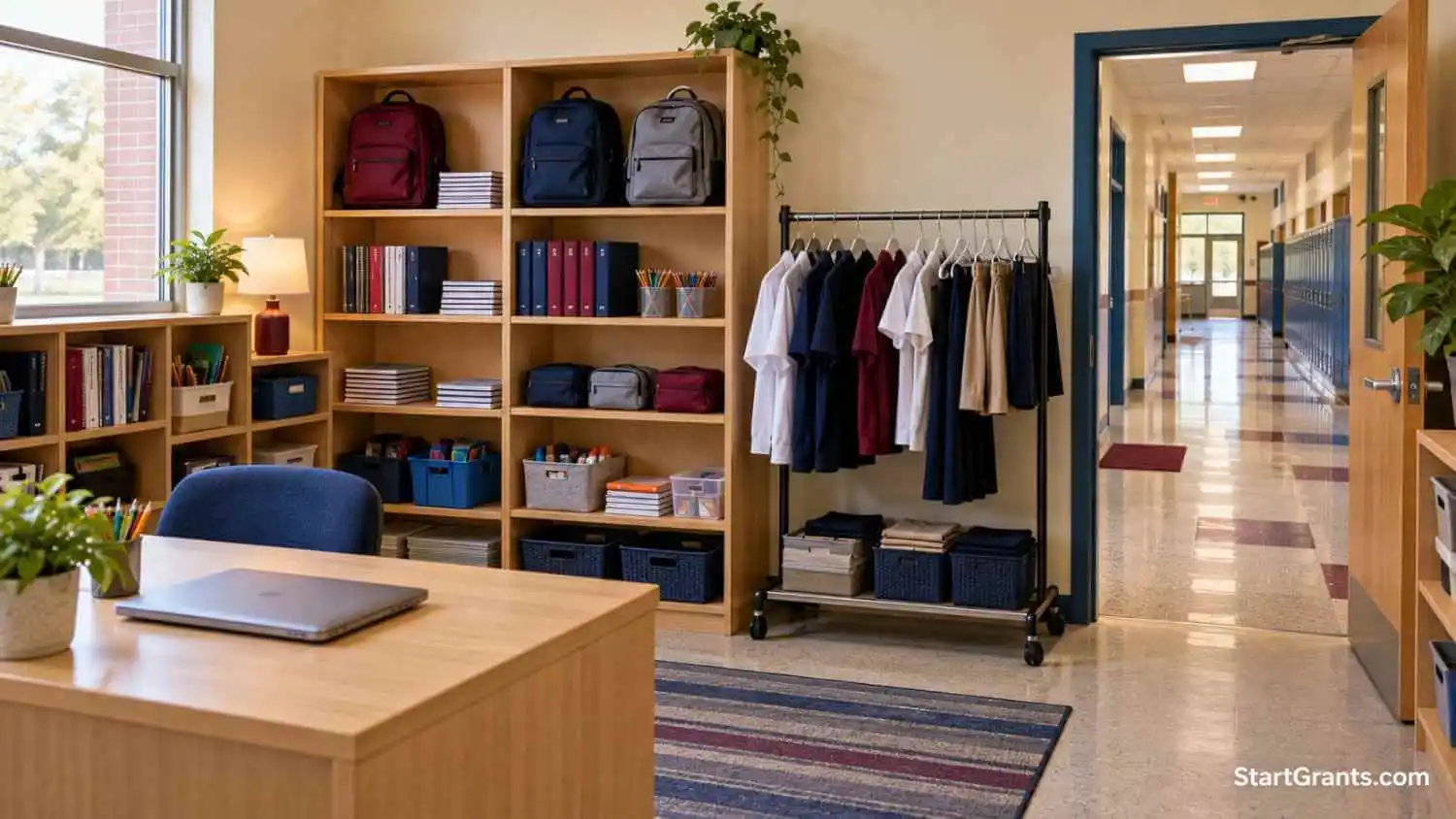
Ask the school social worker about a clothing closet, uniform exchange, emergency clothing, or referrals. These resources are not available at every school. Give the correct sizes and uniform specifications so an organization can assess whether it has suitable items.
Assistance League’s Operation School Bell works through local chapters and school partnerships to address children’s clothing and other needs. The local chapter determines how help is delivered. Ask whether a school referral is required and whether assistance involves clothing, an organized shopping visit, or another arrangement.
Do not assume a nationwide voucher amount, a particular retailer, or reimbursement for purchases made before approval. If a uniform requirement creates an attendance problem, promptly request help from the principal and ask for the district’s hardship procedure.
Tutoring: Start With School Support and Verify Private Offers
Ask the teacher which skills need attention and whether school-based tutoring, intervention groups, homework support, or after-school help is available. Check the public library for learning resources and any tutoring access included with a library card. Availability and eligibility vary.
For paid tutoring, request a written estimate covering assessment fees, session length, frequency, materials, cancellation terms, and the total commitment. A monthly payment plan spreads charges over time; it is not financial aid.
Sylvan’s official position matters: its current FAQ states that Sylvan does not offer scholarships or financial aid. Ask the local center about current pricing and any independently funded arrangement, and verify the sponsor’s terms directly.
For a closer look at this specific tutoring option, see our guide to Sylvan tutoring scholarships and assistance questions. Confirm who would pay for tutoring, whether your chosen center participates, and which costs remain your responsibility before enrolling.
A Muslim Perspective
Ask about suitable school meals
Discuss halal needs with the school nutrition director and ask about ingredients, certification, preparation, and available alternatives. A vegetarian item is not automatically halal-certified. Availability depends on the district; participation in a federal meal program does not itself promise a halal menu.
For a concrete example, New York City Public Schools describes a process for requesting expanded certified halal meal service through school administration, the parent association, and its food-service office. Families elsewhere can ask their district what process it uses. Organizing a request does not guarantee approval or a particular timetable.
Community assistance, zakat, and borrowing
ICNA Relief’s Back2School initiative includes school-supply support. Check local event information and recipient requirements rather than assuming every office has backpacks available. A donation or sponsorship page is not necessarily a family application.
Local mosques and Muslim charities may also offer sadaqah-funded assistance. Zakat eligibility and permitted spending depend on the recipient’s circumstances and the fund’s religious guidance; school expenses alone do not establish eligibility. Consult the administrator and a qualified scholar when needed.
If considering tutoring financing or another payment plan, review interest, fees, late-payment terms, and the total cost. Ask a qualified scholar about riba concerns in the actual contract. A qard hasan is an interest-free loan that still requires repayment. Organizers should honor donation restrictions and protect children’s privacy without requiring public accounts of family hardship.
Documents and Follow-Up: Keep Each Application Separate
Request the exact document list before uploading anything. Depending on the program, you may need enrollment information, household income records, a benefits letter, identification, or clothing sizes. Requirements differ: a school-supply drive, a computer vendor, and a federal service-discount application do not need identical information.
Use official websites and approved submission methods. Ask why sensitive information is needed and how it will be protected. Do not post identification or children’s records in public comments. If something is missing, request acceptable alternatives. For eligible students experiencing homelessness, missing routine records must not delay immediate enrollment.
Keep a short log of the contact person, request date, documents submitted, decision, and next step. If a charitable program has no funds, ask about another provider. If a school decision affects access or legal protections, request the applicable review or appeal process instead of treating it only as a charity waitlist.
Save This K-12 Assistance Checklist
- [ ] List urgent needs, deadlines, and the items already available at home.
- [ ] Contact the school counselor, social worker, or family liaison.
- [ ] Check meal approval or request the current application.
- [ ] Discuss unstable housing with the McKinney-Vento liaison when relevant.
- [ ] Confirm supply and clothing inventory, eligibility, and pickup rules.
- [ ] Ask about school device loans before purchasing equipment.
- [ ] Verify internet discounts and the remaining monthly cost.
- [ ] Check school-based tutoring before committing to a private contract.
- [ ] Submit only required documents through verified channels.
- [ ] Record follow-up dates and ask about alternatives or review procedures.
Frequently Asked Questions
Is there one government grant for all K-12 school expenses?
There is no single nationwide application that guarantees payment for every school expense. Meals, school supports, community donations, service discounts, and private services have separate rules and application routes.
Can I apply for school meal assistance after the year starts?
Yes. Ask the school nutrition office for the current application when your circumstances change. Also check whether your child is already approved or the school provides meals at no charge to all students.
Does staying with relatives automatically qualify a child for McKinney-Vento?
No. Eligibility depends on whether the child lacks a fixed, regular, and adequate nighttime residence. Tell the district liaison why the family is sharing housing and describe the current arrangement.
Where should I ask for school supplies and uniform help?
Start with the school counselor or social worker. Ask about available stock, local referrals, and any registration requirements. Community programs may have limited inventory or serve only certain schools or ZIP codes.
Does free school lunch qualify my household for standard Lifeline?
Not by itself. Standard Lifeline eligibility uses qualifying benefits or income rules. Separate emergency eligibility rules apply to certain survivors; check the official requirements before applying.
Are PCs for People and Compudopt guaranteed free laptop programs?
No. PCs for People offers low-cost technology to qualifying customers, while Compudopt uses interest lists and selection for available giveaways. Neither should be treated as a guaranteed free laptop for every student.
Does Sylvan offer scholarships or financial aid?
Sylvan's current official FAQ says it does not offer scholarships or financial aid. Verify any separately sponsored offer with the sponsor and local center. Payment plans are not scholarships.
Can zakat pay for school supplies or tutoring?
Possibly, depending on the recipient's eligibility and the rules followed by the zakat administrator. School costs alone do not establish eligibility. Ask the fund administrator and a qualified scholar about the proposed assistance.
Disclaimer: StartGrants.com is an independent information portal, not a government agency, school district, assistance provider, tutoring company, or religious authority. We do not award benefits or process applications. Confirm current requirements with the responsible school or organization. This article provides general information, not legal advice or a religious ruling; seek qualified advice for an individual dispute or religious question.