

Before you can claim government funding, your home’s energy efficiency must be mathematically verified by an independent auditor.
Last Updated: May 2026 | Author: Robert
The concept of a “green home” has been heavily romanticized by architectural magazines and social media influencers. When most homeowners think of sustainable living, they picture bamboo flooring, reclaimed wood accents, smart thermostats, and perhaps a few expensive solar panels glistening on the roof.
Unfortunately, the home improvement industry knows exactly how much you want to reduce your carbon footprint, and they have monetized your good intentions.
Contractors and developers routinely charge a massive “Green Premium” for cosmetic eco-friendly upgrades that look beautiful but fail to significantly reduce your home’s actual energy consumption. This practice, known as greenwashing, drains your bank account while providing almost zero financial return on investment.
If you want the federal government to help pay for your green home, you must abandon the cosmetic definition of sustainability. The Department of Energy (DOE) and the Internal Revenue Service (IRS) do not care about the aesthetic of your living room. They care exclusively about one thing: quantifiable, mathematical energy reduction.
To access the billions of dollars in federal grants, rebates, and tax credits available in 2026, you must learn to speak the government’s language of physics and home performance metrics.
The “Greenwashing” Trap & The Government’s Definition

The federal government does not fund cosmetic sustainability. Rebates and tax credits are based strictly on verifiable energy reduction.
Before you apply for any federal funding, you must prove that your home meets strict, mathematically verifiable energy standards. The government relies on three primary benchmarks to determine if a house is legally considered a “Green Home” worthy of financial subsidization.
1. The HERS Index Score
The Home Energy Rating System (HERS) Index is the gold standard of energy efficiency. It is essentially a miles-per-gallon (MPG) sticker for your house. A standard, newly built home that perfectly meets current building codes is assigned a HERS score of 100. A legally defined “Green Home” must score significantly lower. To get government money, you must hire a certified, independent professional registered with the Residential Energy Services Network (RESNET) to test your home and generate this official score.
Seeing the HERS Test in Action: You cannot secure deep energy retrofit rebates without an official HERS Index score. Watch this modern, on-site breakdown from a certified RESNET rater to see exactly how professionals use blower doors to calculate this crucial metric today.
2. ENERGY STAR® Certification
An ENERGY STAR certified home is independently verified by the EPA’s official ENERGY STAR program to be at least 10% more energy-efficient than homes built to standard codes, though most achieve a 20% improvement. This is not just about buying an ENERGY STAR refrigerator; it requires a comprehensive package including complete thermal enclosure systems, high-efficiency HVAC equipment, and rigorous water management systems.
3. DOE Zero Energy Ready Home (ZERH)
This is the ultimate tier of government certification. A DOE Zero Energy Ready Home (ZERH) is built to such a high level of rigorous energy efficiency that a relatively small solar panel system could offset all or most of the home’s annual energy consumption. If your home achieves ZERH status, you unlock the absolute maximum tier of federal tax credits and builder incentives available.
Retrofitting: Turning an Aging House into a Green Home
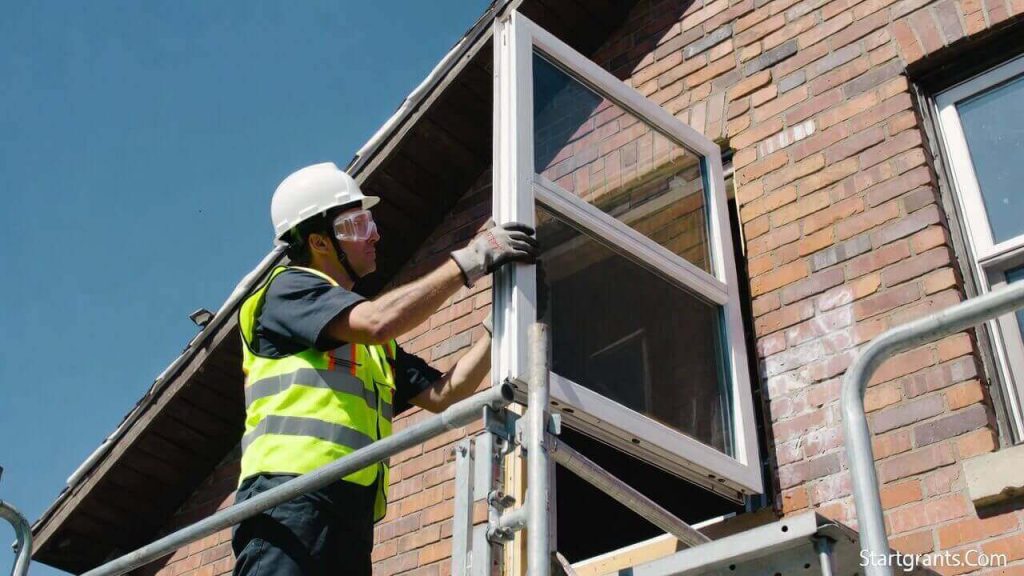
Under the IRA HOMES rebate program, deep energy retrofits that cut a home’s total energy use by 35% can trigger an $8,000 government rebate.
Most Americans are not building custom eco-mansions from scratch; they are living in aging, drafty houses built decades ago. Transforming an old, energy-hemorrhaging house into a certified green home is called “deep energy retrofitting.”
Because retrofitting an old house is incredibly expensive, the federal government stepped in with the most aggressive funding mechanism in modern history: The Inflation Reduction Act (IRA).
The HOMES Rebate Strategy (Whole-Home Approach)
As we detailed extensively in our master guide to energy efficiency grants for homeowners, the IRA introduced two distinct rebate paths. While the HEEHRA program gives you point-of-sale discounts for single appliances (like swapping out a stove), the Home Owner Managing Energy Savings (HOMES) Rebate is specifically designed for deep green retrofits.
The HOMES program does not care how you save the energy—whether through massive attic insulation, upgrading your property by securing grants for energy efficient windows, or comprehensively sealing your ductwork. It only cares about the total percentage of energy saved across the entire house.
To secure this massive cash rebate, your contractor must use DOE-approved energy modeling software to calculate your home’s pre-retrofit energy use, and then model the projected savings of the upgrades:
- The 20% Threshold: If your modeled green retrofit cuts your home’s total energy usage by 20% to 34%, the government will rebate you up to $2,000 (or up to $4,000 if you are a low-income household).
- The 35% Threshold: If you execute a deep green retrofit that cuts your home’s total energy usage by 35% or more, the federal government will rebate you up to $4,000 (or a massive $8,000 if you are a low-income household).
The Bureaucratic Rule: You cannot guess these numbers. You cannot simply install new windows, look at your electric bill a month later, and ask the government for $4,000. You must hire a state-approved contractor who is certified to run the specific energy modeling software required by your State Energy Office before any demolition begins.
Building New: The Hidden Builder Incentives & Green Mortgages

Smart homebuyers use the builder’s $5,000 Section 45L federal tax credit as leverage to negotiate a lower purchase price.
If you are purchasing a newly constructed green home or building one from scratch, the financial mechanics change entirely. The government does not typically hand a homebuyer a direct cash rebate for buying a new eco-friendly house. Instead, the government incentivizes the developer.
As a savvy homebuyer, you must understand these hidden builder incentives so you can leverage them during your price negotiations.
The Section 45L Tax Credit (Builder Leverage)
Under the updated Inflation Reduction Act, the federal government offers the Section 45L New Energy Efficient Home Credit directly to eligible contractors and developers.
If a builder constructs a home that meets the stringent ENERGY STAR® single-family new homes program requirements, the federal government gives that builder a $2,500 tax credit. If the builder goes further and constructs a home certified as a DOE Zero Energy Ready Home (ZERH), the government hands them a massive $5,000 tax credit per home.
The Negotiation Strategy: When you are negotiating the purchase price of a newly built, highly efficient home, the builder will almost certainly try to charge you a “Green Premium” for the advanced insulation and HVAC systems. As an educated buyer, you must remind the builder that they are already receiving a $5,000 federal tax credit for those exact upgrades. You can use this bureaucratic leverage to negotiate a lower purchase price or demand free aesthetic upgrades (like premium countertops or flooring) to offset their federal windfall.
The Builder’s $5,000 Tax Secret: The Inflation Reduction Act completely upgraded the Section 45L tax credit for developers constructing DOE Zero Energy Ready Homes. Watch this recent analysis from professional tax engineers to understand the exact financial leverage you hold when negotiating for a new green home.
Energy Efficient Mortgages (EEMs)
If you are buying an older home that needs a massive green retrofit, but you do not qualify for low-income grants, you might think you have to take out a dangerous, high-interest personal loan. You do not. The federal government, through the Federal Housing Administration (FHA) and the Department of Veterans Affairs (VA), backs Energy Efficient Mortgages (EEMs). As detailed on the official government ENERGY STAR portal, an EEM allows a homebuyer to borrow extra money to pay for green upgrades (like solar panels, geothermal heat pumps, or extreme insulation) and roll that cost directly into their primary 30-year mortgage without requiring a massive out-of-pocket down payment.
- The Bureaucratic Magic: Normally, borrowing more money would push your debt-to-income (DTI) ratio too high, causing the bank to deny your loan. However, with an EEM, the bank uses a certified HERS report to calculate exactly how much money the green upgrades will save you on your monthly electric bill. The bank then legally adds those projected energy savings to your qualifying income.
- This allows you to finance a massive green energy overhaul at standard, historically low mortgage interest rates without needing a larger down payment.
The Solar Reality & Rural Off-Grid Funding
When discussing green homes, the conversation inevitably turns to solar panels. As we warned in our foundational guide, there is no federal program handing out free solar panels. However, there are massive financial mechanisms to help you transition off the traditional power grid.
The 30% Solar Tax Credit (Section 25D)
The primary federal funding mechanism for residential solar power is the Residential Clean Energy Credit (Section 25D). This law allows homeowners to claim a massive 30% non-refundable tax credit on the total cost of installing solar panels, solar water heaters, and residential battery storage systems (like the Tesla Powerwall).
If you spend $20,000 to install a solar array on your green home, the IRS will reduce your federal tax liability by $6,000. It is crucial to remember that this is a tax credit, not a point-of-sale rebate. You must finance the $20,000 upfront and wait until tax season to claim the credit.
USDA Section 504 for Rural Off-Grid Survival
If you live in a deeply rural area where the electrical grid is unreliable, transitioning to off-grid green technology is not a luxury; it is a matter of survival.
While the USDA does not classify this as a “green home grant,” an aging, failing fossil-fuel furnace in the middle of a brutal winter is legally classified as a severe health hazard. A senior citizen can use this $10,000 grant to completely replace a failing heating system—a survival tactic we cover extensively in our specific guide on how to get a government grant to install central heating—or install massive thermal barriers to survive extreme weather. To understand the exact specifications of thermal boundary upgrades, review our tactical guide on securing a government grant for home insulation.
By leveraging the USDA grant to upgrade the home’s thermal envelope and install modern, highly efficient equipment, rural seniors can effectively achieve green home status and drastically lower their living expenses without taking on a dime of debt.
The Halal Blueprint for Green Homes (Stewardship without Riba)

Protect your faith and generational wealth by utilizing 100% Halal federal grants and avoiding predatory PACE loans or solar leases.
When discussing the transition to a sustainable, green home, the conversation in the United States is almost entirely focused on tax credits, return on investment (ROI), and lowering utility bills. However, for Muslim American homeowners, the motivation to build or retrofit a green home carries a profound, overarching spiritual weight.
The Theological Mandate: Khilafah and Israf
In Islamic theology, humanity is appointed as Khalifah (stewards or guardians) of the Earth. Protecting the environment, preserving natural resources, and minimizing pollution are not modern political talking points; they are ancient religious obligations. Furthermore, Islam strictly prohibits Israf (wastefulness or extravagance). Living in a poorly insulated home that constantly bleeds expensive, fossil-fuel-generated heat into the atmosphere is a direct manifestation of Israf.
Therefore, upgrading your home to consume radically less energy—whether through high-density insulation, double-pane argon-filled windows, or solar energy—is deeply aligned with the ethical mandates of Sharia.
The Financial Trap: When “Green” Becomes Haram
The critical danger arises not from the technology itself, but from the predatory financial mechanisms used to pay for it. The American renewable energy sector is deeply entangled with aggressive, high-interest financing models that directly violate Islamic finance laws prohibiting Riba (usury or compound interest).
If you are a Muslim homeowner seeking a green home, you must navigate these three massive financial traps:
1. The Solar Lease and PPA Trap: As previously warned, many companies offer to install solar panels for “zero dollars down.” In a Solar Lease or a Power Purchase Agreement (PPA), you do not own the panels. The company owns them, and you sign a 20-to-25-year contract to buy the electricity they generate. These contracts frequently include annual “escalator clauses” where the price you pay automatically increases by 2.9% to 4% every single year, regardless of market conditions. This is an exploitative, compounding financial burden that traps homeowners and severely complicates the sale of the property.
2. The PACE Loan Nightmare: Property Assessed Clean Energy (PACE) loans are heavily marketed as a government-backed way to finance green upgrades like HVAC systems and hurricane-impact windows. This is the most dangerous financial product in the home improvement industry. A PACE loan is not a traditional personal loan; it places a super-priority tax lien directly onto your property taxes. Because PACE loans carry exorbitant interest rates and predatory fee structures, they are fundamentally built on Riba. If you fall behind on your newly inflated property tax bill, the local government will foreclose on your home. You must reject PACE financing entirely to protect both your faith and your generational wealth.
3. The Halal Execution Strategy: To achieve a green home while remaining 100% Sharia-compliant, you must strictly utilize debt-free government grants or permissible financing structures:
- Exhaust the Grants: Focus aggressively on the IRA’s HOMES rebate program and the HEEHRA point-of-sale discounts. Because these are true federal rebates that require zero repayment and charge zero interest, they are completely Halal.
- Cash or Murabaha: If you are building a new ZERH (Zero Energy Ready Home) and the federal rebates do not cover the full cost, do not take out a standard interest-bearing loan. Work with a certified Islamic finance institution to utilize a Murabaha (cost-plus financing) or Musharakah (co-ownership) model to fund the remaining construction costs without compromising your religious principles.
The Actionable Execution Plan: Building Your Green Home
The bureaucracy surrounding government grants is intentionally complex to prevent fraud. If you want to secure funding for a deep energy retrofit in 2026, you cannot simply hire a contractor and ask for reimbursement later. You must follow this exact, chronological five-step execution plan.
Step 1: Secure an Independent HERS Rater
Do not call a solar salesperson or a window replacement company first. Your very first step must be hiring an independent, RESNET-certified Home Energy Rating System (HERS) Rater. This professional does not sell equipment; they only sell data. They will perform a comprehensive diagnostic audit (including a blower door test and duct leakage testing) to establish your home’s baseline energy consumption. This baseline document is the legal foundation of your entire rebate application.
Step 2: Define the Scope of Work
Review the HERS report to identify your home’s most severe energy liabilities. Is your attic uninsulated? Is your 25-year-old furnace operating at 60% efficiency? Work with your auditor to determine which upgrades will yield the required 20% or 35% total energy reduction needed to trigger the massive IRA HOMES rebate tiers.
Step 3: Vet State-Approved Contractors
The federal government does not write checks directly to homeowners for the IRA rebates. The funds are managed by your individual State Energy Office. You must hire a contractor who is officially registered and vetted by your state’s specific rebate program. If you hire an unapproved contractor, your rebate application will be instantly denied, and you will be responsible for the entire bill.
Step 4: Execute the Pre-Approval Bureaucracy
Before a single wall is torn down or a single solar panel is mounted, your state-approved contractor must submit the proposed scope of work and the pre-retrofit energy model to the State Energy Office for formal pre-approval. Do not sign a final construction contract until the state has officially allocated your rebate funds.
Step 5: Final Verification and Rebate Deduction
Once the retrofitting is complete, the independent HERS Rater must return to your home to perform a “test-out” audit. This final test verifies that the contractor actually achieved the 20% or 35% energy reduction they promised. Once verified, the state will release the funds, and the approved contractor will deduct the rebate amount directly from your final invoice.
Frequently Asked Questions (FAQ)
Q1: Can I get a government grant to build a new eco-friendly house?
A: The government rarely gives direct cash grants to consumers to build a new home. Instead, under Section 45L of the tax code, developers can receive up to a $5,000 federal tax credit for building a DOE Zero Energy Ready Home (ZERH). Homebuyers should use this fact to negotiate a lower purchase price.
Q2: Are PACE loans a good way to finance a green home?
A: No. The Consumer Financial Protection Bureau (CFPB) has issued severe warnings regarding Property Assessed Clean Energy (PACE) loans. They are high-interest loans attached directly to your property taxes as a super-priority lien, which makes it extremely difficult to sell or refinance your home and can lead to foreclosure.
Q3: How do I qualify for the $8,000 HOMES rebate?
A: To qualify for the maximum $8,000 rebate under the HOMES program, you must be a low-income household (typically earning under 80% of your Area Median Income). Additionally, your contractor must prove through verified energy modeling that the retrofits have cut your home’s total energy consumption by at least 35%.
Q4: Are solar leases considered Halal in Islamic finance?
A: Generally, no. Solar leases and Power Purchase Agreements (PPAs) often contain aggressive annual escalator clauses and hidden fee structures that mimic compounding interest (Riba). Furthermore, they create a complex lien on the property without granting ownership of the asset to the homeowner, which directly conflicts with Halal financing principles.
Q5: What is a HERS Index score?
A: The Home Energy Rating System (HERS) Index is the industry standard for measuring a home’s energy efficiency. A standard new home built to current codes has a score of 100. The lower the score, the more energy-efficient the home is. A home with a score of 50 is 50% more efficient than a standard new build.
Q6: Can I use an FHA Energy Efficient Mortgage (EEM) to pay for solar panels?
A: Yes. If a certified energy assessor proves that the solar panel system will save you more money on your utility bills than the cost of the monthly loan increase, an FHA EEM allows you to roll the total cost of the solar installation directly into your primary mortgage without requiring a larger down payment.
Q7: Does the IRS care if my home uses sustainable building materials like bamboo?
A: No. Federal tax credits (like Section 45L) and IRA rebates are based entirely on mathematical, quantifiable energy reduction (kilowatt-hours saved). The government does not provide financial grants for cosmetic sustainability, such as reclaimed wood or non-toxic paint.
Q8: Are ENERGY STAR appliances eligible for direct government grants?
A: While there are no direct “grants” just for buying an appliance, the HEEHRA program provides point-of-sale rebates for specific high-efficiency electric appliances. You can receive upfront discounts at the cash register for things like heat pumps, induction stoves, and heat pump water heaters if you meet the income requirements.
Q9: What happens if my state runs out of IRA HOMES rebate funding?
A: The IRA rebates (like HOMES and HEEHRA) are administered by individual State Energy Offices and have finite, capped budgets. If your state’s funding is exhausted or on a waitlist, you must pivot your strategy. You can still claim the federal Section 25C and 25D Tax Credits. Unlike state rebates, these federal tax credits are not subject to a state budget cap; if you make the qualifying upgrades and have the tax liability, you are legally entitled to the credit regardless of what your state does.
Conclusion: Engineering Your Financial and Environmental Future
Transforming an aging, inefficient house into a certified green home is no longer a luxury reserved for the wealthy; it is a financial necessity for surviving the skyrocketing costs of modern energy.
By abandoning the cosmetic illusions of “greenwashing” and focusing entirely on quantifiable, mathematical energy reduction, you align yourself with the exact metrics the federal government uses to distribute billions of dollars in funding. The government’s definition of a green home lives in blower door tests, HERS ratings, and strict thermal boundaries.
Whether you are leveraging the builder incentives of Section 45L to negotiate the price of a new Zero Energy Ready Home, utilizing an FHA Energy Efficient Mortgage to bypass high-interest personal loans, or executing a deep energy retrofit to capture the $8,000 HOMES rebate, the capital exists to completely overhaul your living situation.
For Muslim American homeowners, this transition is a profound fulfillment of the theological mandate of Khilafah (stewardship of the earth). By dramatically lowering your home’s energy waste, you avoid Israf (extravagance), provided the upgrades are executed without falling into the predatory, Riba-based traps of PACE loans or exploitative solar leases.
Building or retrofitting a green home is no longer about buying trendy, eco-friendly finishes; it is a mathematical operation. Do not let contractors sell you cosmetic greenwashing while keeping the government tax credits for themselves. Scroll back up to our 5-Step Execution Plan, find a RESNET-certified HERS rater in your area, and take control of your financial and environmental future today.
Important Disclaimer: StartGrants.com is an independent information portal. We are not a government agency and do not provide direct grants or products. Always verify the current status of programs with the providing organization.