
Last Updated: | Author: Munir Ardi
New Jersey does have financial-assistance programs connected to leaking residential heating-oil tanks, but there is no automatic “free oil tank removal grant.” The right program depends on whether the tank is underground or aboveground, whether a discharge has been confirmed, who owns the property, the applicant’s finances, the proposed cleanup, and available funding.
The most important distinction is simple: a planned removal of a tank that has not leaked is not handled the same way as investigation and cleanup after a petroleum discharge. As of this review, New Jersey is still not accepting new Petroleum Underground Storage Tank Fund applications for non-leaking residential tanks. Assistance may remain possible for qualifying leaking-tank cases, but an application is not a promise of approval or prompt payment.
If you are comparing this environmental program with other repair resources, begin with Home Improvement Grants: Everything You Need to Know. Oil-tank investigation and petroleum remediation, however, must follow New Jersey environmental rules rather than ordinary home-renovation procedures.
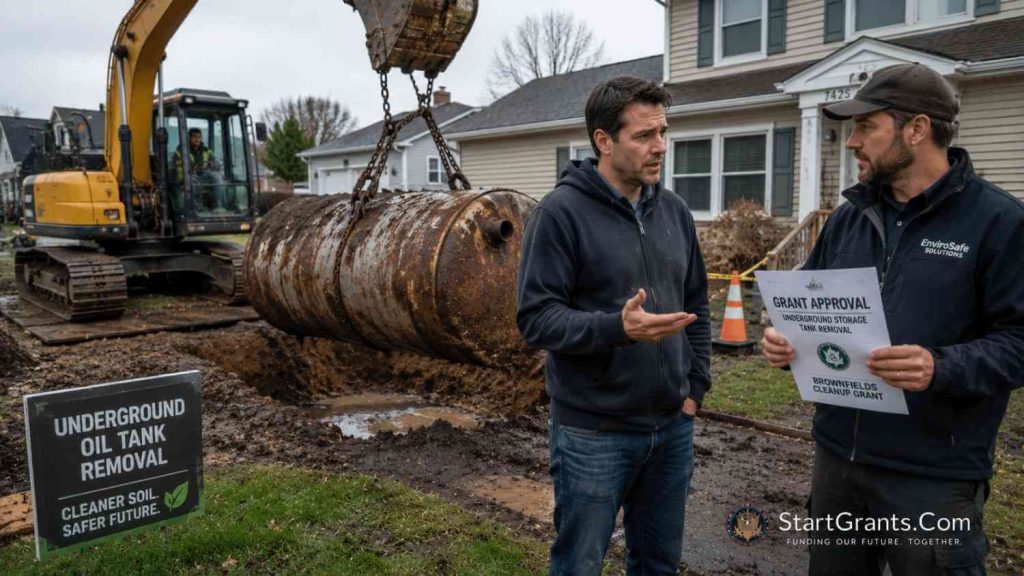
Is the NJ Oil Tank Removal Grant Open in 2026?
Two agencies share responsibility for the Petroleum Underground Storage Tank Remediation, Upgrade and Closure Fund, commonly called the UST Fund. The New Jersey Department of Environmental Protection (NJDEP) reviews environmental eligibility, the work scope, and reasonable costs. The New Jersey Economic Development Authority (NJEDA) reviews financial eligibility and makes the financing decision.
The current NJEDA program page says that, effective May 3, 2011, new applications for non-leaking tanks are no longer accepted because of insufficient funds. NJDEP’s current UST Fund notice says new applications covered by its funding queue are date-stamped and processed when funds become available, and it currently reports an estimated one-year wait. That estimate can change.
This means homeowners should not advertise, budget, or sign a contract on the assumption that the state will pay. For a suspected or confirmed underground-tank leak, contact the UST Fund at 609-984-2076 or srp_ustfund_gq@dep.nj.gov for the current application, queue status, and instructions that apply to the property.
A separate option: HDSRF
The Hazardous Discharge Site Remediation Fund (HDSRF) is not the same program. NJDEP says a homeowner whose unregulated underground or aboveground heating-oil tank caused a discharge may be eligible for a 25% matching grant for an unrestricted-use soil remedial action or for a private loan. Eligibility, eligible costs, matching funds, and the proposed cleanup must still be reviewed. Questions about HDSRF applications can be directed to NJDEP’s HDSRF coordinator at 609-984-1790.
Quick Program Comparison
| Situation | Likely starting point | Important limitation |
|---|---|---|
| Underground residential tank; no evidence of a leak | Municipal construction/fire office and a qualified tank contractor | New UST Fund applications for non-leaking residential tanks are not being accepted. |
| Underground heating-oil tank with a confirmed discharge | NJDEP UHOT Program and UST Fund contact | Funding is not guaranteed; environmental duties continue while an application is pending. |
| Underground or aboveground unregulated heating-oil tank that caused a discharge | Ask NJDEP whether HDSRF fits the case | A matching grant covers only a stated percentage of an eligible remedial action; a loan must be repaid. |
| Structural or general repairs separate from petroleum remediation | Local rehabilitation programs or other home-repair financing | Do not assume a housing program will pay environmental cleanup costs. |
Who May Qualify for UST Fund Assistance?
For conditional-hardship grants, New Jersey’s published financial screens include:
- Taxable income of no more than $250,000.
- Net worth of no more than $500,000, excluding the primary residence and pension plans.
- A finding of financial hardship—meaning NJEDA determines that the applicant cannot reasonably repay all or part of eligible project costs.
- For applicants with taxable income of $200,000 or more, payment of the first $1,000 of eligible project costs under the published program terms.
Meeting those numbers does not create an entitlement. Ownership or operation of the tank, property use, tank status, insurance, timing, eligible costs, application completeness, the remediation plan, and available funds can all affect the result. A loan has separate underwriting and repayment requirements.
Because online contractor pages often repeat old dollar caps, old forms, or old waiting times, use the state’s current application package. Ask the UST Fund to confirm in writing:
- Whether the tank and applicant are in an eligible category.
- Whether an application should be filed before additional non-emergency costs are incurred.
- Which tax returns, asset statements, ownership records, contractor estimates, NJDEP case documents, and insurance records are required.
- Whether prior costs can be considered and which invoices, proof of payment, laboratory reports, and disposal records must be retained.
- Whether the proposed award is a grant, matching grant, reimbursement, or loan, and whether any lien, repayment, insurance-assignment, or property-use condition applies.
What to Do When a Heating-Oil Tank Leaks
- Protect people first. Do not enter an unsafe confined space or try to handle contaminated material. For fire, severe fumes, or immediate danger, call 911.
- Stop further delivery. Tell the oil supplier not to refill a tank suspected of leaking. Do not transfer oil or excavate unless qualified professionals determine it can be done safely and legally.
- Report the discharge. NJDEP’s WARN DEP page lists 1-877-WARN-DEP (1-877-927-6337). NJDEP’s UHOT FAQ requires notice immediately, within 15 minutes of discovery.
- Notify the insurer promptly. Ask for a written coverage determination. Keep the policy, endorsements, claim number, adjuster correspondence, photos, invoices, and denial or partial-payment letter.
- Call the municipal office. Tank closure can require local construction or fire permits and inspections. Requirements can vary by municipality.
- Retain the correct environmental professional. For a leaking unregulated heating-oil tank, NJDEP allows oversight by a certified Subsurface Evaluator working through an appropriately certified UST firm or by a Licensed Site Remediation Professional (LSRP). An LSRP is therefore not mandatory in every uncomplicated UHOT case.
- Contact the funding program. Ask NJDEP which application path applies. Do not delay emergency response, spill reporting, or legally required remediation while waiting for a funding decision.
UHOT Cleanup, NFA Letters, and RAO Documents
The NJDEP Unregulated Heating Oil Tank Program lets qualified environmental professionals investigate and remediate discharges from qualifying heating-oil tank systems. The project can involve tank closure, soil sampling, delineating the contamination, removing or treating contaminated soil, investigating groundwater when required, documenting disposal, and submitting a remedial action report.
For a case completed through the UHOT Program, NJDEP can issue a No Further Action (NFA) letter. The letter is NJDEP’s determination regarding the contamination and remedial work covered by that submission. A more complex site handled under the broader licensed-site-remediation system may instead close through a Response Action Outcome (RAO) issued by an LSRP.
An NFA letter is not required merely because an underground tank existed. NJDEP’s current FAQ says that when a UHOT is closed, no evidence of a discharge is found, and the tank passes municipal inspection, there is no need for an NFA letter. Preserve the permit, inspection approval, closure report, photographs, waste manifests, and sampling results, if any.
Neither an NFA nor an RAO guarantees that every future buyer, lender, or insurer will ask no further questions. It is also inaccurate to say that New Jersey law universally prohibits selling or financing every property without an NFA. Transaction requirements depend on the facts, open environmental cases, contract terms, lender and insurer standards, and legal advice.
How Much Does Oil Tank Removal or Cleanup Cost?
There is no reliable statewide flat price. A simple, non-leaking tank closure is different from a discharge that has migrated under a foundation, crossed a property line, affected groundwater, or requires long-term monitoring. Access, tank size, remaining product, excavation conditions, utility conflicts, disposal volume, laboratory work, engineering controls, municipal fees, and restoration all affect the total.
Ask for an itemized written proposal that separates:
- Tank location, permits, pumping, cleaning, removal or approved closure, and disposal.
- Environmental-professional oversight and soil sampling.
- Laboratory analyses and reporting.
- Contaminated-soil excavation, transport, disposal, and backfill.
- Groundwater investigation or treatment, if required.
- NJDEP submissions, professional fees, and municipal inspections.
- Landscaping, paving, foundation, or interior restoration that may not be an eligible remediation cost.
Use at least two comparable proposals when time and safety allow. A low tank-removal quote can exclude the much larger investigation and remediation scope that begins if a discharge is found.
Will Homeowners Insurance Pay?
Do not assume either full coverage or automatic denial. The New Jersey Department of Banking and Insurance explains that insurers use several approaches. Many policies exclude oil-tank pollution liability but may offer a limited buy-back endorsement; some provide liability coverage subject to policy limits; some provide limited first-party remediation and liability coverage; and some insurers will not write a property with an oil tank or will consider the tank’s age.
Read the declarations, exclusions, endorsements, first-party property provisions, and third-party liability provisions. Ask the insurer to identify the exact policy language supporting its decision. If coverage is disputed, consider advice from a New Jersey insurance professional or attorney. The state’s oil-tank insurance guidance is a useful starting point.
Muslim Perspective: Responsible Cleanup and Careful Financing
For Muslim homeowners, a leaking tank can raise two connected concerns: preventing harm to neighbors and the environment, and choosing a financially responsible way to pay for required work. The practical priority is to stop and report a discharge. Financial or religious uncertainty should not be used to delay emergency action or a legal duty that protects people, soil, and water.
Do not label every state award “halal” without reading the agreement
A true grant may not charge interest, but New Jersey’s programs can also provide loans, partial matching grants, or reimbursements. Some assistance can carry liens, repayment or recapture provisions, property-use conditions, insurance coordination, or documentation duties. Ask for the proposed award agreement before acceptance and identify whether the assistance is:
- A non-repayable grant after all conditions are met.
- A matching grant requiring the homeowner to provide part of the cost.
- A reimbursement paid only after eligible expenses are documented.
- A loan with interest, fees, collateral, or a property lien.
A Muslim applicant who is concerned about riba can take the written terms to a qualified scholar familiar with U.S. finance and to a New Jersey attorney or financial adviser. This is more reliable than treating the program name “grant” as a religious ruling.
Explore non-interest sources without postponing the cleanup
Ask first about grant eligibility, insurance coverage, HDSRF matching assistance, contractor payment schedules, and any no-interest help available from family or community. A local mosque or zakat committee may consider emergency housing or debt assistance under its own eligibility policy, but there is no nationwide promise that zakat or sadaqah will pay an oil-tank project. If relatives offer a qard hasan, put the amount, repayment schedule, and absence of interest in writing to protect relationships.
Insurance and necessity require individual guidance
Commercial-insurance questions receive different contemporary scholarly analyses, especially where a mortgage, third-party liability, or serious household risk is involved. The factual first step is to learn what coverage already exists and what New Jersey requires. The religious conclusion should come from a trusted scholar who can review the actual policy and the homeowner’s circumstances; this article does not issue a fatwa.
Transparency is part of good stewardship
Report the discharge honestly, disclose known conditions as required, submit only genuine invoices, and avoid contractors who offer to change samples or inflate grant costs. Protecting neighbors and public resources includes accurate reporting as well as physical cleanup.

Other Help When the Environmental Fund Does Not Cover Everything
Oil-tank programs generally focus on eligible tank and remediation work, not every repair left behind. If excavation damages a walkway, landscaping, basement finish, or another part of the home, ask whether the restoration item is eligible before assuming it will be reimbursed. For broader repair possibilities, see HUD Home Improvement Grants and Financing Options. HUD-backed financing is not a substitute for NJDEP cleanup approval, and environmental-remediation eligibility must be confirmed with the lender and program administrator.
If a tank or fuel line was damaged by a federally declared disaster, keep photographs, emergency reports, insurer decisions, and repair estimates, then review How to Apply for Disaster Relief Assistance. Disaster aid does not normally pay for deferred maintenance or a pre-existing leak, and duplicate benefits are restricted.
Contractor and Grant Scam Checklist
- Reject any promise that “NJDEP will pay 100%” before the agencies issue a written decision.
- Verify who will pull municipal permits and who will schedule inspections.
- For a discharge, verify the credentials of the SSE, certified UST firm, or LSRP and confirm who signs the NJDEP report.
- Require an itemized scope, change-order process, unit prices, laboratory plan, disposal documentation, and restoration exclusions.
- Do not sign over insurance proceeds or grant rights without understanding the authorization.
- Pay against documented milestones; avoid large cash payments and blank forms.
- Keep copies of every permit, hotline case number, contract, invoice, canceled check, laboratory result, waste manifest, photograph, and agency letter.
Bottom Line
New Jersey’s oil-tank assistance is real, but it is narrower and slower than many contractor advertisements suggest. New applications for non-leaking residential tanks remain closed. A leaking underground heating-oil tank may fit the UST Fund, while a discharge from an unregulated underground or aboveground tank may also warrant an HDSRF review. Neither route guarantees payment.
Report a discovered discharge immediately, use the correct municipal and environmental professionals, notify the insurer, obtain the current application directly from NJDEP, and preserve every record. That sequence protects health, the environment, the funding claim, and the property’s future marketability.
Frequently Asked Questions
Is New Jersey accepting applications for non-leaking residential oil tanks?
Answer: No. NJEDA says new applications for non-leaking tanks have not been accepted since May 3, 2011 because of insufficient funds. Homeowners should confirm the current status before paying any application-related fee.
Can I apply if my underground heating-oil tank leaked?
Answer: A qualifying leaking underground tank may be considered through the UST Fund, but eligibility and payment are not guaranteed. NJDEP currently reports a funding queue, so call 609-984-2076 for the current application and instructions.
What income and net-worth limits apply to a conditional-hardship grant?
Answer: Published program screens set taxable income at no more than $250,000 and net worth at no more than $500,000, excluding the primary residence and pension plans. NJEDA must also find that the applicant cannot reasonably repay all or part of eligible costs.
How quickly must I report a heating-oil discharge?
Answer: NJDEP says a discovered discharge must be reported immediately, within 15 minutes, to 1-877-WARN-DEP (1-877-927-6337). Call 911 first for fire, dangerous vapor, or another immediate threat to people.
Is an LSRP required for every residential heating-oil tank cleanup?
Answer: No. Under the UHOT Program, an eligible case may be overseen by a certified Subsurface Evaluator working through an appropriately certified UST firm or by an LSRP. Complex conditions can make LSRP involvement necessary.
Do I need an NFA letter when the removed tank did not leak?
Answer: NJDEP says an NFA letter is not needed when the tank is closed, there is no evidence of a discharge, and it passes municipal inspection. Keep the permit, inspection approval, closure records, and any sampling results.
Does homeowners insurance always exclude an oil-tank leak?
Answer: No. Coverage varies by insurer, policy, endorsement, type of loss, and whether the claim concerns the homeowner’s property or liability to others. Report the claim promptly and request a written decision citing the policy language.
Is every NJ oil-tank grant automatically acceptable from an Islamic-finance perspective?
Answer: No universal conclusion should be made from the word “grant.” Review whether the award is a grant, matching grant, reimbursement, or loan and whether it carries interest, fees, a lien, recapture, or other conditions, then seek case-specific guidance from a qualified scholar.