
Last Updated: August 2026 | Author: Munir Ardi
The cost of higher education in the United States has reached a catastrophic peak. In 2026, the gap between what federal grants provide and what a university actually charges is wider than ever. When the standard financial aid package falls short, millions of students instinctively surrender and sign the dotted line for massive, high-interest student loans. But elite students deploy a different tactic: they negotiate.
Universities, private foundations, and local corporations have millions of dollars in discretionary funds waiting to be claimed. However, this money is not distributed automatically. You must demand it, and you must do so persuasively. If you are looking to increase your chance in getting scholarships for your upcoming academic year, mastering the art of writing a letter requesting financial assistance for education is the ultimate survival skill to bridge your tuition gap and graduate debt-free.
Before you draft a single sentence, you must understand the broader psychological architecture of modern philanthropy and donor appeals. Anchor your strategic approach by reviewing our central Master Pillar: How to Get Donations for a Fundraiser: The Ultimate Guide.

As tuition costs skyrocket, students must learn to advocate for themselves. A meticulously crafted letter requesting financial assistance is the ultimate tool to unlock university endowments and private foundation grants.
Phase 1: The Anatomy of the Letter (The 4-Part Structure)
A fatal mistake students make when requesting money is writing a “sob story.” Grant committees and financial aid officers read thousands of letters a day; they are numb to generic begging. Your letter must be a highly structured, professional business document that treats the reader as an investor.
A winning letter requesting financial assistance for education follows a strict 4-part architecture:
- The Professional Header: Never use “To Whom It May Concern.” Find the exact name of the Financial Aid Director or Foundation President. Include your student ID, contact info, and the date.
- The Hook (Who You Are): Do not start with your financial problems. Start with your academic value. “My name is Sarah, and I am an incoming junior majoring in Biomedical Engineering with a 3.8 GPA.” Prove you are a high-value asset worth funding.
- The Ask (The Financial Reality): Be radically objective and mathematically precise. “Due to an unexpected medical emergency, my family’s income dropped by 30%, leaving a precise $4,500 gap in my fall tuition.” To understand how to separate a strategic educational appeal from a personal survival plea, read: How to Get Donations for Yourself.
- The ROI (Return on Investment): Close by explaining how their money guarantees your success. “This $4,500 grant will allow me to decline taking on a second night-shift job, ensuring I can maintain my honors status and complete my clinical internship.”
Phase 2: The University Appeal (Professional Judgment)
The most common recipient of this letter is your own university’s Financial Aid Office. This is known as a Professional Judgment Appeal.
When you file the Free Application for Federal Student Aid (FAFSA), the government uses your family’s tax data from two years ago (Prior-Prior Year). If your family experienced a massive financial crisis this year (like a layoff, death, or severe medical bills), your FAFSA data is technically a lie; it says you have money that you no longer possess.
Financial Aid administrators have the federal authority to manually override your FAFSA and increase your Pell Grant or institutional scholarships. However, they will only do this if you submit a formal letter of appeal backed by hard documentation (termination letters, hospital bills).
Pro-Tip: Writing the FAFSA Appeal
Drafting an appeal letter that cuts through the university’s bureaucracy requires a precise, professional tone. If you are unsure how to structure your request or what specific financial details to highlight to secure a Professional Judgment override, you need a proven template. Watch this incredibly practical, step-by-step breakdown to learn exactly how to format and submit a winning request: How To Write Your Financial Aid Appeal Letter:
Phase 3: Pitching Private Endowments & Corporations
If your university refuses to budge, you must pivot to the private sector. Local corporations, rotary clubs, and wealthy alumni frequently sponsor students, provided the pitch aligns with their corporate values.
When writing a letter to a private entity, the focus shifts heavily to Public Relations (PR) and Tax Deductions. Businesses want to know how funding your education benefits their brand. You must adopt a B2B (Business-to-Business) communication style. To master this highly formal, corporate-facing structure, deploy the templates found in our guide: How to Write a Formal Letter Asking for Donations.
Phase 4: The Digital Shift (Email Execution)
In 2026, many private foundations and corporate sponsors no longer accept physical mail. Your beautifully crafted, two-page letter must often be condensed into a high-impact digital format.
Converting a formal letter into an email requires drastically altering the formatting. You must master the “Subject Line” to prevent your appeal from going to the spam folder, and you must use bullet points to accommodate short digital attention spans. Ensure your digital outreach is flawless by studying our technical guide: How to Write a Fundraising Email That Converts.
Phase 5: The Muslim Perspective (Talib al-Ilm, Riba, Gharar, & Qard Hasan)
For Muslim students in the United States, pursuing higher education is not merely a path to a career; it is a sacred religious mandate. The pursuit of beneficial knowledge (Ilmu Nafi’) is an act of worship, elevating the student to the honored status of Talib al-Ilm (Seeker of Knowledge). However, the American higher education system is built on a foundation of massive, systemic debt. Navigating this system requires strict adherence to Islamic financial jurisprudence (Shariah) to ensure your education begins with divine Barakah (blessing).
The Trap of Federal Student Loans (Riba)
If a student fails to write a compelling financial assistance letter, the university’s financial aid package will automatically default to offering “Federal Direct Subsidized and Unsubsidized Loans” to cover the tuition gap.
Do not be fooled by the word “Subsidized.” While the government pays the interest while you are actively enrolled in classes, the loan will inevitably begin charging compounding interest once you graduate. In Islam, intentionally signing a contract that mandates the payment of interest is explicitly Riba, which is strictly Haram (forbidden) and constitutes one of the most severe major sins in the religion. A Muslim student must adamantly refuse these federal student loans.
This elevates the act of writing a letter requesting financial assistance for education into a religious necessity. You are fighting to secure Grants and Scholarships, which are classified as Hibah (gifts). Because they require no repayment and accumulate zero interest, they are 100% Halal.
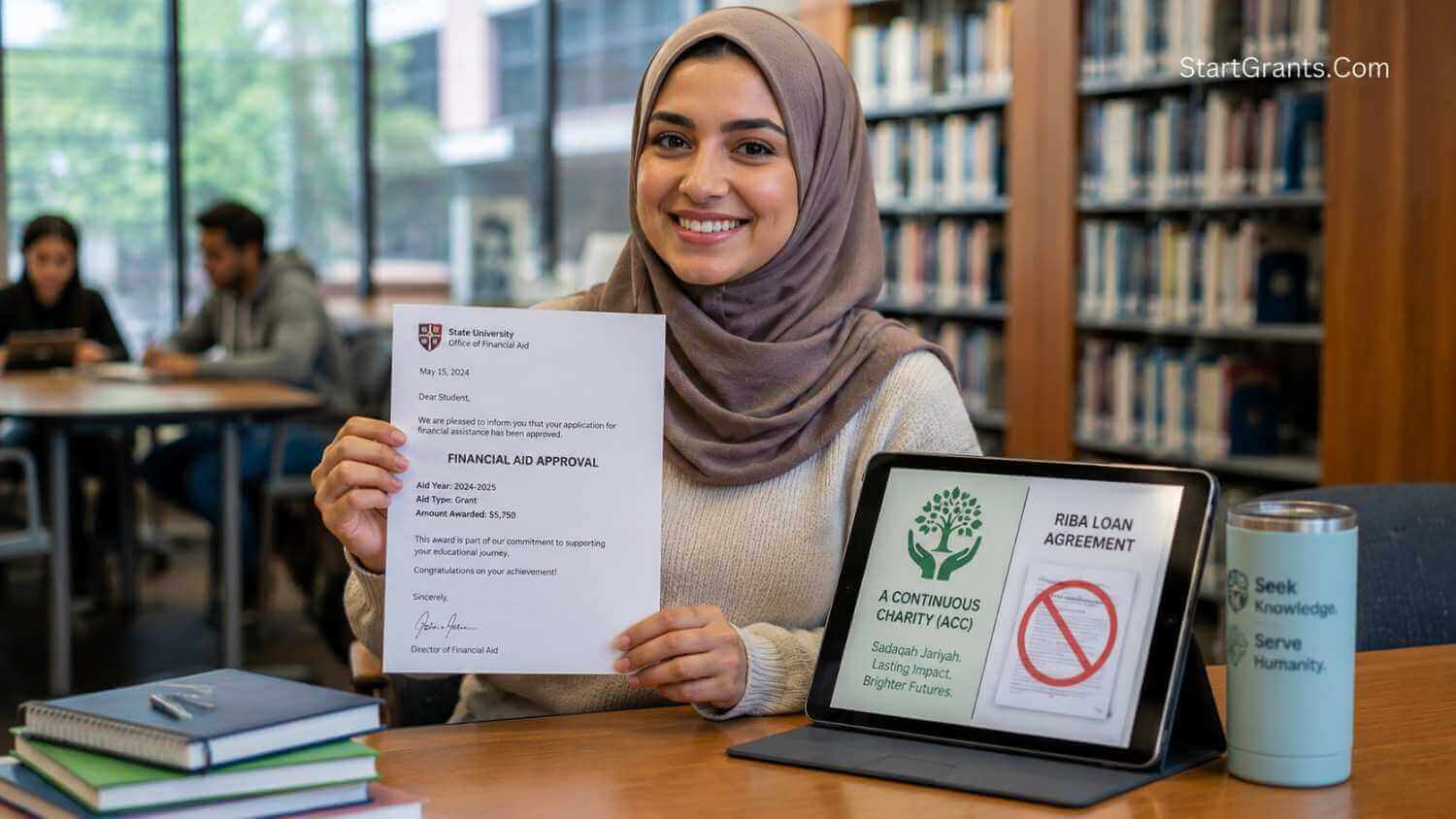
For the Muslim student (Talib al-Ilm), securing education must be done ethically. By aggressively pitching for Halal grants (Hibah) and partnering with organizations like A Continuous Charity for zero-interest loans, students can graduate without the spiritual burden of Riba.
Qard Hasan: The Halal Safety Net
If your university appeal is denied and private grants fall short, how do you pay the remaining tuition without Riba? The Islamic solution is Qard Hasan (a benevolent, zero-interest loan). Muslim students must seek funding from their family, their local Masjid, or utilize specialized national Islamic nonprofits.
Organizations like A Continuous Charity (ACC) exist in the U.S. explicitly to provide strict, interest-free educational loans to Muslim students. By replacing Riba with Qard Hasan, students can achieve their academic dreams without declaring spiritual war upon their future careers.
Gharar and Mandatory University Health Insurance
Upon enrolling, most major universities legally mandate that all students carry comprehensive health insurance. If you do not have private insurance, the university will force you to purchase their expensive student health plan to remain registered for classes.
Traditional commercial insurance contains Gharar (excessive uncertainty) and elements of gambling. Because genuine Takaful (Islamic cooperative insurance) for university students is practically non-existent in the U.S., contemporary Islamic scholars apply the principle of Dharurah (legal and operational necessity). This permits the Muslim student to purchase the mandated commercial health policy to satisfy university enrollment laws and protect themselves from catastrophic medical debt, provided the intent is survival and compliance, not speculative profit.
Zakat for the Student (Ibn al-Sabil & Al-Masakin)
If a student is entirely cut off from their family’s wealth, or if their family is completely destitute and the student cannot afford basic rent, food, or tuition while seeking an education, they fall into the Zakat-eligible categories of Ibn al-Sabil (the stranded traveler/wayfarer seeking knowledge away from home) or Al-Masakin (the needy). It is entirely Halal and highly encouraged for the Muslim community to deploy Zakat funds to support a Talib al-Ilm, ensuring poverty does not force them into Riba-laced debt.
Conclusion
Writing a letter requesting financial assistance for education is not an act of desperation; it is a highly calculated business negotiation. By objectively stating your academic value, providing irrefutable documentation of your financial hardship, and articulating a clear Return on Investment to the donor, you can override automated FAFSA rejections and unlock thousands of dollars in university and private endowments.
For the Muslim student, mastering this written appeal is a critical shield against the predatory American debt machine. By fiercely advocating for Halal grants (Hibah), seeking Qard Hasan when necessary, and navigating mandatory insurance via Dharurah, your pursuit of higher education remains a pure, spiritually elevated journey, completely protected from the destructive curse of Riba.
Frequently Asked Questions (FAQs)
Q1: Who should I send my financial assistance letter to?
A: If you are applying to your university, address the letter directly to the Director of Financial Aid or your specifically assigned Financial Aid Counselor. If you are applying to a private foundation or corporation, address it to the Foundation Director or the Head of Corporate Social Responsibility (CSR). Never use “To Whom It May Concern.”
Q2: What documents should I attach to my financial aid appeal letter?
A: Hardship claims must be backed by irrefutable evidence. You should attach copies of termination letters, unemployment benefit statements, catastrophic medical bills, death certificates, or legal divorce decrees. The more financial proof you provide, the higher your chances of the university approving a Professional Judgment override.
Q3: Is it better to send a physical letter or an email?
A: For a university Financial Aid Office, you must follow their specific protocol (often requiring a physical letter or a PDF uploaded to their secure student portal). For private donors and modern corporate sponsors, a concise, highly structured email with a PDF attachment is usually preferred and yields faster responses.
Q4: Why is it Haram for a Muslim student to accept a Federal Subsidized Student Loan?
A: “Subsidized” simply means the government pays the interest while you are actively enrolled in classes. However, once you graduate or drop below half-time enrollment, the loan will automatically begin accumulating compounding interest. In Islamic finance, intentionally signing any contract that includes a clause for paying interest is classified as Riba, which is strictly forbidden (Haram).
Q5: Can I ask for Zakat from my local Masjid to pay my tuition?
A: Yes, under specific circumstances. If you are pursuing beneficial knowledge but your family is destitute, or you are an independent student unable to afford basic living expenses and tuition, and taking a commercial loan would force you into Riba, you qualify as Al-Masakin (the needy) or Ibn al-Sabil (the wayfarer). The Muslim community is encouraged to use Zakat to support students in need.
Disclaimer: The information provided in this article is for educational and informational purposes only. We are not the Department of Education, a university financial aid office, or a religious fatwa council. FAFSA regulations, Professional Judgment appeal protocols, and foundation grant cycles are subject to constant legislative changes. Always consult directly with your university’s financial aid office for appeal deadlines, and seek guidance from a qualified Islamic finance scholar regarding Halal education financing, Riba avoidance, and specific Zakat eligibility.