
Last Updated: | Author: Munir Ardi
Finding low-income housing in San Francisco is difficult, but the search is more manageable once you separate the available programs. The San Francisco Housing Authority (SFHA), the City’s DAHLIA portal, individual affordable properties, emergency rent programs, and the homelessness response system all serve different purposes. There is no single application that places a household on every list.
This guide explains the current status of San Francisco housing programs, how DAHLIA lotteries and City preferences work, where to get free application help, and what to do if your family is facing eviction or homelessness. It also corrects a common misconception: an affordable-housing lottery number determines the order in which applications are reviewed; it does not guarantee an apartment.

Current San Francisco Housing Status as of August 29, 2026
| Housing channel | Current status | What to do |
|---|---|---|
| SFHA Housing Choice Voucher (Section 8) | Closed | Monitor the official SFHA waitlist page; do not pay anyone for a position. |
| SFHA Project-Based Voucher | Closed | Keep any existing application updated and watch for a future opening. |
| SFHA RAD and public housing | Closed | Check SFHA directly; DAHLIA is a separate system. |
| DAHLIA affordable rental listings | Active listings change regularly | Review each listing’s deadline, income range, household size, preferences, and screening rules. |
| SF Emergency Rental Assistance Program | Applications available, but funding is limited | Apply only if you meet the current rules; eligibility does not guarantee payment. |
The statuses above were checked against the official SFHA waiting-list page, the current DAHLIA rental listings, and the City’s SF ERAP page. Recheck them before applying because a list can open, close, or change without notice.
Start With the Right San Francisco Housing Program
1. DAHLIA for City affordable-housing opportunities
DAHLIA San Francisco Housing Portal is the City’s main online portal for affordable rental and homeownership opportunities. It includes new-unit lotteries, re-rental opportunities, and some first-come, first-served listings. Not every affordable apartment in San Francisco appears there, and DAHLIA is not the application portal for SFHA’s federal voucher and public-housing waiting lists.
2. SFHA for vouchers, public housing, PBV, and RAD
SFHA administers the federal Housing Choice Voucher program and other federally assisted housing. Its current public page lists the Housing Choice Voucher, Project-Based Voucher, RAD, and public-housing waiting lists as closed. If you previously applied, use the instructions in your confirmation notice or SFHA’s applicant system to keep your address and contact information current.
When a California housing authority opens a list, apply only through the agency’s verified website. Our broader guide to how to apply for Section 8 housing in California explains PHAs, income eligibility, waiting lists, and documents in more detail.
3. Individual subsidized and nonprofit properties
Some affordable properties maintain their own applications or waiting lists. Search the HUD Resource Locator, then contact each management office directly to ask whether its list is open. A property may serve families, seniors, people with disabilities, formerly homeless households, or another defined population. Listing a property on a directory does not mean a unit is available.
4. Coordinated Entry for people experiencing homelessness
DAHLIA is not an emergency shelter system. San Francisco’s Coordinated Entry Access Points connect people experiencing homelessness to problem-solving, shelter, rapid re-housing, supportive housing, and other resources. Separate Access Points serve adults without children, families with minor children, young adults ages 18–24, veterans, and survivors of violence. Assessment does not guarantee a particular placement.
How DAHLIA Affordable-Housing Applications Work
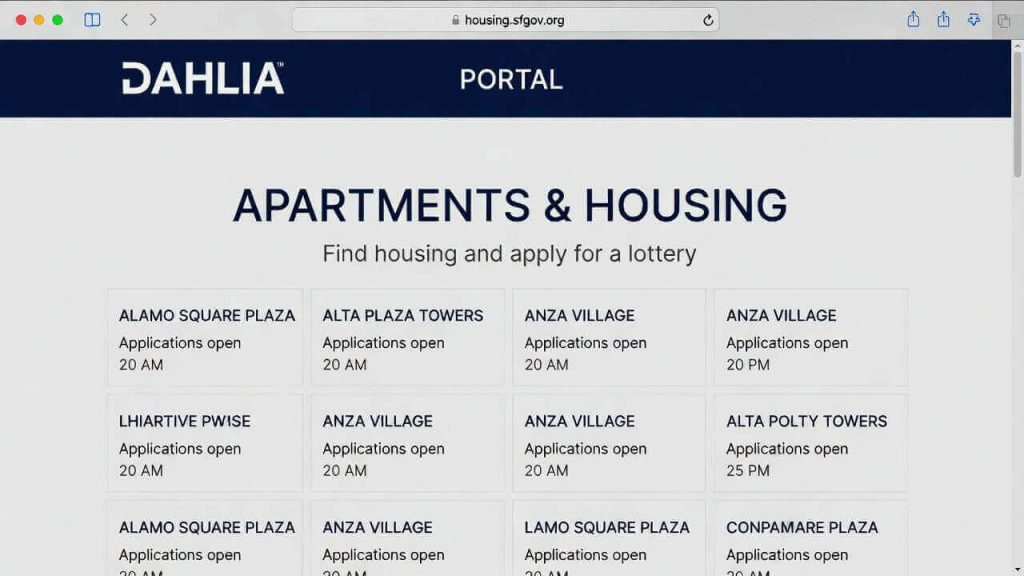
- Create one household account. Enter accurate household, income, and contact information. Duplicate applications can cause problems.
- Use the eligibility estimator. It can highlight possible matches, but it is not a final eligibility decision.
- Read the entire listing. Check minimum and maximum income, household-size rules, rent, utilities, accessible units, preferences, required documents, and resident selection criteria.
- Submit before the displayed deadline. A lottery application is generally not improved by submitting on the first day rather than the last, but waiting creates a risk of technical or document problems.
- Save the confirmation. Keep the application ID, lottery information, and a copy of what you submitted.
- Respond to the leasing agent. If your number is reached, the agent verifies income, assets, household composition, preferences, and other eligibility. Follow the exact response deadline in the notice.
The City explains that a DAHLIA lottery determines who gets to complete the full housing application first. A favorable rank is not the same as approval. The property must still confirm that the household qualifies, and it may conduct screening under the published resident selection criteria.
Understanding BMR Rentals Without the Marketing Hype
Below Market Rate (BMR) rentals are income-restricted units created or regulated through City affordable-housing requirements. Some are located in otherwise market-rate developments; others are in fully affordable buildings. “BMR” does not mean free housing, and it does not automatically mean the rent equals 30% of your household’s actual income.

A BMR rent is normally tied to the affordability level assigned to the unit and the governing agreement. A household can meet the maximum-income limit yet still find the rent difficult to afford. Some listings also state a minimum income unless the applicant has a qualifying rent subsidy or other permitted exception. Review utilities and mandatory fees because they affect the real monthly cost.
Do not assume that every BMR tenant receives every amenity at no charge. Parking, storage, utilities, pets, and optional building services may have separate rules or costs. The DAHLIA listing and lease—not a general online article—control what is included.
2026 San Francisco AMI: Check Household Size and the Listing
Area Median Income (AMI) is not one national dollar amount. MOHCD uses annual San Francisco-area figures and publishes different charts for different housing programs. The following are sample maximum household incomes for affordable rental projects under MOHCD contract, effective June 1, 2026:
| AMI level | 1 person | 2 people | 3 people | 4 people |
|---|---|---|---|---|
| 30% AMI | $34,050 | $38,900 | $43,750 | $48,650 |
| 50% AMI | $56,750 | $64,850 | $72,950 | $81,050 |
| 60% AMI | $68,050 | $77,800 | $87,550 | $97,250 |
| 80% AMI | $90,750 | $103,750 | $116,700 | $129,700 |
Important: These figures do not establish eligibility for every DAHLIA listing. Tax-credit, HUD-assisted, inclusionary BMR, supportive-housing, and homeownership programs can use different limits and income calculations. Use the City’s AMI tool, then rely on the exact chart and rules linked in the property listing.
San Francisco Lottery Preferences: Priority, Not a “Cheat Code”
City housing preferences can move an eligible household higher in a specific City-run lottery. They do not let anyone skip eligibility verification, and the City states that these preferences cannot be used for state or federal programs such as Section 8. DAHLIA identifies which preferences apply to each listing.
- Certificate of Preference (COP): available to qualifying people displaced by the former San Francisco Redevelopment Agency; certain descendants may qualify for specific buildings.
- Displaced Tenant Housing Preference (DTHP): may apply after qualifying displacement involving fire, an owner move-in eviction, an Ellis Act eviction, rising rent in an affordable unit, or an unlawful residential unit.
- Neighborhood Resident Housing Preference (NRHP): may apply when the applicant lives within one-half mile of, or in the same supervisorial district as, a qualifying new listing.
- Live or Work in San Francisco Preference: may apply if a household member lives in San Francisco or works at least 75% of their working hours in the City.
- Veteran priority: can provide priority within another preference category when the listing and rules allow it; veteran status alone does not replace the other preference.
Use the official housing-preference guide to check the definition and acceptable documents. Never claim an address, eviction, job location, family relationship, or other preference that cannot be verified.
Documents to Prepare Before a Leasing Agent Contacts You
Requirements vary, but a well-organized application folder may include:
- Identification requested by the listing for each adult household member;
- Recent pay statements and employer verification;
- Current benefit, pension, unemployment, or child-support documentation;
- Recent bank and asset statements;
- Tax returns or an explanation of why a return was not filed;
- Household-composition, custody, or dependent records when relevant;
- Preference documentation;
- Voucher or subsidy documentation, if applicable; and
- Reasonable-accommodation information only when needed.
Do not email sensitive documents to an address found in an unsolicited message. Confirm the leasing agent through the DAHLIA listing and use the requested secure submission method. If you are denied, ask for the written reason and follow the appeal or review instructions for that property; there is no universal rule that every low credit score must be approved.
Immigration Status and DAHLIA: The Program Funding Matters
DAHLIA contains housing financed under different programs, so one citizenship rule does not cover every listing. MOHCD’s Inclusionary BMR procedures state that citizenship, legal residency, and immigration status are not qualifying criteria for a City Inclusionary BMR unit. However, a federally subsidized property or voucher program may have federal eligible-immigration-status requirements.
Do not assume that being in a sanctuary city makes every federally funded unit available regardless of status, and do not assume that every DAHLIA applicant must be a U.S. citizen. Read the listing’s funding and eligibility rules, speak with a housing counselor, and obtain qualified immigration advice if applying could affect your household.
Emergency Rent Help, Eviction Defense, and Shelter
SF ERAP
SF ERAP can help some San Francisco residents with past-due rent after a recent financial hardship or with a security deposit for an identified new unit. Current basic rules include San Francisco residency, age 18 or older, household income at or below 50% AMI, a qualifying recent hardship for back-rent applications, and no SF ERAP assistance in the previous 12 months. Funding is limited and the program serves households at the highest risk of housing loss; meeting the minimum rules does not guarantee assistance.
Eviction court papers
An assistance application does not automatically stop an eviction lawsuit. If you receive an Unlawful Detainer, contact the Eviction Defense Collaborative immediately at 415-659-9184. Court deadlines move quickly.
Homeless tonight or fleeing violence
Call 311 in San Francisco or 415-701-2311 from outside the City for current shelter information. Families, pregnant people, young adults, adults without children, and survivors may have different entry points. Use the City’s current shelter or Coordinated Entry directions rather than arriving at a facility without confirming how placement works.
Muslim Perspective: Practical Housing Support in the Bay Area
Muslim households may apply for DAHLIA listings, SF ERAP, SFHA programs, and homelessness services under the same published rules as other households. The federal Fair Housing Act prohibits housing discrimination because of religion. If a landlord, leasing agent, lender, or housing program treats you differently because you are Muslim, document what happened and review HUD’s housing-discrimination complaint process.
Combine City assistance with verified community resources
Do not abandon an SF ERAP, DAHLIA, legal-aid, or shelter application while asking a mosque for help. Community funds are usually limited and operate under separate eligibility rules.
- Rahima Foundation states that it provides limited financial assistance and groceries to qualifying Bay Area residents. It also clearly states that it is not a shelter and does not provide housing. Ask what costs are currently eligible and whether funding is available.
- Muslim Community Association of the Bay Area has an official zakah and sadaqah application reviewed by its committee. MCA is located in Santa Clara, so confirm geographic eligibility and current processing before relying on it.
- Local masjid committees may have zakat, sadaqah, referral, or interest-free emergency support, but there is no Bay Area-wide guarantee. Ask whether assistance is a grant or loan, whether payment goes directly to the landlord, and which documents are required.
Avoid turning a deposit problem into expensive debt
If avoiding interest-based borrowing is important to your family, tell the SF ERAP partner or community caseworker that the immediate need is a verified security deposit or rent balance. Do not assume a payday loan is the only way to hold an apartment. At the same time, do not label every public payment automatically as zakat, hibah, halal, or haram. A qualified scholar can advise on a specific financing contract, while a counselor or attorney can explain its legal repayment terms.
Ask shelters about religious and family needs
When shelter is necessary, ask about privacy, family placement, halal food access, prayer space, interpretation, clothing needs, and whether older male children can remain with their mother. Policies and available accommodations vary. Safety comes first; a Muslim-oriented provider should be treated as an additional option, not a reason to delay emergency shelter or domestic-violence help.
Should You Expand the Search Beyond San Francisco?
If work, school, medical care, custody, or support networks allow flexibility, compare affordable-housing programs in nearby jurisdictions as well as other California cities. Each housing authority and city portal has separate waiting lists, preferences, rents, and transportation tradeoffs. Another city is not automatically easier or cheaper after commuting and relocation costs.
For a structured comparison with Southern California, review our guide to low-income housing options in Los Angeles. Apply only where your household could realistically live and comply with the program’s residency, occupancy, and reporting requirements.
Free Help With a DAHLIA Application
San Francisco funds housing counselors who can help applicants search listings, calculate possible AMI eligibility, understand preferences, and complete DAHLIA applications. Use the City’s current housing-counselor directory rather than paying an unverified broker or “lottery consultant.” A counselor can help prepare an application but cannot guarantee a winning number or approval.
Frequently Asked Questions
Is the San Francisco Section 8 waiting list open?
As of August 29, 2026, SFHA lists its Housing Choice Voucher waiting list as closed. Its Project-Based Voucher, RAD, and public-housing lists are also shown as closed. Check SFHA directly for changes.
Is DAHLIA the same as the SFHA Section 8 waiting list?
No. DAHLIA is San Francisco’s main portal for City affordable-housing opportunities. SFHA separately administers federal vouchers, public housing, PBV, and RAD waiting lists.
Does winning a DAHLIA lottery mean I get the apartment?
No. The lottery establishes the order in which applicants are reviewed. The leasing agent must still verify income, assets, household size, preferences, occupancy standards, and other property criteria.
Can I bypass the lottery with a preference?
No. A valid preference can improve a household’s ranking in a City lottery that uses that preference. It does not eliminate the lottery or eligibility review, and it cannot be used for Section 8.
Does every BMR renter pay 30% of actual income?
No. Many BMR rents are based on the AMI level assigned to the unit rather than an individualized calculation of 30% of the tenant’s actual income. Read the listing for rent, utilities, fees, minimum income, and subsidy rules.
Can a noncitizen apply through DAHLIA?
It depends on the housing program. City Inclusionary BMR rules do not use citizenship or immigration status as eligibility criteria, but federally subsidized units and vouchers may apply federal eligible-status requirements. Check the specific listing.
Can SF ERAP pay a security deposit?
SF ERAP may help an eligible San Francisco household with a security deposit for an identified new unit. Income, residency, recent-assistance, risk, and other rules apply, and limited funding means not every eligible household will receive payment.
Where can I get free help with DAHLIA?
Use San Francisco’s official housing-counselor directory. Participating nonprofit counselors can help with the housing search and application, but they cannot guarantee selection or approval.
Final Takeaway
The strongest San Francisco housing strategy is parallel, accurate, and persistent: monitor SFHA, apply to matching DAHLIA listings, contact individual subsidized properties, use a counselor, and seek emergency assistance or legal help before a crisis becomes irreversible. Keep every application current and never pay someone who claims to control a lottery or waiting list.
Important disclaimer: StartGrants.com is an independent information portal. It is not affiliated with the City and County of San Francisco, SFHA, HUD, MOHCD, DAHLIA, a property manager, lender, law firm, or assistance provider, and it does not award housing or rental assistance. Program status, funding, income limits, waiting lists, preferences, and deadlines can change. Verify all details with the responsible agency or listing and seek qualified legal help for eviction, immigration, discrimination, or contract questions.


