
Last Updated: | Author: Munir Ardi
There is no single statewide application for Section 8 housing in California. The federal Housing Choice Voucher program is funded by the U.S. Department of Housing and Urban Development (HUD), but applications, waiting lists, eligibility decisions, and voucher administration are handled by local Public Housing Agencies (PHAs).
That distinction matters. A waiting list in one city may be closed while a county agency, neighboring PHA, public-housing property, or project-based program is accepting applications. The practical goal is not to find a mysterious “California Section 8 form.” It is to identify the correct housing agencies, verify which lists are genuinely open, and maintain every application until the agency contacts you.
Section 8 is only one part of the broader housing safety net. If you also need information about public housing, emergency rental help, home-repair assistance, or other federal and local resources, explore our overview of government housing grants and assistance programs.
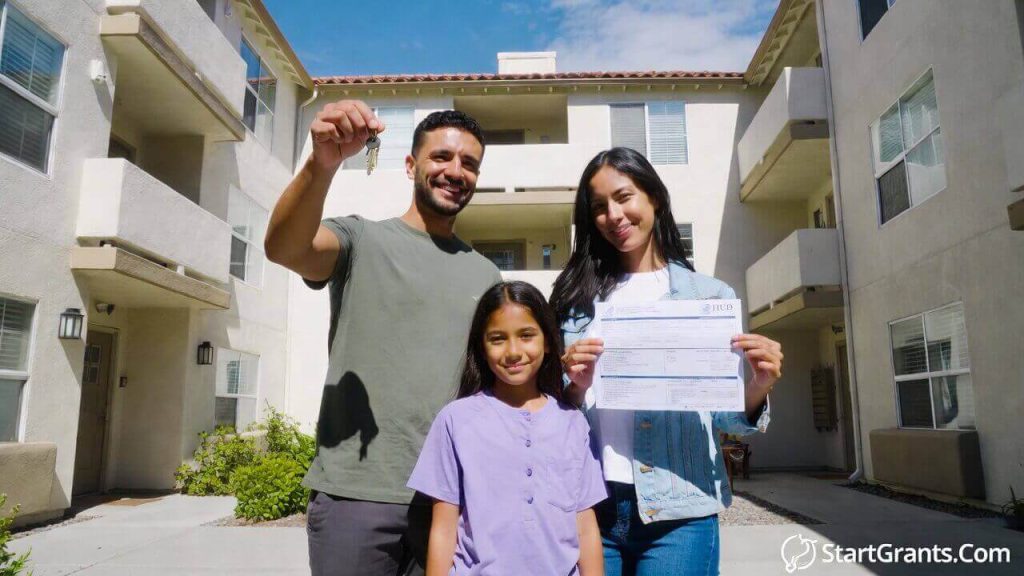
What Section 8 Actually Provides
“Section 8” usually refers to the tenant-based Housing Choice Voucher (HCV) program. After a household is selected, found eligible, and issued a voucher, it searches for a rental unit. The landlord submits program paperwork, the PHA evaluates whether the rent is reasonable, and the unit must meet HUD housing-quality requirements. Once approved, the PHA pays a housing-assistance payment directly to the landlord, and the tenant pays the remaining household share.
A voucher is different from public housing and project-based assistance:
- Tenant-based HCV: the assistance moves with the household, subject to program and portability rules.
- Project-Based Voucher (PBV): assistance is initially tied to a designated unit at a specific property.
- Public housing: the housing authority owns or controls the development and maintains a separate application or waiting list.
- Other affordable properties: tax-credit, city-financed, senior, disability-accessible, and below-market-rate apartments may have their own property applications and are not automatically Section 8.
When an HCV list is closed, ask the PHA whether any public-housing, PBV, RAD, senior, accessible, or property-specific lists are open. These programs are not interchangeable, but they may provide another legitimate route to an affordable home.
Step 1: Find the Correct California Housing Agencies
Start with HUD’s Public Housing Agency directory, which HUD says is updated weekly. HUD also provides a California PHA contact report. If you cannot identify the correct agency, HUD’s Public and Indian Housing Customer Service Center is 800-955-2232.
Search by the area where you are willing and able to live—not simply by the name of your current county. California jurisdictions overlap in ways that are easy to misunderstand. A city may have its own PHA, a county authority may serve only participating cities or unincorporated areas, and a mailing address may not identify the administering agency.
HUD says applicants may need to apply to multiple PHA waiting lists because demand is high. This is allowed, but it does not mean every list is open or that every PHA will give a nonresident the same position as a local applicant. Read the published selection policy before applying.
Use the Agency’s Own Website
A legitimate application link may lead from a government or housing-authority website to a contracted portal such as RentCafé. Start from the PHA’s official page every time. Do not rely on a social-media advertisement, search-engine ad, or third-party “Section 8 registration” page.
Step 2: Check Which Waiting List Is Open
California does not have one calendar for HCV openings. A PHA may use:
- a first-come or date-and-time list;
- a randomized lottery after a limited application window;
- a list ordered by verified local preferences;
- a property-specific waiting list; or
- referrals from a Coordinated Entry System or designated partner for a special program.
Do not assume that an opening lasts only a few days or occurs every three to five years; both claims vary by agency. Likewise, no credible source can promise a universal waiting time. Funding, voucher turnover, bedroom size, preferences, and the number of applicants all affect selection.
Current Examples: Los Angeles and San Francisco
As of August 29, 2026, HACLA’s general HCV waiting list is closed, while other Los Angeles-area lists have different statuses. LACDA, for example, opened 16 site-based Public Housing lists through September 16, 2026, with some smaller lists able to close earlier. The local systems and current alternatives are explained in our page about low-income housing in Los Angeles.
The San Francisco Housing Authority currently lists its HCV, PBV, RAD, and Public Housing waiting lists as closed. However, San Francisco’s DAHLIA portal continues to publish separate affordable rental opportunities and lotteries. Learn how those local systems differ in our review of low-income housing in San Francisco, California.
These examples are date-sensitive. Always recheck the housing authority on the day you apply.
Step 3: Check the Correct 2026 Income Limit
HUD publishes income limits by metropolitan area or county and household size. Use the HUD Income Limits portal and select the 2026 dataset, then confirm the limit with the PHA administering the application.
The draft version of this article incorrectly suggested that everyone below 80% of Area Median Income automatically qualifies for an HCV. The general HCV admission standard is usually the very low-income limit—no more than 50% of the applicable area median income—although federal rules contain limited exceptions. HUD regulations also require at least 75% of families admitted from a PHA’s HCV waiting list during its fiscal year to be extremely low-income.
The familiar income labels are:
- Extremely low income: calculated under HUD’s federal definition and commonly associated with the 30% AMI tier.
- Very low income: generally 50% of area median income.
- Low income: generally 80% of area median income, but this label alone does not create universal HCV eligibility.
California limits can be much higher in high-cost regions than in lower-cost counties. A working household should not self-disqualify based on salary alone, but it also should not rely on a statewide dollar example. The PHA must evaluate current household size, countable income, assets, deductions, citizenship or eligible immigration status, and any program-specific rules.
Step 4: Submit an Accurate Pre-Application
A waiting-list pre-application usually asks for household members, contact information, income, and any preference claimed. The agency may not verify every detail until the household approaches the top of the list, but the information must be truthful when submitted.
Depending on the PHA, useful documents may include:
- government-issued identification for adult household members;
- Social Security number documentation when required;
- birth, custody, or household-composition records;
- pay stubs, benefit letters, pension information, tax records, and bank or asset statements;
- documents supporting a local preference; and
- records supporting a disability-related reasonable accommodation request.
The exact documentation list belongs to the PHA. Do not delay a short pre-application because you are collecting items the agency has not requested, but begin organizing records before the full eligibility interview.
Local Preferences Are Not Universal
PHAs may adopt local preferences in their administrative plans. Examples can include residency or employment in the jurisdiction, veteran status, disability, older age, homelessness, displacement, or other locally identified needs. No preference in that list is mandatory for every California PHA, and the number of “points” is not standardized statewide.
VAWA protects survivors of domestic violence, dating violence, sexual assault, and stalking in covered housing programs, but it does not create one universal emergency preference on every HCV waiting list. A survivor should ask the PHA or a qualified advocate about the agency’s selection policy and applicable VAWA protections.
Claim only a preference that the application actually offers and that your household can document. A false statement can lead to denial, removal from a waiting list, repayment obligations, or termination of assistance.
Step 5: Save Proof and Maintain Every Application
After submitting, save the confirmation page, applicant number, date, agency name, list name, and login URL. Every application must be updated separately. Reporting a new address to one PHA, CalFresh, Social Security, or the Postal Service does not update other housing waiting lists.
There is no universal California rule requiring all applicants to report every change within 10 days. Follow the deadline in that PHA’s notice, portal, or administrative policy. At minimum:
- keep the mailing address, email, and phone number current;
- check spam folders and voicemail;
- respond by the deadline stated in every notice;
- complete any periodic waiting-list update or purge; and
- keep copies of submitted changes and delivery confirmations.
A PHA may remove an applicant who does not respond. If disability, limited English proficiency, or another barrier makes the process inaccessible, request an accommodation or language assistance directly from the agency.
What Happens When Your Name Is Reached?
Being selected for a waiting list does not prove final eligibility. When funding and an appropriate voucher become available, the PHA verifies household composition, income, assets, immigration eligibility, preferences, and other admission criteria. Applicants should receive the agency’s decision and information about review or hearing rights when applicable.
If approved, the household attends a briefing and receives a voucher stating its bedroom size, initial term, and search rules. Federal regulations require an initial voucher term of at least 60 calendar days. A PHA may provide a longer term or extensions under its administrative plan; “60 to 120 days” is not one statewide guarantee.
During the search:
- Ask the PHA for its payment standards, utility allowances, occupancy standards, and landlord packet.
- Find a willing landlord and eligible unit.
- Submit the Request for Tenancy Approval before the voucher expires.
- Wait for the PHA’s rent-reasonableness review and inspection.
- Do not sign a lease with terms that conflict with PHA instructions or move in expecting retroactive approval.
How Much Rent Will a Voucher Holder Pay?
“Section 8 means rent is always exactly 30% of income” is an oversimplification. HUD explains that the household’s family rent portion is usually about 30% of adjusted monthly income. At initial lease-up, the family share can be as high as 40% when the selected unit’s gross rent is above the PHA payment standard.
The calculation depends on adjusted income, household deductions, the PHA payment standard, bedroom size, rent to the owner, and tenant-paid utilities. The payment standard is not necessarily the maximum rent a landlord may request, and it is not a promise that the PHA will approve any unit at that price.
If household income changes after leasing, report it according to the PHA’s rules. Do not assume that an income increase automatically ends assistance; the PHA recalculates the tenant share under applicable policy.
California Landlords and Source-of-Income Protection
California law protects applicants and tenants from discrimination based on source of income, including Housing Choice Vouchers. A landlord cannot lawfully reject someone only because the person uses Section 8 or advertise a blanket “No Section 8” policy.
The California Civil Rights Department also explains that when a housing provider applies an income multiple to a voucher applicant, it must be based on the tenant-paid portion of rent rather than the total contract rent.
This protection does not eliminate all screening. A landlord may use other lawful and consistently applied criteria, while the PHA must approve the owner, lease, rent, and unit. Document discriminatory advertisements or communications and use the Civil Rights Department’s complaint process when appropriate.
Portability: Useful Right, Not a Closed-List Loophole

HUD defines portability as the process for transferring an existing tenant-based rental subsidy outside the jurisdiction of the PHA that initially issued it. A person who is merely waiting for Section 8 has nothing to port.
If a newly admitted household lived outside the initial PHA’s jurisdiction when it applied, the family may have to use the assistance within that initial jurisdiction for one year before porting. The initial PHA may allow an earlier move, but it is not required to do so in every case.
Before moving, the voucher holder must work with the initial PHA. The receiving PHA may have different payment standards, bedroom-size rules, utility allowances, search procedures, and landlord availability. Never move or break a lease based only on an online portability claim.
Other Voucher and Referral Paths
Some households may qualify for programs that do not use the general HCV waiting list:
- HUD-VASH: combines vouchers with VA case management for eligible veterans experiencing homelessness. Start with the VA rather than a paid application service.
- Mainstream Vouchers: serve eligible non-elderly persons with disabilities; availability and application routes vary by PHA.
- Foster Youth to Independence: requires coordination among a participating PHA and a public child-welfare agency for eligible current or former foster youth.
- Homeless or supportive-housing referrals: some local vouchers and PBV units are filled through a Coordinated Entry System or designated service provider rather than an open public application.
A special program is not an automatic entitlement. Ask the responsible PHA, VA office, child-welfare agency, or Coordinated Entry provider about current referral criteria.
Immigration Status and Mixed-Status Families
Federal HCV assistance is restricted to U.S. citizens and noncitizens with eligible immigration status. Under the federal regulations in effect when this article was updated, a mixed-status family with eligible and ineligible members may request prorated assistance; ineligible members do not receive a share of the subsidy.
HUD proposed a major change to mixed-family rules in February 2026. As of August 29, 2026, the current eCFR still contains the proration rule. Because federal housing and public-charge policy is changing, mixed-status households should check the latest HUD/PHA notice and obtain advice from a qualified immigration legal-services provider before relying on an older article or social-media post.
A Muslim Perspective on Section 8 Housing in California

Muslim households apply through the same PHAs and under the same federal program rules as other applicants. Section 8 is a rental subsidy, not an interest-bearing loan. Receiving an eligible public benefit does not require a family to hide its faith, and federal and California fair-housing protections prohibit housing discrimination because of religion.
Use Zakat or Sadaqah as a Possible Bridge—Not a Promise
Community assistance may help with a temporary rent, utility, food, or move-in gap while a household waits, but every organization sets its own geography, documentation, religious eligibility, and funding limits.
- Sahaba Initiative in Southern California publishes emergency assistance from available zakat funds for qualifying Muslim community members. Applicants must contact the organization to confirm current funding and service area.
- MCC East Bay states that its zakat program may help eligible Muslims residing in Alameda County with rent and household expenses. It publishes a separate referral route for certain Contra Costa County residents.
Neither program guarantees approval, pays every housing expense, or replaces a PHA application. Ask whether payment goes to the landlord, what documents are required, whether the program serves your ZIP code, and how personal information will be protected.
Protect Faith, Safety, and Financial Stability
If avoiding interest is important to your household, ask caseworkers about grants, vendor payments, deposit assistance, negotiated payment plans, or other non-loan support before using a payday loan or high-interest credit card. Do not accept a product merely because it is advertised as “halal”; review the written terms and consult a qualified scholar or financial adviser for a personal religious decision.
Muslim applicants can report discrimination based on a Muslim name, hijab, religious observance, race, or national origin. Keep screenshots, advertisements, names, dates, and written communications. For shelters or transitional programs, ask about halal or vegetarian food, privacy, family placement, and prayer accommodation—but use emergency services first when someone is in immediate danger or has no safe place to stay.
Section 8 Scam Warning
Applying to a legitimate PHA waiting list should not require purchasing an application or paying for a better position. Common warning signs include:
- a guaranteed voucher or guaranteed approval;
- a fee to “move to the top” of a waiting list;
- payment by gift card, cryptocurrency, wire transfer, or cash app;
- a request for an online-banking password;
- pressure to send identity documents through an unverified social-media account; or
- a portal that cannot be reached from the PHA’s official website.
A real agency may ask for sensitive documents during eligibility verification, but it will explain the secure submission method. If in doubt, stop and call the PHA using the number in HUD’s directory.
California Section 8 Application Checklist
- Find every relevant PHA through HUD’s official directory.
- Check HCV, public housing, PBV, RAD, and property-specific list statuses separately.
- Confirm the 2026 income limit for the correct area and household size.
- Read the agency’s preferences and occupancy rules.
- Apply only through the official link and save confirmation.
- Maintain each application and respond to every update request.
- Prepare documents for final eligibility verification.
- If issued a voucher, learn the payment standard, unit size, search deadline, and extension policy.
- Submit the landlord packet and Request for Tenancy Approval before the voucher expires.
- Wait for PHA approval and inspection before assuming assistance will begin.
Frequently Asked Questions
How do I apply for Section 8 housing in California?
Use HUD’s Public Housing Agency directory to find the agencies serving areas where you can live. Visit each PHA’s official waiting-list page and submit its pre-application when the Housing Choice Voucher list is open. California does not have one statewide Section 8 application.
What is the Section 8 income limit in California?
There is no single statewide dollar limit. HUD sets annual limits by county or metropolitan area and household size. General HCV eligibility usually uses the very low-income limit, or 50% of area median income, subject to limited exceptions and the PHA’s final determination.
Are California Section 8 waiting lists open?
Some are open and others are closed. Each PHA controls its own HCV, public-housing, and property-based lists. Check the agency’s official page on the day you apply because openings and deadlines can change without creating a statewide announcement.
Can I apply to more than one California housing authority?
Yes. HUD advises that applicants may need to apply to multiple PHA waiting lists because demand is high. Each application must be accurate and maintained separately, and local preferences may affect selection order.
Can I apply in a rural county and immediately port the voucher back to my city?
Not necessarily. Portability applies only after a tenant-based voucher is issued. A newly admitted family that lived outside the issuing PHA’s jurisdiction when it applied may have to use the voucher there for one year unless that PHA allows an earlier move.
How much rent does a Section 8 tenant pay?
The family rent portion is usually about 30% of adjusted monthly income, but the exact amount depends on income, deductions, utilities, payment standards, and the selected unit. At initial lease-up, the family share can be as high as 40% of adjusted income in certain circumstances.
Can a California landlord reject an applicant only for using Section 8?
No. California protects housing vouchers as a source of income. A landlord may still use other lawful and consistently applied screening criteria, and the PHA must approve the owner, unit, proposed rent, and lease.
Can a mixed-status family receive Section 8 assistance?
Under the federal rules in effect on August 29, 2026, a mixed-status family with at least one eligible member may request prorated assistance, while ineligible members receive no subsidy. HUD proposed changes in 2026, so applicants should verify the latest rule before applying.
Important disclaimer: StartGrants.com is an independent information portal. It is not HUD, a California state agency, a Public Housing Agency, a housing provider, a law firm, a financial adviser, or a religious authority. StartGrants.com does not accept Section 8 applications, issue vouchers, sell waiting-list positions, guarantee housing, or provide individual legal, immigration, financial, or religious advice. Program status, eligibility, deadlines, funding, and regulations can change. Verify every application and decision with the responsible agency or a qualified professional.


