
Last Updated: August 2026 | Author: Munir Ardi
The addiction recovery journey does not end when a patient walks out of an inpatient clinical rehabilitation facility. In fact, the most dangerous phase of recovery begins the exact moment they leave. Clinical statistics reveal a catastrophic relapse rate for individuals who transition directly from a highly monitored rehab center back into their former, toxic living environments.
To break the cycle of chronic relapse, recovering individuals require a transitional, highly structured, and strictly substance-free environment: a Sober Living Home (SLH). However, purchasing residential real estate, outfitting it to code, and employing trained peer-support specialists requires massive capital. Fortunately, federal agencies view transitional housing as critical infrastructure and are pouring billions into this sector.
Before you begin scouting real estate to open a recovery residence, you must understand the broader federal funding architecture for behavioral health and housing. Anchor your organizational strategy by reviewing our master pillar: Disability and Mental Health Grants.
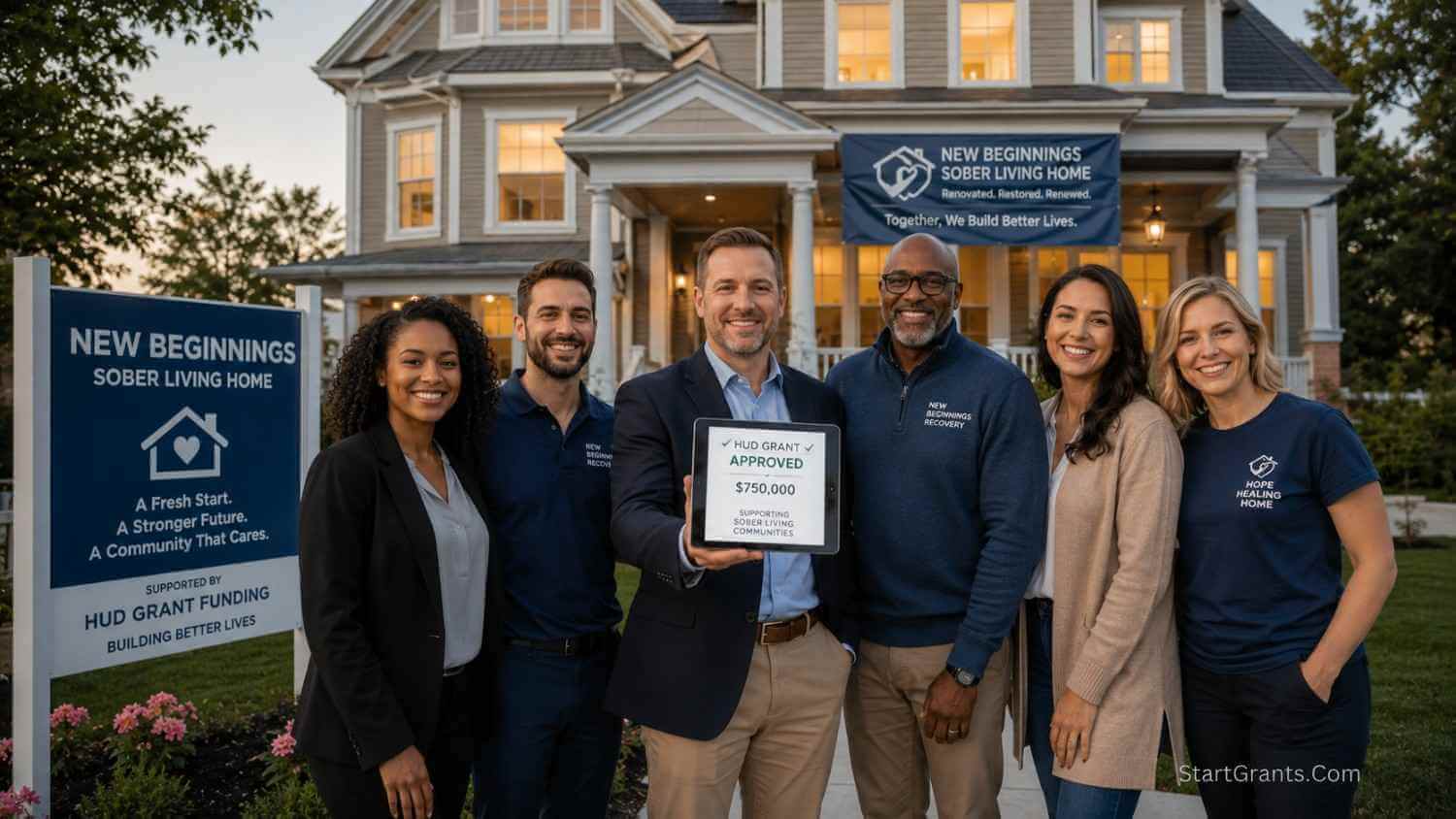
To combat the addiction crisis and prevent homelessness, federal agencies like HUD and SAMHSA provide massive block grants to 501(c)(3) organizations to purchase, renovate, and operate certified sober living homes.
Phase 1: The Federal Engines (SAMHSA & HUD)
The most common misconception regarding grants for sober living homes is that the government writes checks to individual patients to pay their monthly rent. This is false. Federal agencies do not fund individuals; they fund the 501(c)(3) non-profit organizations that build and operate these facilities.
To secure massive capital for your recovery residence, your non-profit must target the two federal titans of transitional housing:
1. SAMHSA Substance Abuse Block Grants (SABG)
The Substance Abuse and Mental Health Services Administration (SAMHSA) issues the SABG to all 50 states. States are mandated by federal law to use a significant portion of these funds to expand recovery support services, which directly includes subsidizing the operational costs of certified sober living homes.
2. HUD Continuum of Care (CoC) Program
Because individuals exiting rehab without a safe home are at an extreme risk of becoming unhoused, sober living homes fall directly under the jurisdiction of the Department of Housing and Urban Development (HUD). Through the Continuum of Care (CoC) program, HUD provides massive block grants to local municipal housing authorities to build and maintain transitional housing for vulnerable populations.
Phase 2: The Dual Diagnosis Synergy
If you want your grant proposal to score in the top 1% of federal reviews, you cannot pitch your sober living home as only a drug-free house. You must address “Co-Occurring Disorders” (Dual Diagnosis).
Over 50% of individuals battling severe addiction are simultaneously suffering from an underlying mental health crisis (such as severe PTSD, bipolar disorder, or severe depression). The government heavily prioritizes funding for facilities that offer integrated, dual-diagnosis support. To fully maximize your funding potential, you must combine your housing proposal with strategies found in our specialized guides:
Phase 3: The Bureaucratic Shield (NARR Certification)
Over the last decade, many predatory real estate investors actively researched how to profit from owning a halfway house. This resulted in a wave of fraudulent operators cramming vulnerable addicts into unsafe homes purely to harvest insurance money and maximize personal margins. In response to this unethical profiteering, federal and state grant committees established a strict bureaucratic firewall.
Today, the government will rarely issue a grant to an uncertified home. Before applying for federal funds, your facility must be certified by the National Alliance for Recovery Residences (NARR) or your state’s equivalent affiliate. NARR certification proves to grant reviewers that your home adheres strictly to national safety standards, ethical codes, and peer-support protocols, entirely separating legitimate non-profit recovery residences from for-profit halfway house schemes.
Pro-Tip: Decoding the SAMHSA Bureaucracy
Securing federal capital for a recovery residence means going head-to-head with the government’s complex grant application process. Before you submit a single document, you must know how to properly decode a Funding Opportunity Announcement (FOA). To master this bureaucratic maze and ensure your 501(c)(3) proposal isn’t rejected on a technicality, watch this official, step-by-step tutorial directly from the agency: SAMHSA Funding Opportunity Announcement Applicant Tutorial:
Phase 4: State Opioid Response (SOR) Grants
The Fentanyl and Opioid epidemic has triggered emergency legislative action. To combat unprecedented overdose rates, Congress established the State Opioid Response (SOR) Grant program.
This is a highly specialized pool of emergency capital distributed to state health departments. A core mandate of the SOR grant is to expand access to FDA-approved Medication-Assisted Treatment (MAT) and the recovery housing required to support these patients. If your sober living home explicitly accepts and supports patients utilizing MAT (such as Buprenorphine or Methadone) for opioid use disorder, you have direct access to this massive emergency funding pipeline.
Phase 5: The Muslim Perspective (Millati Islami, Riba, Gharar, & Zakat)
For the American Muslim community, acknowledging the addiction crisis requires breaking through layers of severe cultural stigma. Addiction does not discriminate, and it is silently ravaging segments of the Ummah. Establishing an Islamic sober living home is a profound theological duty, serving as a sanctuary to preserve human life and intellect (Hifz al-Nafs and Hifz al-Aql). However, structuring this facility requires strict adherence to Islamic financial jurisprudence (Shariah).
Breaking the Stigma: Millati Islami
A secular halfway house can be isolating for a recovering Muslim. They need an environment that supports their clinical recovery while simultaneously rehabilitating their spiritual connection to Allah. By structuring your sober living home around the principles of Millati Islami (an internationally recognized, 12-step Islamic recovery program that integrates the path of recovery with the path of Islam), your facility becomes a unique, spiritually empowering sanctuary.
The Trap of Commercial Mortgages (Riba)
Purchasing a large 6-bedroom residential property to convert into a sober living home requires hundreds of thousands of dollars. The standard Western advice is to secure a commercial real estate mortgage.
For a Muslim-led non-profit, intentionally entering a contract that requires the payment of compounding interest is explicitly Riba. Engaging in Riba is strictly Haram (forbidden) and entirely eradicates the Barakah (blessing) of the sanctuary you are trying to build. A Muslim board of directors must adamantly refuse these loans.
This elevates the pursuit of Government Grants (Hibah) from HUD and SAMHSA into a religious necessity. Because grants require no repayment, they are 100% Halal capital. If grant funding falls short, the organization must seek Qard Hasan (zero-interest loans) from the community or utilize Islamic Commercial Finance (such as a Musharaka joint venture) to secure the property ethically.
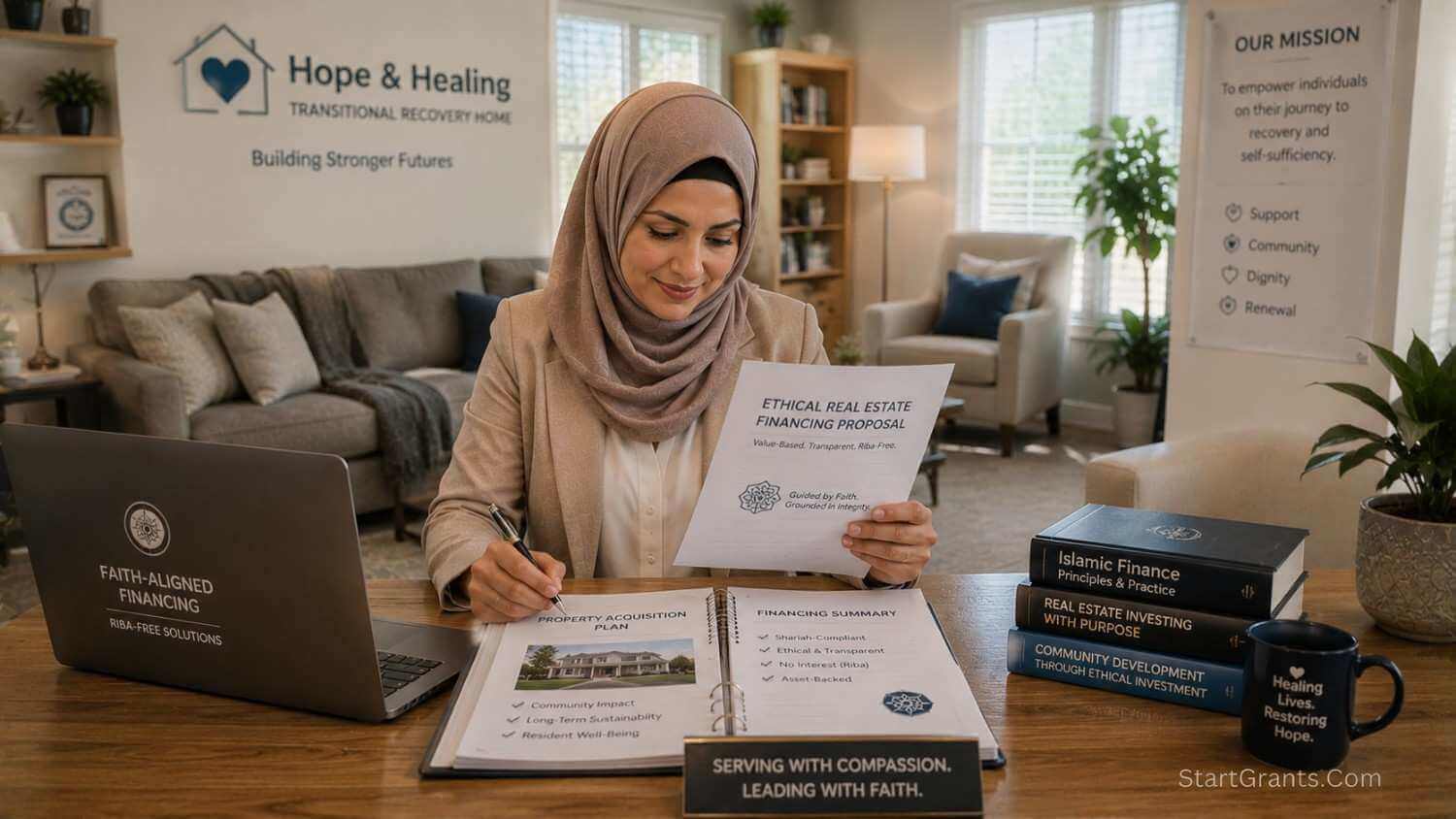
Establishing a Muslim-focused sober living environment requires strict ethical structuring. By utilizing Halal government grants (Hibah) instead of Riba-laced commercial mortgages, organizations can build pure, spiritually protected spaces for those undergoing Millati Islami recovery.
Gharar and High-Risk Liability Insurance
Operating a facility housing individuals in early recovery carries an astronomical risk profile. The government and your local municipality will legally mandate that the non-profit carries extensive Commercial General Liability and Professional Indemnity Insurance.
Traditional commercial insurance contains Gharar (excessive uncertainty) and elements of gambling. Ideally, Islamic organizations should utilize Takaful (Islamic cooperative B2B insurance). Because genuine commercial Takaful for high-risk recovery housing is practically non-existent in the U.S. market, contemporary Islamic scholars apply the principle of Dharurah (legal and operational necessity). This permits the Muslim board to purchase the required commercial policy to satisfy federal grant mandates and protect the community from catastrophic lawsuits, provided the intent is purely protection, not speculative profit.
Zakat vs. Sadaqah Jariyah (Accounting Purity)
A Muslim-led sober living home must be impeccably precise with its accounting regarding community donations.
If the community raises money to purchase the physical house, buy furniture, or pay the director’s salary, this money must be classified as Sadaqah Jariyah (continuous voluntary charity). The physical bricks of the building cannot receive Zakat.
However, if a recovering Muslim addict is bankrupt, estranged from their family, and facing immediate homelessness, they fall directly into the Zakat-eligible categories of Ibn al-Sabil (the stranded traveler) and Al-Gharimin (those overwhelmed by debt/hardship). The non-profit can legally and ethically use collected Zakat funds to explicitly subsidize or completely pay for that specific individual’s monthly bed-rent at the sober living home, ensuring they are not thrown back onto the streets.
Conclusion
Securing grants for sober living homes requires proving to the federal government that your facility is a highly structured, professional bulwark against homelessness and chronic relapse. By securing your NARR certification, embracing dual-diagnosis capabilities, and tapping into massive pipelines like the HUD CoC and SAMHSA SABG block grants, your non-profit can acquire the capital needed to provide a safe haven for those fighting for their lives.
For the Muslim community, establishing these homes is an urgent fulfillment of preserving human dignity. By fiercely rejecting the predatory trap of Riba-laced commercial mortgages, managing liability insurance ethically via Dharurah, and providing absolute accounting clarity between Zakat rent subsidies and Sadaqah operations, your Millati Islami recovery residence will serve as an unshakeable, divinely blessed fortress of healing.
Frequently Asked Questions (FAQs)
Q1: Does the government pay for individuals to live in a sober living home?
A: The federal government does not typically write a check directly to an individual to pay their rent. Instead, agencies like HUD and SAMHSA provide block grants to state and local governments, who then award sub-grants to 501(c)(3) non-profits. These non-profits use the funds to lower the cost of the beds or offer subsidized rent to eligible low-income residents in recovery.
Q2: What is NARR certification, and why is it important for grants?
A: The National Alliance for Recovery Residences (NARR) is the primary credentialing body for sober living homes in the U.S. They ensure a home meets strict national standards for safety, ethics, and peer support. Most state and federal grant committees will reject an application from an uncertified home to prevent funding fraudulent operations.
Q3: Can I get a grant to open a for-profit halfway house?
A: It is incredibly difficult. The vast majority of federal grants (especially HUD Continuum of Care and SAMHSA block grants) are legally restricted to officially registered 501(c)(3) non-profit organizations or local government entities. If you operate as a for-profit business, you will likely need to rely on SBA loans or private investment.
Q4: Why must an Islamic recovery home avoid a commercial mortgage?
A: Commercial mortgages require the borrower to pay back the principal amount plus a percentage of compounding interest over the life of the loan. In Islamic finance, intentionally engaging in a contract that stipulates the payment of interest is classified as Riba, which is strictly forbidden (Haram). Islamic organizations must rely on Halal grants (Hibah) or Islamic commercial finance.
Q5: Can an Islamic charity use Zakat to buy a house for sober living?
A: No. In Islamic jurisprudence, Zakat is a divine, obligatory tax restricted entirely to eight specific categories of human recipients (the Asnaf), such as the absolute poor and destitute. Zakat cannot be used to purchase physical real estate or pay for organizational overhead. The building itself must be funded through Sadaqah (voluntary charity) or grants, while Zakat can only be used to pay the actual rent for an eligible, destitute patient living inside it.
Disclaimer: The information provided in this article is for educational and informational purposes only. We are not a federal health agency, a real estate law firm, or a religious fatwa council. SAMHSA grant requirements, HUD Continuum of Care regulations, and NARR certification standards are subject to constant legislative changes. Always consult directly with your state’s Department of Behavioral Health for grant availability, a certified CPA regarding nonprofit Zakat accounting, and a qualified Islamic finance scholar regarding Halal institutional real estate structuring.


I am interested in a re-entry program for women being released from prison and the main reason why is because 66 percent of them can not read and with education and possibly some college would make our world and their lives a hold lot better I would love to do that because I know how it feels not to be able to read I just got my GED 8 years ago I was 50 years old