Last Updated: July 2026 | Author: Munir Ardi
Every year, residential and wildland fires in the United States claim thousands of lives and cause billions of dollars in catastrophic property damage. The brutal reality of emergency management is that fighting a fully engulfed structure fire is exponentially more expensive—and far more dangerous—than preventing it from starting in the first place.
To combat this ongoing crisis, the federal government and massive private foundations have shifted their strategic focus. Instead of solely funding fire engines and hoses, they are pouring hundreds of millions of dollars into proactive, community-based defense systems. Securing fire prevention grants is the ultimate mechanism for local fire departments, municipalities, and 501(c)(3) nonprofits to fund life-saving education, smoke alarm distribution, and arson investigation programs.
Before launching an institutional application for public safety funding, it is critical to understand the overarching federal architecture that funds first responders. Anchor your funding strategy by reviewing our master pillar: Medical Research and Institutional Grants.
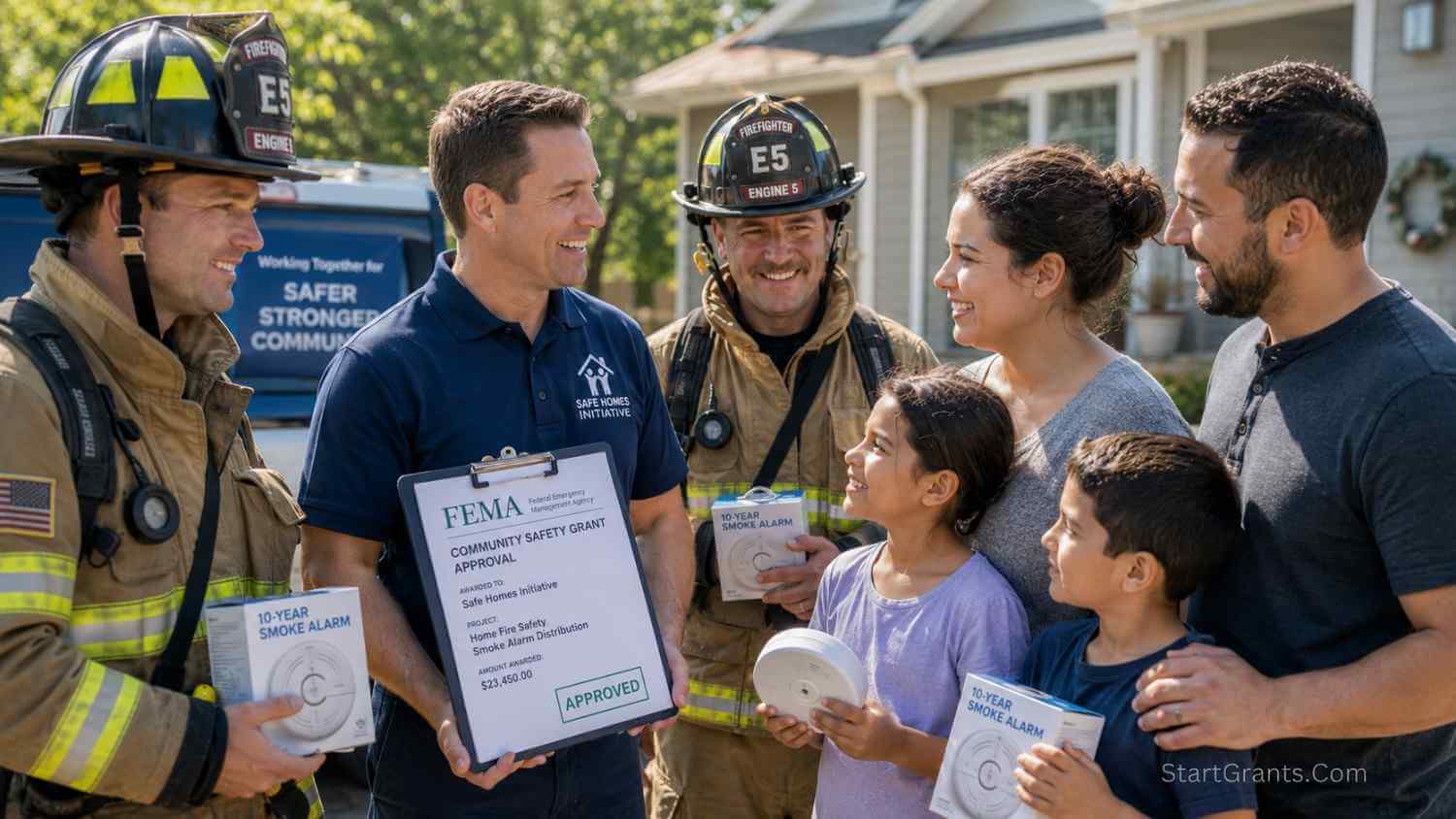
Preventing a fire is exponentially cheaper than fighting one. Through FEMA’s FP&S program and private foundation grants, fire departments and local non-profits can secure massive capital to fund life-saving community education and smoke alarm distribution.
Phase 1: The Federal Powerhouse (FEMA FP&S)
The undisputed titan of fire safety funding is the Federal Emergency Management Agency (FEMA). Under their Assistance to Firefighters Grant (AFG) umbrella, FEMA operates the highly specific Fire Prevention and Safety (FP&S) Grants program.
Unlike standard AFG grants that buy bunker gear or fire trucks, FP&S grants are strictly dedicated to keeping the public out of the hospital. These grants are exceptionally unique because they are not restricted to fire departments. National, state, and local 501(c)(3) organizations (such as community centers and safety coalitions) are fully eligible to apply.
FP&S funds are typically deployed to execute massive, city-wide smoke alarm installation campaigns in low-income neighborhoods, fund juvenile firesetter intervention programs, and conduct advanced research into firefighter occupational health (such as cancer prevention).
Pro-Tip: Writing the First Responder Proposal
Securing FEMA funding requires passing a grueling peer-review process conducted by veteran fire chiefs. If your proposal lacks clarity or ignores bureaucratic rules, it will be discarded instantly. To understand exactly how to structure a winning application for your department or non-profit, watch this essential tactical breakdown: 10 Steps for a Successful Fire Department Grant Application:
Phase 2: Corporate & Foundation Pipelines
Federal grants are powerful, but they operate on strict annual cycles. If your community faces an immediate hazard, you must target agile, private sector endowments that fund public safety initiatives year-round.
- FM Global Fire Prevention Grant: FM Global, one of the world’s largest commercial property insurers, understands that fire prevention directly protects their bottom line. They issue highly accessible grants to local fire departments and community organizations specifically to fund arson investigation equipment, fire prevention education materials, and pre-incident planning software.
- Firehouse Subs Public Safety Foundation: This incredibly lucrative corporate foundation acts as a rapid-response fund for hometown heroes. They consistently award grants to municipal departments to purchase life-saving gear, including thermal imaging cameras and public fire safety trailers.
Phase 3: Synergizing First Responder Capital
A smart municipal grant writer never limits their proposal to a single hazard. To maximize your funding, you must “braid” your fire prevention proposal with comprehensive medical and emergency response initiatives. When reviewing your community’s safety infrastructure, you must strategically target these overlapping public health silos:
- Cardiac Arrest Defense: Firefighters are often the first on the scene of a medical emergency. Funding fire prevention must be paired with funding the medical equipment on your apparatus. Secure these critical devices by reading our guides on AED Grants for Fire Departments and broader Automated External Defibrillator Grants for community centers.
- The Arson K9 Synergy: Investigating the cause of a fire is a critical component of prevention. Many departments utilize highly trained “accelerant detection dogs” (arson dogs) to find evidence of intentional fires. Fund this specialized tactical unit by exploring Police K9 Grants.
Phase 4: The Bureaucratic Shield (Data is King)
You cannot win a fire prevention grant by simply stating, “Fires are bad, and we want to stop them.” Grant committees demand mathematical proof of a community hazard.
Your proposal must act as an impenetrable bureaucratic shield forged out of hard data. If you are applying for a FEMA FP&S grant to distribute smoke alarms, you must cite data directly from the National Fire Incident Reporting System (NFIRS). You must prove statistically that the specific zip codes you intend to target have a disproportionately high rate of residential fires and a documented lack of working smoke alarms. If your application lacks NFIRS data, it will be instantly rejected by federal reviewers.
Phase 5: The Muslim Perspective (Hifz al-Nafs, Riba, Gharar, & Zakat)
For Islamic Centers, Masjids, and Muslim-led community organizations in the United States, maintaining strict fire safety protocols is not merely a legal building code requirement; it is a profound theological obligation. The preservation of life and property are central pillars of Islamic law. However, securing the massive capital required to retrofit public buildings with fire prevention systems requires navigating strict Shariah financial guidelines.
The Theology of Hifz al-Nafs and Mal
In Islamic jurisprudence (Maqasid ash-Shariah), the supreme objectives include Hifz al-Nafs (the preservation of life) and Hifz al-Mal (the preservation of wealth/property). A Masjid board that neglects to install proper smoke alarms, emergency exits, or commercial sprinkler systems is actively violating its divine mandate to protect the congregation. Utilizing fire prevention grants to fortify an Islamic center is considered an act of profound worship and community defense.
The Riba Trap in Fire Sprinkler Systems
Retrofitting an older building with a commercial-grade fire sprinkler system or a hardwired fire alarm network can easily cost $50,000 to $100,000. When cash reserves are low, secular institutions routinely take out commercial bank loans or lines of credit to float the construction costs, paying compounding interest in the process.
For a Muslim-led organization, intentionally paying this interest is explicitly Riba, which is strictly Haram (forbidden) and entirely strips the Barakah (blessing) from the institution. A Muslim board of directors must adamantly refuse these loans.
This reality makes securing Government Grants (Hibah) an absolute religious necessity. Because grants require no repayment, they are 100% Halal capital. If grant money is unavailable or delayed, the organization must rely on internal cash reserves or seek Qard Hasan (zero-interest benevolent loans) from wealthy community members, ensuring the facility is protected without compromising its spiritual integrity.

Protecting a community center is a divine obligation (Hifz al-Nafs). By utilizing Halal government grants (Hibah) instead of Riba-bearing commercial loans, Muslim boards can install critical fire safety infrastructure while maintaining absolute spiritual purity.
Gharar and Fire Insurance Mandates
If an Islamic center receives a massive federal grant, or simply to operate legally within a municipality, the organization is mandated to carry comprehensive Commercial Fire and Hazard Insurance. Traditional commercial insurance is structurally problematic in Islam due to Gharar (excessive uncertainty) and gambling elements.
Ideally, Muslim institutions should utilize Takaful (Islamic cooperative property insurance). Because authentic commercial Takaful for massive public buildings is practically non-existent in the U.S. market, contemporary Islamic scholars universally apply the principle of Dharurah (legal and operational necessity). This permits the Masjid to purchase the heavily mandated commercial fire policies to protect the community’s assets from catastrophic ruin and satisfy state laws, provided the intent is purely protection, not speculative profit.
Zakat vs. Sadaqah Jariyah (The Smoke Alarm Dilemma)
When an Islamic community launches a fire prevention initiative, a massive theological error frequently occurs regarding the misuse of Zakat funds. A Muslim board must be impeccably precise with its accounting:
- Sadaqah Jariyah (Fixed Assets): If the Masjid is raising money to install a commercial sprinkler system or a hardwired fire alarm inside the actual Mosque building, this is a fixed asset for general public use. Zakat cannot be used for this. The physical infrastructure of the Masjid must be funded through government grants (Hibah) or Sadaqah Jariyah (continuous voluntary charity).
- Zakat (Specific Recipients): However, what if the Masjid receives a grant to distribute free residential smoke alarms to the surrounding neighborhood? If the Masjid specifically targets impoverished, low-income families who cannot afford basic life safety equipment, those families qualify as Al-Fuqara (the poor) or Al-Masakin (the needy). It is entirely Halal to utilize community Zakat funds to purchase and install smoke alarms explicitly for these destitute families, protecting their lives and fulfilling the divine obligation.
Conclusion
Securing fire prevention grants requires transitioning from a reactive mindset to a highly proactive, data-driven strategy. By leveraging NFIRS data to prove community hazards, aggressive first responders and 501(c)(3) nonprofits can unlock massive capital from FEMA’s FP&S program and corporate endowments like FM Global to fund critical safety education and life-saving equipment.
For the Muslim community, fortifying public buildings against fire is the ultimate manifestation of Hifz al-Nafs and Hifz al-Mal. By fiercely rejecting the predatory trap of Riba-laced commercial loans in favor of Halal government Hibah, carefully navigating insurance mandates via Dharurah, and strictly separating Zakat from Sadaqah Jariyah in safety campaigns, your organization becomes a fortress of physical protection and uncompromising spiritual Barakah.
Frequently Asked Questions (FAQs)
Q1: Who is eligible to apply for FEMA Fire Prevention and Safety (FP&S) grants?
A: Unlike many federal fire grants, FP&S grants are incredibly broad in their eligibility. Fire departments, national, regional, state, and local recognized organizations (including 501(c)(3) nonprofits) that are focused on preventing injuries and saving lives are eligible to apply.
Q2: Will a fire prevention grant pay to renovate my fire station?
A: No. The FP&S grant is strictly for activities that proactively prevent fire, such as community education, arson investigation, smoke alarm installation, and firefighter occupational health research. For station renovations or buying fire engines, departments must apply for standard Assistance to Firefighters Grants (AFG).
Q3: What is NFIRS, and why do I need it for my grant proposal?
A: The National Fire Incident Reporting System (NFIRS) is a database of fire incidents tracked by the U.S. Fire Administration. Grant reviewers rely on NFIRS data to verify that your community actually has a statistically high risk of fire. If your proposal lacks hard data proving the hazard, it will likely be rejected.
Q4: Why is it Haram for an Islamic Center to use a bank loan to buy fire alarms?
A: Commercial bank loans require the borrowing organization to pay back the principal amount plus a percentage of compounding interest over time. In Islamic finance, intentionally entering a contract that stipulates the payment of interest is classified as Riba, which is strictly forbidden (Haram), even if the loan is used for noble life-safety purposes.
Q5: Can we use Zakat money to install a fire sprinkler system in the Masjid?
A: No. In Islamic jurisprudence, Zakat is a divine, obligatory tax strictly restricted to specific human recipients (the Asnaf), primarily the absolute poor. Zakat cannot be used to purchase physical infrastructure or fixed assets for an organization (like sprinkler pipes or building renovations). Those capital expenses must be paid using Sadaqah Jariyah (continuous voluntary charity) or government grants.
Disclaimer: The information provided in this article is for educational and informational purposes only. We are not a federal agency, an emergency management department, or a religious fatwa council. FEMA FP&S grant requirements, NFIRS data mandates, and state building codes are subject to constant legislative changes. Always consult directly with the U.S. Fire Administration for grant availability, a certified CPA regarding nonprofit Zakat accounting, and a qualified Islamic finance scholar regarding Halal institutional structuring, avoiding Riba, and commercial insurance mandates via Dharurah.