
Last Updated: | Author: Munir Ardi
To apply for federal disaster relief, first confirm that FEMA Individual Assistance is authorized for your location, file applicable insurance claims, and submit one household application through an official FEMA channel before the disaster-specific deadline. FEMA assistance is not an automatic payment for every loss and does not fully restore every home.
After a flood, wildfire, tornado, hurricane, or other disaster, safety, shelter, medical care, and preventing further harm come first. For individuals and families, the main federal program is FEMA’s Individuals and Households Program (IHP). It may help with uninsured or underinsured necessary expenses and serious needs when a presidential declaration authorizes Individual Assistance for your location. This guide explains the application, documentation, inspection, insurance, appeal, and recovery sequence. For repair assistance unrelated to a declared disaster, use our complete home improvement grants guide.
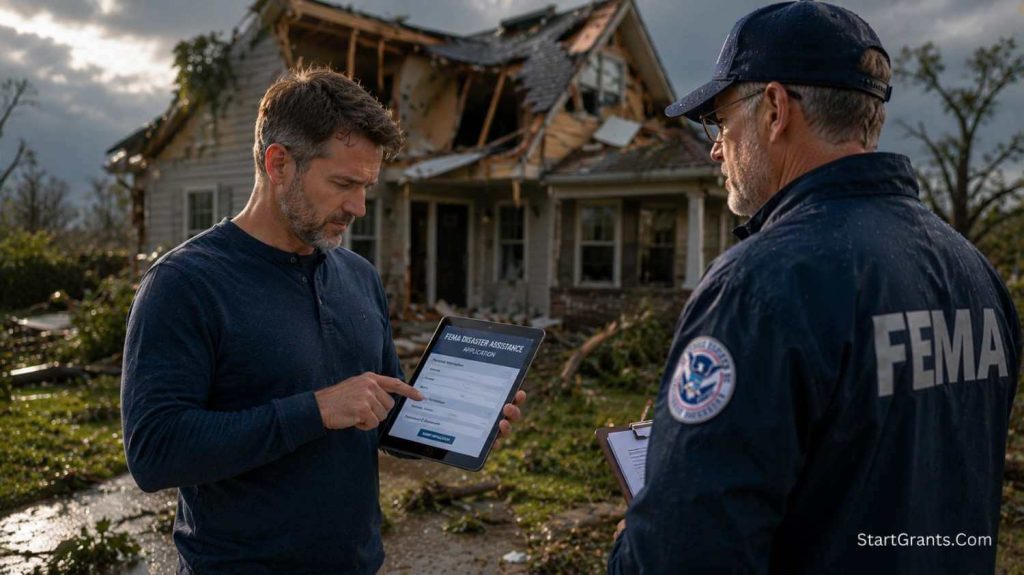
1. Confirm That FEMA Individual Assistance Is Available
A presidential disaster declaration does not automatically make every affected resident eligible for FEMA money. The declaration must authorize Individual Assistance for the specific area where your disaster-damaged primary residence is located. Some declarations authorize only Public Assistance for governments and certain nonprofits.
Check FEMA’s official disaster declarations, open the relevant disaster page, and review the designated areas and available assistance. If your area is added later, the disaster page will be updated.
FEMA applications are generally accepted for 60 days after a declaration, but an extension or a different published closing date may apply. A late application may sometimes be considered when FEMA accepts it and you explain the reason for the delay. Do not rely on the general rule—use the exact deadline on the disaster page or confirm it with FEMA.
If FEMA Individual Assistance is not authorized, you may still have options through insurance, state or local emergency management, nonprofits, community groups, or an SBA disaster declaration. Call 211 where available and check your state emergency management website. Assistance offered outside FEMA has its own rules and is not guaranteed.
2. Understand What FEMA IHP Can—and Cannot—Pay
FEMA IHP is a safety-net program for eligible disaster-caused needs that insurance or another source does not cover. It is not compensation for every loss, and it is not designed to return a home to its exact pre-disaster condition. Eligibility and the award depend on the declaration, household circumstances, insurance, ownership or occupancy verification, documentation, and FEMA’s assessment of the eligible need.
| Possible assistance | What to know |
|---|---|
| Temporary housing | May include lodging reimbursement, rental assistance, or another temporary housing option when the primary home is uninhabitable. |
| Home repair or replacement | Generally for eligible owner-occupants and essential work needed to make the primary home safe, sanitary, and functional—not upgrades or full restoration. |
| Other Needs Assistance | May address eligible personal property, transportation, medical, dental, funeral, childcare, moving, storage, cleaning, or other serious needs. |
| Immediate-needs assistance | Some disasters include assistance for urgent needs or short-term displacement. Availability and eligibility are disaster-specific. |
For disasters declared during federal fiscal year 2026, the published maximum is $44,800 for qualifying financial Housing Assistance and separately $44,800 for Other Needs Assistance, as summarized in current official state emergency-management guidance. This is a statutory ceiling, not a standard check or a target award. Most applicants receive based on verified eligible needs and may receive much less. Rental assistance, lodging reimbursement, and certain accessibility-related expenses may be treated differently from capped assistance. Review FEMA’s current housing and other-needs guidance for the categories available in your disaster.
3. Apply for FEMA Disaster Assistance Step by Step
Step 1: Address immediate safety and insurance
Follow evacuation orders and do not enter a damaged structure until local authorities say it is safe. Contact your homeowners, renters, auto, or flood insurer promptly. FEMA can consider eligible needs not covered by insurance, but it cannot pay the same expense twice.
Step 2: Gather the application information
FEMA may ask for:
- Your Social Security number and identity information;
- The address of the damaged primary residence and a current mailing address;
- A telephone number and email address;
- A general description of the damage and losses;
- Insurance information;
- The names of household occupants; and
- Bank routing and account numbers if you choose direct deposit.
You do not need to wait for a final insurance settlement before starting the FEMA application. Follow up with the insurance decision, settlement, or denial documents when FEMA requests them.
Step 3: Submit one household application
Apply through DisasterAssistance.gov, the FEMA App, by calling 1-800-621-3362, or at a Disaster Recovery Center. If you use a relay service, give FEMA the number for that service. Language assistance and reasonable accommodations are available.
The application is free. Ordinarily, members of the same pre-disaster household should not submit competing applications for the same address and losses. If the living arrangement was unusual—such as roommates with separate finances, a split household, or displacement to different locations—explain it to FEMA rather than guessing.
Step 4: Save the FEMA application number
Record the nine-digit FEMA application number and the disaster number. Use the application number on documents you send. Update FEMA if your phone, address, household situation, or insurance information changes.
Step 5: Upload supporting documents
Depending on the requested assistance, FEMA may need proof of identity, occupancy, ownership, insurance, disaster-caused expenses, or another fact. Examples include a lease, utility bill, deed, mortgage statement, insurance settlement, contractor estimate, receipts, or a written statement when standard documents are unavailable. Use the document list in your FEMA account or letter; do not send sensitive information to an unverified email address.
4. Document Damage Without Putting Yourself at Risk
Take clear photos or video before disposal or repairs when it is safe to do so. Record the room, item, approximate age, and damage. Keep receipts for emergency lodging, cleanup supplies, temporary repairs, transportation, childcare, medical care, and other disaster-caused costs. Make only the repairs needed to prevent further damage before an inspection, unless safety or local authorities require more.
After flooding, act quickly but safely. Mold can begin growing on wet materials within roughly 24 to 48 hours. Not every dark-colored mold is “toxic black mold,” and color alone does not establish the health risk or species. Use protective equipment, follow public-health guidance, and hire qualified help for large contamination, sewage, structural hazards, or vulnerable occupants. FEMA may consider eligible, disaster-caused mold cleanup when it is needed to make an owner-occupied home habitable. For other possible assistance routes, read Government Help for Homeowners With Mold.
5. What Happens During a FEMA Home Inspection?
FEMA may determine that an inspection is needed. It may be in person or, in some circumstances, remote. The inspection is free. The inspector documents disaster-related conditions but does not make the final eligibility or award decision.
A legitimate FEMA inspector will have official photo identification and will already have your FEMA application number. FEMA states that an inspector will not ask you to provide that number. Inspectors do not charge a fee, recommend contractors, or ask for bank information. If someone demands payment or pressures you to sign a repair contract, stop and verify the contact through the FEMA Helpline.
When possible, have your photo ID, proof that you owned or occupied the home, insurance information, damage list, and relevant receipts ready. Point out hidden but accessible damage and accessibility needs; do not enter unsafe areas to prove a loss.
6. Insurance and Duplication of Benefits
File applicable insurance claims and give FEMA the insurer’s decision. FEMA may help with a different eligible need, a deductible-related unmet need, or an amount insurance did not cover, but it cannot duplicate a payment for the same purpose.
Duplication can involve insurance, FEMA, SBA, HUD-funded programs, state or local grants, nonprofits, crowdfunding designated for a particular repair, or another source. When a second program asks what you have received, disclose it accurately. Receiving more than one form of assistance is not automatically wrong; using two payments for the same eligible cost can create a duplicate benefit.
FEMA grants generally do not have to be repaid when correctly awarded and used for the approved purpose. FEMA may recover money that was duplicated, misused, obtained through false information, or paid in error. Keep award letters, estimates, invoices, proof of payment, and receipts for at least three years—or longer if the applicable program tells you to.
7. SBA Disaster Loans: Current Rules, Costs, and Choice
The Small Business Administration offers disaster loans to homeowners and renters as well as businesses. These are loans, not grants. Current program limits allow eligible homeowners to apply for up to $500,000 for a primary residence and homeowners or renters to apply for up to $100,000 for personal property. Insurance and other recoveries can reduce the eligible loan amount.
For applicants who cannot obtain credit elsewhere, the fixed rate will not exceed 4%; the rate for a particular disaster may be lower. The first payment is generally deferred for 12 months, and interest does not accrue during that initial 12-month period. Terms can extend up to 30 years, depending on the applicant and disaster. Read the promissory note because the offered rate, payment, collateral, and other terms matter.
You are not required to accept an approved SBA loan. However, choosing not to borrow does not convert the same loss into a FEMA grant, and FEMA assistance may still be limited. Compare the written loan terms, insurance, FEMA award, household budget, and other recovery resources before deciding. Current limits and terms are published at SBA Disaster Recovery.
8. If FEMA Says You Are Ineligible or Awards Too Little
Read the entire decision letter before assuming the application is finally denied. The letter may identify missing documentation, an insurance issue, inability to verify ownership or occupancy, damage FEMA did not connect to the disaster, or a substantive eligibility decision.
You generally have 60 days from the date on the decision letter to appeal. Submit documents that directly address the stated reason—for example, an insurance settlement, proof of occupancy, a contractor’s estimate, repair invoices, or ownership records. Under FEMA’s post-2024 process, a signed narrative appeal letter is not always required when adequate supporting documents are submitted; FEMA also provides an optional appeal request form. Follow the instructions in your letter.
Appeals may be submitted through a DisasterAssistance.gov account, at a Disaster Recovery Center, or by the mail or fax listed by FEMA. Keep proof of submission. FEMA advises that a response to an appeal may take up to 90 days. See FEMA’s current appeal guidance.
9. Filling the Gaps After FEMA
Recovery programs should be layered by unmet purpose, not stacked to pay the same bill twice. Ask each program what it covers and how it coordinates with prior assistance.
- HUD CDBG-DR: Congress may appropriate long-term recovery funds, which HUD allocates to eligible states, local governments, or tribes. Households apply through the locally designed program—not directly to HUD—and funding may arrive well after immediate FEMA aid. Availability, geography, income rules, priorities, and duplication reviews vary. See HUD Home Improvement Assistance.
- Rural housing repair: An eligible very-low-income homeowner in a qualifying rural area may separately investigate USDA Section 504 repair loans or, for homeowners age 62 or older, grants to remove health and safety hazards. It is not automatic disaster compensation and cannot duplicate another payment. Start with USDA Rural Development Home Repair Assistance.
- Older homeowners: Area Agencies on Aging, local housing departments, weatherization providers, or accessibility programs may address remaining eligible work. Compare options in Home Improvement Help for Older Homeowners.
- Mitigation: FEMA hazard-mitigation grants are commonly administered through state, tribal, or local governments rather than paid directly to every homeowner. SBA may allow an eligible physical-disaster loan increase of up to 20% of verified damage for approved mitigation. For safe-room pathways and limits, see FEMA Storm Shelter and Safe-Room Funding.
- Special environmental hazards: A leaking heating-oil tank requires prompt reporting and qualified cleanup under state rules. New Jersey residents dealing with a qualifying tank problem can review New Jersey Oil Tank Removal Assistance, but a grant is not guaranteed and prior disaster payments must be disclosed.
10. Muslim Perspective: Ethical and Practical Disaster Recovery
Muslim families do not need a separate FEMA application. FEMA-funded assistance must be provided without religious discrimination, and faith is not an eligibility test. A family may request language help, reasonable accommodation, or an accessible application method just like any other applicant.
Islamic practice can still shape how a household evaluates funding and manages the recovery process:
Protect life and prevent further harm first
Evacuation, safe shelter, medication, emergency medical care, and preventing additional property damage should not be delayed while debating financial terminology. Follow lawful safety orders and use qualified professionals for electricity, gas, structural damage, sewage, mold, and hazardous materials.
Treat FEMA assistance as conditional public aid
A FEMA award is not a commercial loan and ordinarily has no interest or repayment schedule. However, it is not an unrestricted gift: the applicant must be truthful, disclose insurance and other assistance, and use the money for the approved disaster need. FEMA may seek repayment for duplication, misuse, fraud, or error. Families who want a religious classification such as hibah should show the actual award letter and conditions to a qualified scholar rather than relying on a label in an article.
Review SBA loan terms before making a riba-related decision
SBA disaster loans charge interest after the initial interest-free accrual period. Muslims concerned about riba should obtain the written offer, identify the rate and obligations, and consult a qualified scholar familiar with U.S. housing and disaster finance. The loan is optional, and the post-March 22, 2024 FEMA process no longer generally requires an SBA application for the forms of assistance affected by the reform. Do not submit a loan application hoping to manipulate a denial, and do not misstate income or debts.
Ask about zakat, sadaqah, and qard hasan without assuming eligibility
A local mosque or charitable caseworker may assess whether a household qualifies for zakat or another fund based on its current finances and the organization’s religious policy. Disaster damage alone does not guarantee a particular zakat category or a cash award. Ask whether assistance is a grant, restricted payment, vendor payment, or interest-free loan, and whether it must be disclosed to FEMA or another program.
ICNA Relief and Islamic Relief USA report domestic disaster-response work. Services depend on the event, location, available funds, and assessment; neither organization should be presented as guaranteed home-rebuilding money. Local mosques, 211, and state or local Voluntary Organizations Active in Disaster may also identify active resources.
Handle insurance and flood requirements case by case
Some federally assisted flood-damaged properties in a Special Flood Hazard Area must obtain and maintain flood insurance to remain eligible for future federal disaster assistance. The requirement can attach to the property. Mortgage and program rules may create additional obligations. Because Islamic opinions about conventional insurance and necessity can differ, consult both a knowledgeable scholar and an insurance or legal professional; do not cancel required coverage based only on general internet advice.
Prevent duplication and preserve trust
Keep one recovery ledger listing insurance, FEMA, SBA proceeds, mosque or charity aid, crowdfunding, and vendor payments. Record the purpose of each payment and keep receipts. Honest disclosure protects the family from recoupment and helps scarce charitable funds reach other survivors.

Frequently Asked Questions
How do I know whether I can apply for FEMA disaster assistance?
Check the FEMA disaster declaration page to confirm that Individual Assistance is authorized for your specific area. Then verify the application deadline. A presidential declaration that provides only Public Assistance does not open household applications.
How much can a household receive from FEMA in 2026?
For disasters declared during federal fiscal year 2026, the published cap is $44,800 for qualifying financial Housing Assistance and separately $44,800 for Other Needs Assistance. These are ceilings, not standard awards. Eligibility and payment depend on verified disaster-caused needs, insurance, documentation, and the rules for each assistance category.
Do FEMA disaster grants have to be repaid?
Ordinarily, correctly awarded FEMA assistance used for its approved purpose does not have to be repaid. FEMA may recover funds that duplicate another benefit, were misused, were obtained through false information, or were paid in error.
Must I apply for an SBA loan before FEMA will consider a grant?
Not as a blanket rule for disasters declared on or after March 22, 2024. FEMA removed the SBA application prerequisite for certain forms of assistance. Older disasters may follow earlier rules, so use the instructions for the specific declaration and decision letter.
Can I receive FEMA assistance if I have insurance?
Possibly. FEMA cannot duplicate insurance, but it may consider an eligible need that is uninsured or underinsured. Apply on time, file the insurance claim, and send FEMA the settlement, denial, or other requested documentation.
What should I do if FEMA says I am ineligible?
Read the reason in the decision letter and provide documents that address it. An appeal generally must be submitted within 60 days of the letter date. A narrative appeal letter is not always required under the current process, but supporting evidence and the instructions in the letter are essential.
Does FEMA pay for mold after a flood?
FEMA may consider disaster-caused mold cleanup for an eligible homeowner when it is needed to make the primary home habitable and insurance does not cover the same need. Take safe steps to dry the property quickly, document the damage, and follow public-health guidance.
Can a Muslim family use FEMA assistance or seek Islamic charity?
FEMA assistance is available without religious discrimination and is not an interest-bearing loan, but it has eligibility and use conditions. Islamic charity may also be available after an individual assessment; disaster exposure alone does not guarantee zakat or a payment. Families with religious questions should review the actual terms with a qualified scholar.