
Last Updated: May 2026 | Author: Zee
For seniors living on a fixed pension or Social Security income, the prospect of leaving behind crippling debt to their grieving children is a profound source of anxiety. With the national average cost of a traditional burial easily exceeding $8,000 to $10,000, end-of-life expenses represent one of the largest financial shocks a working-class family can endure.
While exploring general financial assistance for funeral expenses through government grants or localized charities is a necessary emergency step when a death occurs suddenly, the most responsible and dignified strategy is proactive planning. This is exactly where specialized final expense insurance, commonly referred to as a Funeral Advantage program, steps in.
Unlike traditional life insurance, which is designed to replace decades of lost income and build generational wealth, a Funeral Advantage program is a highly targeted micro-policy. It is engineered specifically for older adults who want to guarantee that their cremation or burial costs are covered in full, ensuring their loved ones can mourn without the burden of financial toxicity.
This comprehensive guide will break down exactly how the Funeral Advantage program assists seniors you cannot miss, how it bypasses strict medical exams, and how it protects grieving families from predatory funeral home pricing.

Proactive planning provides peace of mind. A specialized Funeral Advantage program assists seniors on a fixed income by securing funds for end-of-life expenses without needing a medical exam.
Phase 1: The Core Mechanics of Funeral Advantage
To understand why this program is uniquely suited for seniors, you must understand what it is legally built to do. A Funeral Advantage program is fundamentally a specialized whole life insurance policy, often referred to as “burial insurance” or “final expense insurance.”
How the Policy Operates
- Targeted Death Benefit: Instead of offering a massive $500,000 payout, these policies typically offer smaller, highly targeted face values ranging from $5,000 to $25,000. This is specifically calculated to cover the exact cost of a funeral, cemetery plot, and immediate outstanding medical bills.
- Fixed Premiums for Life: For seniors on a strict, fixed income, budget certainty is critical. Legitimate final expense policies operate on a “whole life” structure. This means that once your rate is locked in, the monthly premium will never increase, and the coverage will never be canceled as long as the premiums are paid, regardless of your advancing age.
- Consumer Protection: Because insurance is highly regulated, we strongly recommend that seniors verify any insurance provider through the National Association of Insurance Commissioners (NAIC) to ensure the company offering the Funeral Advantage program is legally licensed to operate in their specific state.
To understand how specialized final expense insurance operates and why it is uniquely structured for older adults, watch this clear, educational breakdown. It explains the fundamental differences between traditional life insurance and policies designed strictly for burial costs:
Phase 2: Bypassing the Medical Exam (Simplified and Guaranteed Issue)
The primary reason most seniors abandon the idea of getting life insurance is the fear of the medical exam. Traditional policies require blood tests, urine samples, and an extensive review of your medical history. If you are a senior with high blood pressure, diabetes, or a history of illness, a traditional policy will either flatly deny you or charge astronomical premiums.
Funeral Advantage programs are deliberately designed to remove this barrier entirely.
Simplified Issue Policies
Most seniors will qualify for a “Simplified Issue” policy. This means there is absolutely no medical exam, no needles, and no doctor’s visit required. The application merely consists of a short health questionnaire (usually a few “yes or no” questions regarding major terminal illnesses or recent hospitalizations). If approved, the policy usually provides first-day coverage, meaning the full death benefit is available immediately.
Guaranteed Issue Policies
If a senior has severe, pre-existing health conditions that disqualify them even from a Simplified Issue policy, the final safety net is a “Guaranteed Issue” policy.
- No Health Questions Asked: As the name implies, approval is 100% guaranteed for applicants within a specific age bracket (typically ages 50 to 85). You cannot be denied coverage due to your health status.
- The Graded Benefit Clause: The trade-off for guaranteed approval is a “graded benefit” period. This means if the policyholder passes away from natural causes within the first two years of the policy, the beneficiary will not receive the full payout; instead, they will receive a full refund of all premiums paid plus a predetermined interest rate (usually around 10%).
- Strategic Planning: This is a vital tool for older adults diagnosed with serious illnesses. If a senior is navigating severe medical debt, we highly advise cross-referencing this insurance strategy with our guide on places to get help with funeral costs for cancer patients to ensure all financial avenues are secured.
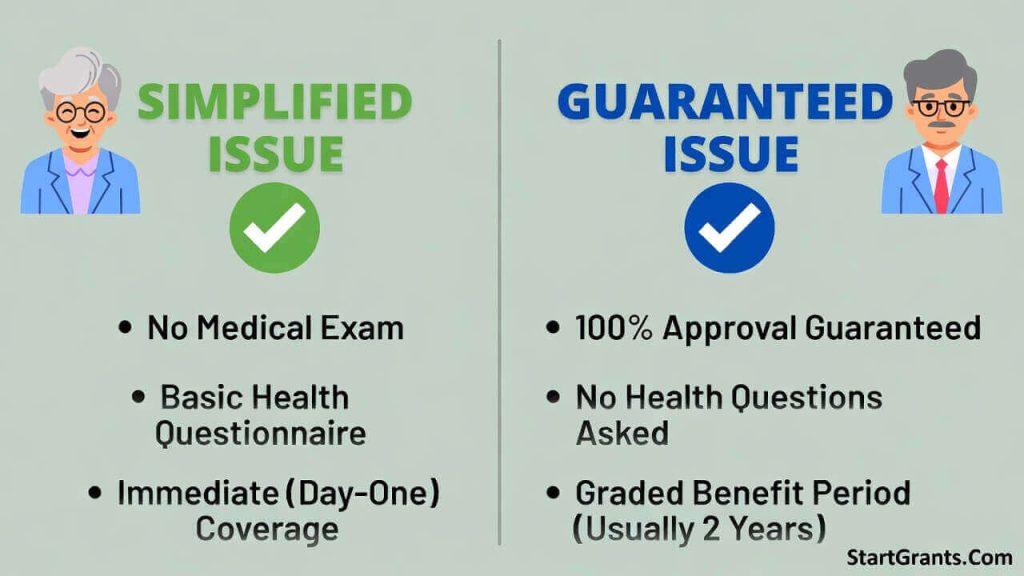
Understanding your options: Most seniors qualify for Simplified Issue (with basic health questions) for immediate coverage. Guaranteed Issue accepts everyone regardless of health but has a graded benefit period.
Phase 3: Beyond the Cash Payout (Family Support Services)
A standard life insurance policy simply mails a check to the beneficiary weeks after the death certificate is processed. However, when a senior passes away, the surviving family needs immediate logistical help within the first 24 to 48 hours to secure a funeral home and negotiate prices.
This is where a true Funeral Advantage program distinguishes itself from generic final expense insurance.
The Role of the Family Support Advocate
The most valuable component of a Funeral Advantage program is often the inclusion of a free membership to a family support service or consumer protection group.
- Immediate Intervention: Upon the passing of the policyholder, the grieving family immediately contacts the support program via a 24/7 hotline.
- Price Shopping and Negotiation: Instead of an emotionally exhausted son or daughter trying to negotiate with a funeral director, a trained advocate from the program takes over. Empowered by the 2026 FTC Funeral Rule updates requiring online pricing transparency, the advocate will actively compare General Price Lists (GPL) to ensure the family is not overcharged or pressured into buying unnecessary upgrades (like expensive sealed caskets or mandatory embalming).
- Consumer Empowerment: By utilizing independent advocates, families are shielded from predatory sales tactics. We highly recommend exploring the resources provided by the Funeral Consumers Alliance (FCA), a national non-profit dedicated to protecting a grieving family’s right to choose a meaningful, affordable farewell without being financially exploited.
By pairing a guaranteed cash benefit with active logistical negotiation, the Funeral Advantage program ensures that every dollar of the payout is maximized.

True Funeral Advantage programs go beyond a cash payout. A dedicated advocate supports your family by price shopping and negotiating directly with funeral homes to prevent overcharging.
Phase 4: What if a Senior Cannot Afford the Monthly Premiums?
While final expense insurance is specifically designed to be affordable for older adults, the reality is that some seniors live strictly on a meager Social Security check. Even a $40 to $75 monthly premium might mean choosing between life-saving medication or funeral insurance.
If a Funeral Advantage program is simply out of the financial question, seniors and their families must pivot to alternative safety nets.
1. The Medicaid Spend-Down (Irrevocable Funeral Trusts)
If an elderly parent is moving into a nursing home and needs to qualify for government assistance, having too much cash in a savings account will disqualify them. Under federal Medicaid regulations, seniors are legally allowed to “spend down” their assets by purchasing an Irrevocable Funeral Trust or a pre-paid funeral contract. This safely legally shelters the money specifically for their burial, allowing them to qualify for Medicaid without losing their funeral funds to the nursing home.
2. County Indigent Burial Programs
If the senior has absolutely zero assets and cannot afford any insurance premiums, the surviving family will need to rely on the local government. Every county has a protocol for residents who die in absolute destitution. To understand exactly how to trigger this safety net and what rights the family must surrender, you must read our comprehensive guide on navigating funeral expenses for the poor.
3. Relying on Local and National Charities
If the county program is unacceptable to the family, the final alternative is to seek emergency hardship grants immediately following the death. While this is highly stressful and not guaranteed, numerous 501(c)(3) organizations exist to help. We strongly encourage families to bookmark our master list of charities that help with funeral costs, which details how to apply for funds from the Salvation Army, Catholic Charities, and specialized memorial foundations.
Phase 5: The Application Protocol and Consumer Protections
Before a senior signs any final expense or Funeral Advantage policy, it is critical to understand the fine print. Predatory insurance sales tactics do exist, and protecting your fixed income requires absolute vigilance.
1. Understanding the Graded Benefit Period
Always ask the insurance agent: “Is this policy Day-One Coverage or Graded Benefit?” If you are placed in a Guaranteed Issue policy because of severe health issues, you must survive the first two years (the graded period) for the policy to pay the full death benefit. If you pass away in month 18 from natural causes, your family will only receive a refund of your premiums plus interest. Do not let an agent sell you a graded policy if you are healthy enough to qualify for immediate coverage under a Simplified Issue plan.
2. Never Make the Funeral Home the Beneficiary
When setting up the policy, name a trusted adult child or family member as the primary beneficiary—never the funeral home itself. If the funeral home is the beneficiary, they have little incentive to negotiate prices. The beneficiary should receive the cash payout and then use the Federal Trade Commission (FTC) Funeral Rule to legally demand an itemized General Price List (GPL), decline unnecessary embalming, and shop around for the most affordable services.
Securing the insurance payout is only half the battle; ensuring your family is not exploited by predatory pricing is the other. Watch this crucial consumer protection tutorial from a licensed funeral director explaining exactly what your 10 federal rights are under the FTC Funeral Rule:
Conclusion: Securing Your Legacy and Protecting Your Family
For older adults living on a fixed pension or Social Security, leaving a financial mess for grieving children is a heavy burden to carry. However, the Funeral Advantage program provides a dignified, highly accessible solution. By bypassing strict medical exams through Simplified or Guaranteed Issue policies, seniors can lock in a fixed, affordable monthly premium that guarantees a tax-free cash payout upon their passing.
When paired with aggressive family support services that negotiate directly with funeral directors, this specialized insurance ensures your family is not exploited during their most vulnerable hours. If you are a senior veteran, we also highly recommend cross-referencing your strategy with our guide on The American Red Cross funeral help for military members and their families to ensure you are maximizing your VA burial allowances alongside your private policy.
Do not leave your grieving family with a financial crisis they cannot navigate. Audit your current savings, compare Simplified Issue policies today, and lock in your rate while you are still healthy enough to protect your legacy. Ultimately, proactive planning is the greatest gift a senior can leave behind. Whether you utilize a Funeral Advantage program, set up an irrevocable funeral trust, or rely on county indigent benefits, taking action today guarantees that your final farewell will be a time of healing and remembrance, not a time of financial panic and debt.
Frequently Asked Questions (FAQs)
Q1: What is the maximum age to apply for a Funeral Advantage program?
A: Most legitimate final expense and Funeral Advantage programs accept applications from seniors between the ages of 50 and 85. Some highly specialized carriers will issue policies up to age 90, though the monthly premiums will be significantly higher.
Q2: Do I have to take a medical exam to get funeral insurance?
A: No. Funeral Advantage policies are designed specifically for seniors and completely bypass traditional medical exams. You will either apply for a “Simplified Issue” (answering a few basic health questions) or a “Guaranteed Issue” (no health questions asked, guaranteed approval).
Q3: Can the insurance company cancel my policy if I get sick later?
A: No. As long as you continue to pay your locked-in monthly premium, a whole life final expense policy cannot be canceled by the insurance company due to advancing age or a decline in your health.
Q4: What happens if the insurance payout isn’t enough to cover the funeral?
A: If the death benefit falls short due to rising funeral home costs, surviving families can use the FTC Funeral Rule to aggressively cut costs (such as choosing direct cremation). If a deficit remains, families often turn to community support. For guidance on launching a respectful memorial campaign, read our tutorial on how to ask for donations for funeral expenses.
Q5: Can I buy a Funeral Advantage policy for my aging parents?
A: Yes. Adult children frequently purchase final expense insurance on behalf of their elderly parents to ensure they are not burdened with sudden debt. However, you must have your parent’s explicit consent (they usually need to sign the application or complete a brief phone interview) and you must prove an “insurable interest,” meaning you would be the one financially responsible for their funeral.
Q6: How much does a Funeral Advantage program typically cost per month?
A: The monthly premium depends entirely on three factors: the applicant’s exact age, gender, and the amount of coverage (death benefit) requested. Generally, a healthy 65-year-old might pay between $40 and $70 per month for a $10,000 policy, while an 80-year-old applying for a Guaranteed Issue policy will face significantly higher premiums for the exact same coverage.
Q7: Does the $10,000 payout increase over time to match inflation?
A: Generally, no. A standard Funeral Advantage whole life policy locks in both your monthly premium and your exact death benefit (e.g., $10,000). Because funeral costs rise over time due to inflation, a policy bought today might not cover a full traditional burial 15 years from now. This is why many families use the payout for an affordable direct cremation instead of a lavish traditional funeral.
Q8: Is a Funeral Advantage policy compliant with Islamic finance rules?
A: It depends on your interpretation of Islamic jurisprudence. While ensuring a swift Janazah (Islamic funeral) and avoiding leaving your family in debt is a strict religious obligation, traditional whole life insurance policies often contain elements of Riba (interest) and Gharar (uncertainty). For Muslims seeking Sharia-compliant alternatives, many opt to utilize a Takaful (Islamic cooperative insurance) model, or they pre-pay for their cemetery plot directly through their local mosque’s Janazah committee to ensure their final arrangements are completely Halal. You can learn more about managing end-of-life wealth ethically through resources like Zakat and Continuous Charity (Sadaqah Jariyah).
Important Disclaimer: StartGrants.com is an independent information portal. We are not a government agency and do not provide direct grants or products. Always verify the current status of programs with the providing organization.