
Last Updated: May 2026 | Author: Robert
You served your country; now it is time for your country to serve you.
For a veteran, homelessness is not just a hardship—it is a systemic failure. However, unlike the general civilian population, you have access to a dedicated “Fast Track” of resources designed to get you off the street immediately. While civilians often wait weeks for housing, the Department of Veterans Affairs (VA) has specific mandates to house veterans within days, or even hours.
This guide helps you bypass the confusion. It explains how to access Emergency Housing Assistance through the SSVF program, how to use your DD-214 to unlock hotel vouchers, and what to do if you have a “Bad Paper” (Other Than Honorable) discharge.
Immediate Action Required: If you are a veteran who is homeless or at risk of becoming homeless today, do not search Google. Call the National Call Center for Homeless Veterans immediately:
877-4AID-VET (877-424-3838)
This hotline is staffed 24/7 by counselors who can connect you directly to the nearest VA Medical Center or community partner.
Civilian Note: If you served but do not qualify for VA benefits (due to discharge status or length of service), you may need to use civilian resources. Check our guide on Emergency Motel Vouchers for Non-Veterans while you appeal your status.
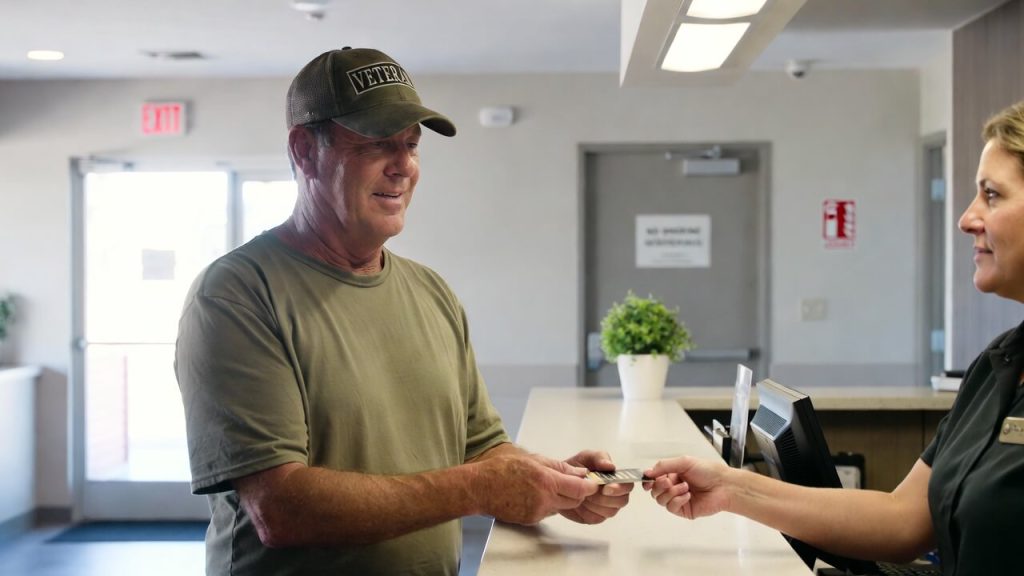
The SSVF program allows veterans to access immediate emergency lodging while waiting for permanent housing solutions.
Phase 1: The “First Response” – SSVF Program
Many veterans mistakenly go to the VA Hospital ER asking for a hotel room. This often leads to disappointment because hospitals are not hotels. The real power lies in a program called Supportive Services for Veteran Families (SSVF).
1. What is SSVF?
SSVF is a VA-funded program run by local non-profit organizations (not the VA hospital itself). Their primary mission is Rapid Re-Housing. They are the ones who hold the checkbook for emergency expenses.
Unlike Section 8 which takes years, SSVF is designed for “Emergency Stabilization.”
2. How SSVF Pays for Hotels
Under the Temporary Financial Assistance (TFA) category, SSVF grantees can pay for emergency lodging in hotels or motels if:
- No Shelter Beds: Emergency shelters in your area are full or unavailable.
- Safety Risk: The available shelters are deemed unsafe for your specific situation (e.g., severe PTSD triggers in crowded barracks).
- Transition Plan: You are waiting for a permanent apartment to be ready within 30 days.
The Benefit: SSVF can typically pay for up to 30 days of hotel costs for a veteran and their family.
3. Eligibility Criteria (The “Litmus Test”)
To qualify for SSVF hotel vouchers, you generally need:
- Veteran Status: A discharge status of anything except Dishonorable. (General and OTH are often accepted depending on the specific grantee’s rules).
- Income Limit: Your household income must be below 50% of the Area Median Income (AMI). Most homeless veterans easily qualify.
- Housing Status: You must be currently homeless (street, car, shelter) or at “imminent risk” (eviction notice in hand).
4. How to Find Your Local SSVF Provider
The first step is not going to the hospital, but calling 877-4AID-VET to connect with local grant providers in your area.
Do not just walk into the VA hospital. You need to find the “Community Action Agency” handling the money.
- Step 1: Call 877-4AID-VET and ask specifically: “I need the phone number for the local SSVF provider in [Your County].”
- Step 2: Use the official VA SSVF Provider Locator to find the non-profit handling grants in your specific county.
- Step 3: When you call the provider, say: “I am a veteran sleeping in my car. I am requesting Temporary Financial Assistance for Emergency Housing under the SSVF grant.” Using this specific terminology shows you know your rights.
Pro Tip: Have your DD-214 (Certificate of Release or Discharge) ready. If you lost it, the SSVF case manager can often help you order an emergency copy from the National Archives, but having a photo of it on your phone speeds up the process by days.
Phase 2: The Long-Term Solutions (HUD-VASH & GPD)
While SSVF gets you into a hotel tonight, it is a temporary fix. You need a permanent base of operations. The VA offers two primary “weapons” to secure long-term stability: The HUD-VASH Voucher and the Grant and Per Diem (GPD) program.

Case Managers don’t just hand out vouchers; they help you build a long-term plan to transition from a motel to your own apartment.
1. The “Gold Standard”: HUD-VASH Vouchers
Think of HUD-VASH as a “Super Section 8” voucher designed exclusively for veterans.
- The Concept: It combines a Housing Choice Voucher (Section 8) from HUD with intensive case management from the VA.
- The Benefit: You pay 30% of your income towards rent; the VA pays the rest. Unlike standard Section 8 waitlists that take years, HUD-VASH is prioritized based on clinical need.
- Eligibility: Generally requires an Honorable or General Discharge. However, recent policy changes have expanded access for some “Other Than Honorable” (OTH) cases.
- The Catch: This process takes time (30-60 days). Use SSVF hotel vouchers to bridge the gap while waiting for your HUD-VASH application to process.
Action: Go to your local VA Medical Center (VAMC) and ask for the Homeless Coordinator. Do not leave until you have filled out the initial screening form for HUD-VASH.
You can read the specific HUD-VASH Eligibility Requirements directly from the VA website to see if your discharge status qualifies.
2. The “Bridge”: Grant and Per Diem (GPD) Program
If you are not ready for independent living (perhaps you need to focus on sobriety, PTSD recovery, or job training first), the GPD program is your best option.
- What it is: Transitional housing. You live in a structured facility (often run by non-profits like Salvation Army) for up to 24 months.
- The Environment: Think of it like a college dorm or a relaxed squad bay. You have your own bed and locker, but you share kitchen and living areas.
- Why choose GPD?
- Structure: Mandatory curfews and drug testing help maintain sobriety.
- Services: On-site employment specialists (HVRP) help you find work.
- Service Dogs: Many GPD facilities are now required to accept service animals, unlike traditional shelters.
3. “Bad Paper” Veterans (Other Than Honorable)
This is the most common reason veterans avoid seeking help: “I have a Bad Conduct or OTH discharge, so the VA won’t help me.” This is a myth.
While you might be barred from GI Bill benefits, homeless assistance rules are different.
- GPD Access: Many GPD providers are legally allowed to serve veterans with OTH discharges.
- SSVF Access: SSVF is extremely flexible and often serves OTH veterans to prevent street homelessness.
- Upgrade Help: While in the program, case managers can help you file for a Discharge Upgrade to restore your full benefits. You can also contact the National Veterans Legal Services Program (NVLSP) directly for free legal advocacy to correct your military records.
Phase 3: Non-VA Options & Special Demographics
Sometimes the VA bureaucracy is too slow, or you simply do not qualify due to a Dishonorable Discharge. In these cases, you need to execute a “Plan B” using civilian and specialized non-profit resources.
1. The “Big Three” Veteran Non-Profits
When the government says “No,” these organizations often say “Yes.”
- Volunteers of America (VOA): They are one of the largest providers of SSVF and GPD housing. They specialize in helping veterans with Other Than Honorable (OTH) discharges who fall through the cracks.
- The Salvation Army: Their Veterans Services division operates specific shelters in many cities. They focus on “Clinical Housing” (sobriety and mental health).
- Endeavors: A massive non-profit operating in Texas, Florida, and North Carolina. They provide rapid re-housing and disaster relief specifically for veteran families.
2. Female Veterans: Safety & Privacy

Women are the fastest-growing segment of the homeless veteran population, and the VA has specific pathways to ensure your safety and privacy.
Women are the fastest-growing segment of the homeless veteran population, yet many shelters are designed for men.
- The Danger: Mixed-gender shelters can be unsafe for female veterans, many of whom are survivors of Military Sexual Trauma (MST).
- The Solution:
- Women Veterans Call Center: Call 855-VA-WOMEN (855-829-6636). This is a separate line staffed by women to discuss specific housing and health needs.
- SSVF Priority: Female veterans with children are often given the highest priority for hotel vouchers to avoid placing them in congregate shelters.
- Contact the Women Veterans Call Center to speak with female staff who understand the specific trauma and housing needs of women who served.
3. Muslim Veterans: Faith & Community Support
For the estimated 5,000+ Muslim veterans, standard shelters often fail to meet basic religious needs (Halal food, prayer space, privacy).
- Islamic Relief USA & ICNA Relief: While civilian organizations, they hold veterans in high regard. They can often provide emergency financial aid for motels when VA vouchers are pending.
- Association of Muslim Veterans: Organizations like the Association of Muslim Veterans often advocate for specific religious accommodations and can connect you with community support.
- Chaplain Services: If you are in a VA program, you have the right to request a Muslim Chaplain to advocate for Halal MREs or specific accommodation for daily prayers. Do not hesitate to use the Chaplaincy; it is part of your benefit.
4. Operation: Sacred Trust (Example)
In states like Florida, initiatives like “Operation Sacred Trust” combine VA funds with community donations to pay for:
- Emergency hotel stays (up to 45 days).
- Utility deposits.
- Car repairs (so you can get to job interviews).
- Action: Search for “SSVF Provider [Your State]” to find the equivalent program in your area.
Reading about the bureaucracy is one thing, but understanding how the VA mobilizes during a crisis is another. Before reviewing our final FAQs, watch this excellent breakdown from a veteran advocate on how the VA’s emergency shelter and hotel voucher programs operate to get you off the streets immediately:
Conclusion: Stand Down, Soldier. We’ve Got Your Watch
You have spent your life protecting others. Asking for help now is not a sign of weakness; it is a strategic maneuver to regroup and redeploy into civilian life. The resources are there, and you have earned them with your service.
Your Immediate Orders:
- Call: Dial 877-4AID-VET right now. Do not wait for “business hours.”
- Gather Intel: Locate your DD-214. If you don’t have it, tell the operator immediately so they can start the request.
- Secure Perimeter: If you are unsafe tonight, use the SSVF “Temporary Financial Assistance” to get a hotel room.
Mission Abort? (If VA Cannot Help) Sometimes, due to discharge status or specific regulations, the VA might say “No.” Do not retreat. You still have civilian options.
- Check our Civilian Emergency Voucher Guide for non-VA programs.
- Explore every available housing option (Section 8, Public Housing) in our Comprehensive Emergency Housing Master Guide.
Frequently Asked Questions (FAQ)
Q1: Can I get a hotel voucher if I have a “Bad Conduct” or “Other Than Honorable” (OTH) discharge?
A: Yes. While you may not qualify for the GI Bill or HUD-VASH immediately, the SSVF (Supportive Services for Veteran Families) program is designed to prevent homelessness regardless of discharge status (except Dishonorable in some cases). Non-profit partners often have flexible funds to help you.
Q2: Can I bring my Service Dog to the hotel or shelter?
A: Absolutely. Under the ADA and VA rules, a trained Service Dog (for PTSD, mobility, etc.) is not a “pet.” Hotels and GPD facilities funded by the VA must accept your service animal. Emotional Support Animals (ESAs) have different rules, so ask the SSVF provider specifically about “pet-friendly” motel vouchers.
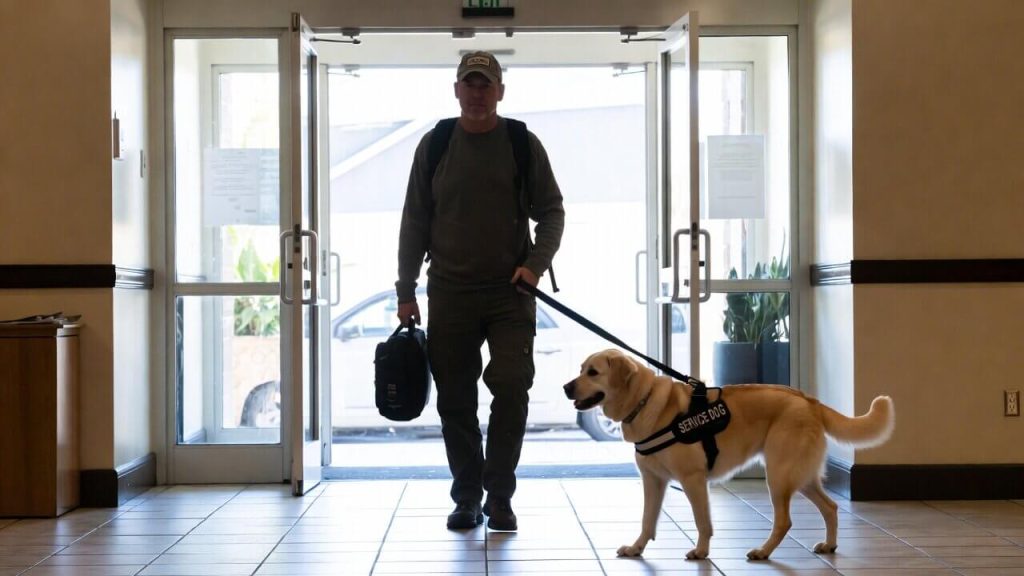
Don’t worry about your service dog. Under ADA and VA rules, your loyal companion is welcomed in government-funded hotels and facilities.
Q3: Does the VA pay for my wife and children to stay with me?
A: Yes, under SSVF. The “F” in SSVF stands for Families. They prioritize keeping veteran families together in hotel vouchers or apartments. However, traditional GPD (transitional housing) facilities are often dormitory-style and may be single-sex (veteran only), so ask for “Family Case Management” specifically.
Q4: How long can I stay in the hotel with a voucher?
A: Typically 30 to 45 days under Emergency Housing Assistance. This is meant to be a bridge while the case manager helps you secure a permanent apartment deposit or a HUD-VASH voucher.
Q5: I am a female veteran. Are there safe places just for women?
A: Yes. Ask the VA Homeless Coordinator for a referral to a Women’s GPD Program. These are secure, female-only facilities often with enhanced security and trauma-informed care for MST survivors.
Important Disclaimer: StartGrants.com is an independent information portal. We are not a government agency and do not provide direct grants or products. Always verify the current status of programs with the providing organization.