
Last Updated: July 2026 | Author: Munir Ardi
The global fashion industry generates trillions of dollars annually, but breaking into this exclusive sector is notoriously expensive. Whether you are an aspiring student trying to afford the staggering tuition at a premier fashion institute, or an emerging designer attempting to manufacture your debut collection, the barrier to entry is almost entirely financial.
Because the creative arts do not follow traditional corporate trajectories, standard commercial banks are highly hesitant to lend money to unproven artists. To survive and scale, you must master the acquisition of “gift aid.” Learning how to secure grants for fashion designers and specialized educational scholarships is the ultimate competitive advantage that separates a thriving brand from a bankrupt hobby.
Before executing the specific tactics for the fashion industry outlined below, you must understand how creative disciplines fit into the broader federal and vocational funding ecosystem. Anchor your overarching strategy by reviewing our Master Pillar: Grants for Vocational and Trade Schools.

Breaking into the multi-billion dollar fashion industry requires immense capital. Whether you are paying for design school tuition or launching your debut collection, securing non-dilutive grants and scholarships is the ultimate competitive advantage.
Phase 1: Funding Your Education (Fashion Design Scholarships)
If you are at the beginning of your journey, your primary goal is securing the technical skills (pattern making, draping, CAD) without accumulating six figures in student debt. Many individuals search for the “fashion design scholarships of the calculation schedule for submission,” but the process is actually highly standardized across two main pipelines.
1. The Federal Pipeline (FAFSA & Pell Grants)
A common myth is that federal grants are only for traditional 4-year universities. This is false. If you attend an accredited fashion trade school or vocational design institute (such as Parsons or FIT), you are entirely eligible for the Federal Pell Grant. By submitting the Free Application for Federal Student Aid (FAFSA), low-income students can secure over $7,300 annually in federal gift aid to pay for tuition and sewing supplies.
2. The CFDA Scholarships
The Council of Fashion Designers of America (CFDA) is the premier governing body of American fashion. They offer millions of dollars in highly specialized, merit-based scholarships to students enrolled in design programs. Their calculation schedule for submission usually opens in early Spring. Securing a CFDA scholarship not only pays your tuition but also acts as a massive resume booster that commands industry respect.
Phase 2: Funding Your Brand (Grants for Fashion Designers)
Once you have the skills, you must fund the business. Manufacturing samples, renting a runway space, and launching a marketing campaign require raw capital. For independent designers, you must target specific arts and corporate endowments.
1. National Endowment for the Arts (NEA)
The federal government funds creative endeavors through the National Endowment for the Arts (NEA). While the NEA rarely writes checks directly to an individual designer, they provide massive block grants to local state arts councils. You must contact your local city or state arts council to apply for localized creative entrepreneur grants funded by the NEA.
2. Corporate Fashion Incubators
The most lucrative grants for fashion designers come from corporate partnerships. Programs like the CFDA/Vogue Fashion Fund provide massive cash grants (often exceeding $100,000) and top-tier business mentorship to emerging designers. Similarly, major retail corporations frequently host grant competitions to discover sustainable or diverse new brands to feature in their stores.
Pro-Tip: Pitching Your Fashion Brand from Zero
Corporate incubators and fashion grants are fiercely competitive, but what if you are starting with absolutely nothing? You cannot just submit beautiful sketches; you must understand how to bootstrap and pitch a viable business model from scratch. To understand exactly how to secure capital when you have absolutely $0 in the bank and how to structure your brand’s financial foundation, watch this essential industry breakdown: How to Fund Your Fashion Brand (Even If You Have $0!):
Phase 3: Bureaucratic Shields & Creative Synergy
To win a business grant, you must stop operating like a “starving artist” and start operating like a CEO. No federal agency or corporate foundation will give you $50,000 if you ask them to deposit it into your personal checking account. You must legitimize your label.
- Form an LLC & Acquire an EIN: You must legally register your fashion brand with your state and obtain a free Employer Identification Number (EIN) from the IRS to open a dedicated business bank account.
- The Female Founder Advantage: The fashion industry is heavily supported by women. If you are a female designer, you must aggressively target corporate grants specifically reserved for women-owned businesses. Learn how to leverage this demographic status in our guide: How to Find Grants for Women-Owned Businesses.
- Visual Arts Synergy: You cannot sell fashion without impeccable visuals. When drafting a grant budget for your brand, you can legally write in the costs of hiring professional photographers for your lookbook. Understand the financial ecosystem of visual artists by exploring: Grants for Photographers.
Phase 4: The Muslim Perspective (Modest Fashion, Riba, & Zakat)
For Muslim creatives in the United States, the fashion industry presents a phenomenal opportunity. The “Modest Fashion” sector is currently a multi-billion dollar global market that is severely underserved by mainstream Western brands. Designing clothing that aligns with Islamic principles of modesty (covering the Awrah) is a highly lucrative and spiritually rewarding pursuit. However, funding this enterprise requires navigating strict Islamic financial jurisprudence (Shariah).
The Trap of Riba in Education and Business
The standard Western path to becoming a designer is fraught with Riba (compounding interest). Students are encouraged to take out Federal Student Loans for fashion school, and emerging brand owners are pushed by banks to use high-interest business credit cards or Merchant Cash Advances to fund their fabric inventory.
In Islam, intentionally engaging in a contract that stipulates the payment of interest is strictly Haram (forbidden) and eradicates the spiritual Barakah (blessing) from your brand. A Muslim designer must adamantly refuse these loans.
This elevates the pursuit of Grants (Hibah) into a religious necessity. Grants require no repayment and generate no interest, making them 100% Halal. If grants are insufficient, Muslim students should seek Qard Hasan (zero-interest loans) through organizations like A Continuous Charity (ACC). For Muslim brand owners seeking inventory capital, they should utilize Mudarabah (profit-sharing) partnerships with Halal angel investors.
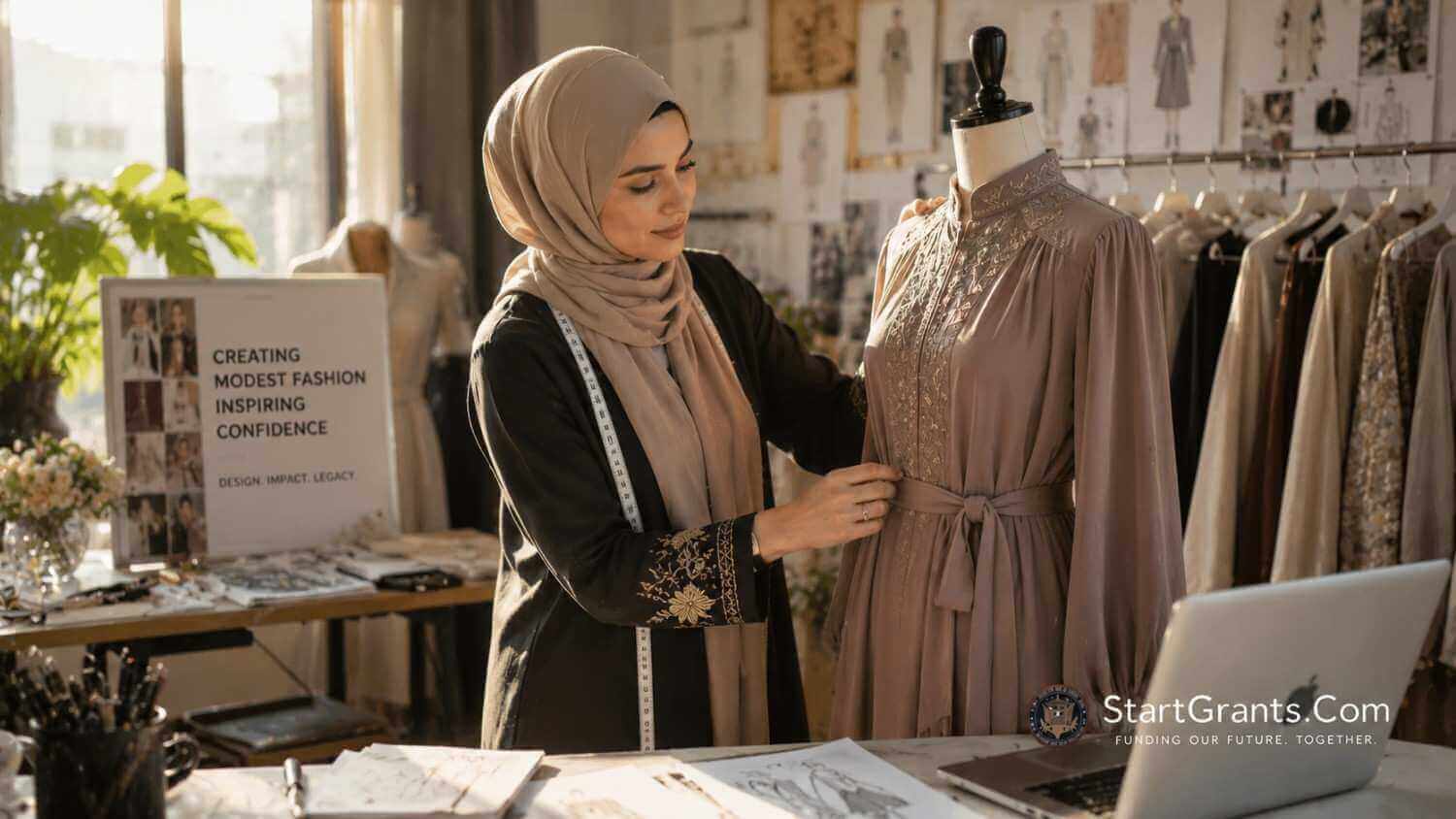
For the Muslim fashion designer, the booming “Modest Fashion” sector presents a massive opportunity. Navigating this industry requires strict Halal financial discipline, from avoiding Riba-based startup loans to meticulously calculating Zakat on fabric inventory.
Gharar and Boutique Insurance
If your fashion brand scales and you open a physical boutique or a manufacturing warehouse, the state and your investors will legally mandate that you carry Commercial Property and Liability Insurance to protect your expensive fabric inventory.
Traditional commercial insurance contains Gharar (excessive uncertainty) and elements of gambling. Ideally, Muslim-owned businesses should utilize Takaful (Islamic cooperative B2B insurance). Because genuine commercial Takaful is practically non-existent in the U.S. fashion retail market, contemporary Islamic scholars apply the principle of Dharurah (legal and operational necessity). This permits the Muslim designer to purchase the required commercial policy to protect the business from absolute ruin, provided the intent is legal compliance and survival, not speculative profit.
Zakat al-Tijarah (The Fiqh of Fabrics and Sewing Machines)
If your fashion brand successfully generates wealth, you must fulfill your divine corporate tax: Zakat al-Tijarah (Zakat on Business Wealth). The rules of Islamic Fiqh provide a brilliant and logical distinction for manufacturers and designers regarding what is taxed.
- Tools of Production (Zakat-Exempt): The fixed assets you use to create the clothing—such as your expensive industrial sewing machines, sergers, drafting tables, digital drawing tablets, and mannequins—are completely exempt from Zakat. You do not pay 2.5% on your sewing machines.
- Business Inventory (Zakat-Eligible): However, the raw materials intended to be converted into merchandise (yards of silk, cotton, buttons, zippers) and the finished garments hanging on your racks waiting to be sold are considered business inventory.
Every lunar year (Hawl), a Muslim brand owner must calculate the value of the business’s liquid cash (including grant money in the bank) plus the current wholesale value of the fabric and finished inventory. If this total meets the minimum threshold (Nisab), the business must pay exactly 2.5% to charity. Fulfilling this obligation purifies the brand’s wealth and ensures continued divine protection over your creative enterprise.
Conclusion
Securing grants for fashion designers and educational scholarships requires transitioning from a pure artist into a strategic entrepreneur. By mastering the FAFSA for trade school funding, targeting elite CFDA endowments, and formalizing your LLC to win corporate incubator grants, you can fund your debut collection without surrendering your future profits to predatory banks.
For the Muslim designer, pioneering the Modest Fashion industry is a profound exercise in ethical resilience. By fiercely rejecting the trap of Riba-laced student and business loans in favor of Halal grants (Hibah), navigating commercial insurance mandates ethically via Dharurah, and accurately fulfilling Zakat al-Tijarah on your fabric inventory, your clothing brand becomes a powerful engine of economic empowerment and absolute spiritual purity.
Frequently Asked Questions (FAQs)
Q1: Does the federal government give grants directly to fashion designers?
A: Rarely directly. The National Endowment for the Arts (NEA) provides massive federal funding, but they typically distribute this money as block grants to local state and city arts councils. As a fashion designer, you must apply to your local municipal arts council to access these federal funds.
Q2: Can I use the Federal Pell Grant for a fashion design trade school?
A: Yes. As long as the vocational school, trade school, or design institute you are attending is federally accredited and participates in the Title IV federal student aid program, you can use the Pell Grant to pay for your fashion education.
Q3: What are the CFDA Scholarships?
A: The Council of Fashion Designers of America (CFDA) offers prestigious, merit-based scholarships to students enrolled in full-time fashion design programs. These scholarships provide significant tuition relief and invaluable industry exposure to emerging talent.
Q4: Why is it Haram for a Muslim designer to use a business credit card for fabric inventory?
A: If a designer uses a business credit card to buy fabric and fails to pay the balance in full by the end of the month, the bank will charge compounding interest. In Islamic finance, intentionally paying interest is classified as Riba, which is strictly forbidden (Haram). Muslim designers must prioritize Halal grants (Hibah) or profit-sharing (Mudarabah) investments.
Q5: Do I have to pay Zakat on my industrial sewing machines?
A: No. According to Islamic jurisprudence, fixed assets and the “tools of production” used to operate a business (such as sewing machines, cutting tables, and computers) are exempt from Zakat. You only pay Zakat al-Tijarah (2.5%) on your business’s liquid cash, raw fabric inventory, and finished garments intended for sale.
Disclaimer: The information provided in this article is for educational and informational purposes only. We are not a federal agency, a financial advisory firm, or a religious fatwa council. Federal student aid (FAFSA) regulations, NEA grant programs, and tax laws are subject to constant legislative changes. Always consult with a certified CPA regarding your business taxes, your university’s financial aid office for scholarship deadlines, and a qualified Islamic finance scholar regarding Halal business structuring, Zakat calculations, and insurance mandates.