
Last Updated: April 2026 | Author: Robert
Graduating with a bachelor’s degree is supposed to be the finish line of your undergraduate financial struggles. However, for a growing segment of the population, it is merely the beginning of the most complex and expensive educational transition: the Post-Baccalaureate gap.
Whether you earned a degree in History but suddenly decided to pursue Medical School, or you realized your current career path requires a radically different academic foundation, you are now a “Career Changer.” To pivot, you must complete rigorous prerequisite courses—like organic chemistry, advanced anatomy, or physics—before any master’s or professional program will even look at your application.
This transition period is known as a Post-Baccalaureate (Post-Bac) program. The academic challenge is immense, but the financial reality is terrifying. You are caught in higher education’s “Death Zone.” Because you already hold a bachelor’s degree, you are entirely locked out of standard federal grant money. Because you are not yet enrolled in a master’s or doctoral program, you cannot access graduate fellowships or research assistantships.
If you are not careful, this gap year can easily force you into tens of thousands of dollars in high-interest, predatory private student loans. In this comprehensive 2026 guide, we will aggressively dismantle the Post-Bac funding trap. We will outline exactly how to maximize the hidden federal loan exceptions, secure institutional endowment funds, and aggressively hunt for specialized private grants designed exclusively for students fighting to change their lives.
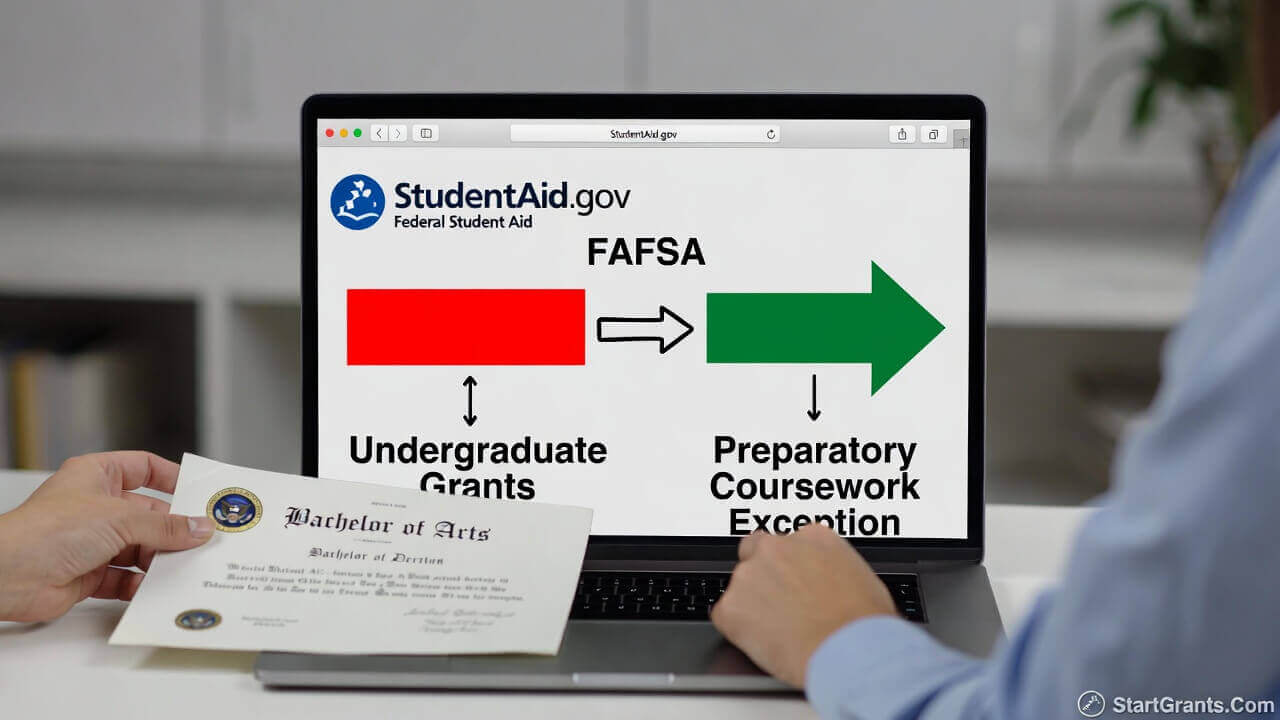
File your FAFSA as an Independent Student at StudentAid.gov. Understand the critical shifts required to qualify for the 12-month preparatory coursework exception.
Phase 1: Understanding the “Post-Bac Death Zone”
To secure funding, you must first understand why the government and universities categorize you differently than a standard college student. A Post-Baccalaureate student is technically taking undergraduate-level courses, but their academic status is completely detached from the traditional four-year financial aid model.
The Loss of the Federal Pell Grant
The cornerstone of free educational money in the United States is the Federal Pell Grant. However, the U.S. Department of Education’s Title IV regulations are absolute: once you receive your first bachelor’s degree, your Pell Grant eligibility is permanently terminated, regardless of how drastically your financial situation has deteriorated.
- The Teacher Certification Exception: There is only one strictly enforced loophole to this rule. If your Post-Bac coursework is specifically required by your state to earn an initial teaching certification (and the program does not lead to a master’s degree), you may still qualify for a Pell Grant. If you are pursuing medicine, law, or any other field, this exception does not apply to you.
Types of Post-Baccalaureate Programs
Funding strategies differ wildly depending on how your coursework is structured. You must identify which category you fall into before applying for any grants:
- Formal “Career Changer” Programs: These are highly structured, cohort-based programs offered by universities (often medical schools) designed specifically for students with non-science backgrounds. Because these programs are formalized, they often have their own internal financial aid pools and direct pipelines to professional schools.
- Formal “Academic Record Enhancer” Programs: If you already took the required science courses during your bachelor’s degree but your GPA was too low for medical or graduate school admission, you might enroll in an enhancer program to prove your academic rigor. Funding for these programs is exceptionally scarce, as institutions view them as corrective rather than foundational.
- The “Do-It-Yourself” (DIY) Post-Bac: Many students simply enroll as a non-degree-seeking student at a local community college or state university to take prerequisite classes a la carte. While this is the cheapest upfront option, it is a financial nightmare regarding financial aid, as almost all federal and institutional grants require you to be enrolled in a degree-seeking program.
If you are attempting a DIY Post-Bac, your primary strategy must involve petitioning the university for a status change or aggressively pursuing external, non-profit foundation money. For a broader understanding of exactly how postgraduate funding rules operate before you specialize your search, you must read our master blueprint on how to obtain Pell grants for graduate students.
Phase 2: The Federal Lifeline (Preparatory Coursework Exception)
While the federal government will not give you free grant money for a career-changing Post-Bac, they do provide a very specific, time-limited loan exception to keep you out of the hands of predatory private lenders. You must still fill out the Free Application for Federal Student Aid (FAFSA).
The 12-Month Stafford Loan Window
If you are enrolled at least half-time in prerequisite coursework required for admission to a graduate or professional program, you are eligible for Federal Direct Subsidized and Unsubsidized Loans.
- The Catch: You can only receive these loans for one consecutive 12-month period. If your Post-Bac program takes 18 or 24 months to complete (which is common for Pre-Med students working part-time), the federal funding will abruptly shut off after your first year.
- The Independent Advantage: Because you already hold a bachelor’s degree, the FAFSA automatically classifies you as an Independent Student. This means your Student Aid Index (SAI) is calculated without your parents’ income, which significantly raises the borrowing limits of your Direct Loans.
Why You Must Avoid Private Loans
When that 12-month federal window closes, or if federal loans simply do not cover your living expenses while you study full-time, universities will immediately point you toward private lenders (like Sallie Mae or Discover). Do not take this bait. Private student loans require a credit check, often mandate a co-signer, and carry variable interest rates that can financially cripple you before you even enter medical or graduate school. Your mission during this gap period is to replace the need for private debt with institutional and foundation grants.
Many Post-Bac students are surprised to discover they are classified as ‘Independent’ on the FAFSA, regardless of age. To understand exactly how this status impacts your Student Aid Index (SAI)—and unlocks the Preparatory Coursework exception—watch this official walkthrough from the Department of Education:
A Critical Note for Muslim Applicants
If you are a Muslim student navigating the Post-Baccalaureate gap, the heavy reliance on Federal Direct Loans and private lenders presents a severe religious dilemma. Both of these funding avenues accrue interest, which is strictly prohibited (Riba) in Islamic finance. Taking on interest-bearing debt, even for education, is a line many Muslim families refuse to cross. Therefore, your financial strategy must completely bypass Phase 2 of this guide. You must rely exclusively on institutional endowment funds and aggressively hunt for specialized external money. To build a completely interest-free funding strategy, you must seek organizations like A Continuous Charity that offer Qard Hasan (interest-free educational loans) to help Muslim students navigate higher education without Riba.
Phase 3: Unleashing Institutional Endowment (The University Vault)
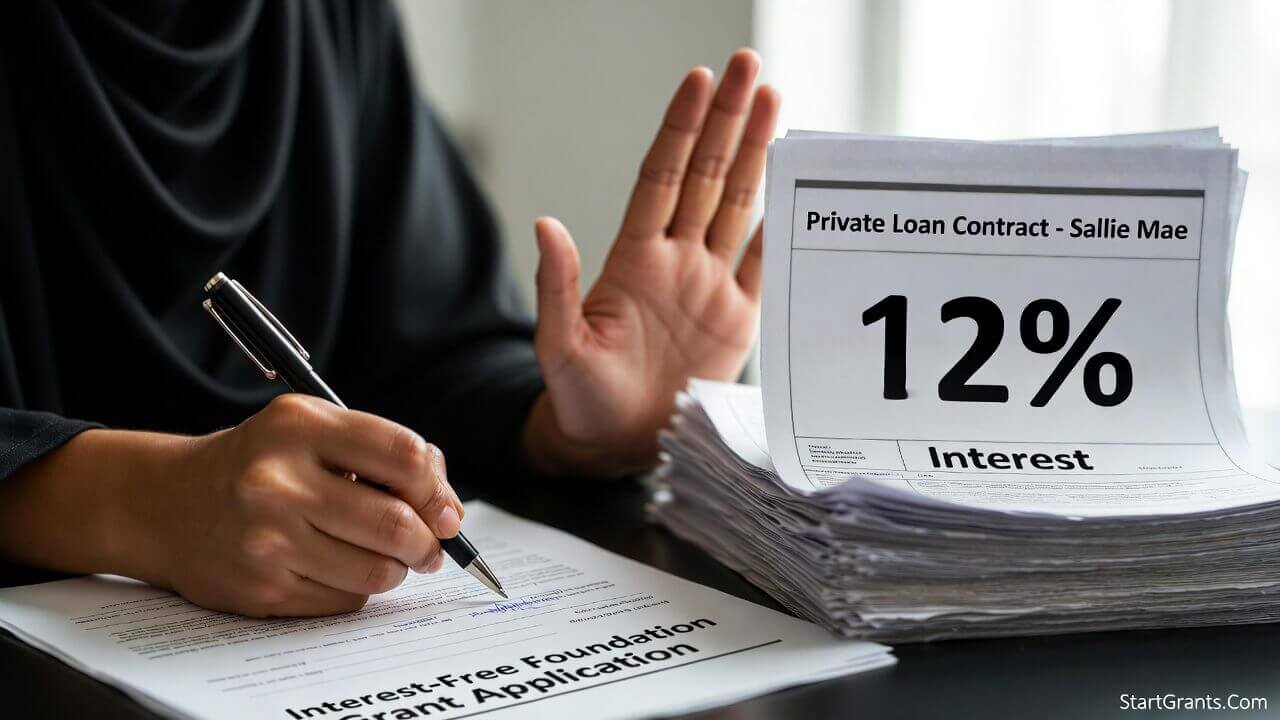
Muslim applicants must proactively bypass interest-bearing loans (Riba). Focus your strategy on zero-interest community loans and foundation grants designed for faith-driven students.
If federal grants are locked behind the undergraduate barrier, your primary battlefield shifts directly to the university you are attending. Universities—especially private, non-profit institutions with massive endowments—control millions of dollars in institutional aid.
However, extracting this money as a Post-Bac student requires a fundamentally different strategy than an incoming college freshman. You must actively negotiate your financial aid package.
The “Need-Aware” Admissions Hurdle
Elite universities are fiercely protective of their endowment funds. While many top-tier schools pledge to meet 100% of the demonstrated financial need for their undergraduates, this generous policy rarely extends to their Post-Bac programs.
- The Reality of Post-Bac Admissions: Most universities view their Post-Bac programs (especially formal Pre-Med tracks) as massive revenue generators. Because the students are often older professionals desperate to change careers, the institutions charge premium tuition rates and offer very little institutional grant money upfront.
- The Petition for Status Change: If you are enrolled in a DIY Post-Bac program (taking prerequisite courses a la carte), the financial aid office will likely classify you as a “non-degree seeking” student. This classification automatically disqualifies you from almost all institutional grants. Your immediate, tactical objective must be to petition your academic advisor to change your status to a formal “certificate seeking” or “second bachelor’s degree seeking” student. This minor bureaucratic change can suddenly unlock access to university-specific scholarships.
Departmental and Diversity Fellowships
Within the university itself, the financial aid office is not the only source of funding. The specific academic department housing your Post-Bac program (such as the Biology or Chemistry department) often controls smaller, specialized endowment funds donated by alumni.
- The Diversity Advantage: If you are a member of an underrepresented minority group (URM) in medicine or STEM fields, universities have dedicated funds to support your transition. Many formal Post-Bac programs are specifically designed to increase diversity in professional schools. Programs affiliated with the Association of American Medical Colleges (AAMC) frequently offer institutional grants to Black, Hispanic, and Native American students who demonstrate exceptional academic promise but lack the financial resources to complete the prerequisite coursework.
Phase 4: The Pre-Med Pipeline (Hunting External Foundation Grants)

Hunting Specialized External Funding. Since standard federal grants are off the table, Pre-Med students must bypass the university and aggressively apply for diversity and career-changer grants from organizations like the NMF.
The vast majority of Post-Baccalaureate students are aspiring physicians, dentists, or veterinarians taking the brutal science prerequisites required for medical school admission. Because the national shortage of healthcare professionals in underserved areas is severe, massive private foundations have stepped in to fund the “Pre-Med Pipeline.”
You must aggressively hunt for these specialized foundation grants, as they are designed exclusively for career changers and academic enhancers.
1. The National Medical Fellowships (NMF)
The National Medical Fellowships is one of the oldest and most prestigious organizations dedicated to increasing the number of underrepresented minority physicians in the United States.
- The Pre-Med Support: While their primary funding goes to students already enrolled in medical school, they frequently partner with specific universities to offer stipends and grants to Post-Bac students who commit to practicing medicine in underserved communities upon graduation. Securing an NMF grant not only pays for your coursework but dramatically strengthens your eventual medical school application.
2. The Health Professions Scholarship Program (HPSP) and Military Tracks
If you are willing to serve your country, the U.S. military operates one of the most lucrative funding pipelines in the world for aspiring medical professionals.
- The Catch and the Reward: The HPSP offers a full-tuition scholarship, plus a generous monthly living stipend, to students entering medical, dental, or veterinary school. While the scholarship itself kicks in after you finish your Post-Bac and enter professional school, the military (particularly the Army and Navy) offers specialized preparatory programs and stipends for candidates who need to complete prerequisite coursework before officially commissioning. You must consult a military medical recruiter to navigate these highly specific, service-bound grants.
3. State-Level Primary Care Initiatives
State governments are acutely aware that rural hospitals are facing catastrophic staffing shortages. To combat this, many states divert funds from their higher education budgets to support students entering the primary care pipeline.
- The Service Commitment: Like the TEACH Grant for educators, these state-level Post-Bac grants almost always come with a strict service agreement. If the state pays for your prerequisite courses and eventual medical school tuition, you must sign a legally binding contract to practice primary care in a designated Health Professional Shortage Area (HPSA) within that state for a minimum number of years after your residency. If you break the contract, the grant instantly converts into a high-interest loan.
Phase 5: The Pre-Law Gap and the Graduate Transition
While the medical field dominates the Post-Baccalaureate conversation, thousands of students undergo a similar gap-year transition to prepare for law school, specialized master’s programs, or doctoral research. The financial strategy here shifts from funding laboratory prerequisites to funding high-stakes standardized testing and academic conferences.
The Pre-Law Post-Baccalaureate
If you are using a gap year to study for the LSAT, complete paralegal certification courses, or boost your undergraduate GPA before applying to a Juris Doctor (J.D.) program, you will not find federal grants. Law schools do not typically care about specific prerequisite classes; they care almost exclusively about your LSAT score.
- The LSAT Investment: Instead of paying for expensive DIY Post-Bac classes at a local college, your money is often better spent on elite LSAT tutoring. A high LSAT score is the absolute key to unlocking massive institutional merit aid at top-tier law schools. To understand exactly how to leverage this score to avoid six-figure debt, you must study our comprehensive guide on law school scholarships find the scholarship you need.
Transitioning to Master’s and Ph.D. Programs
Once you successfully complete your Post-Baccalaureate program and are officially accepted into a graduate school, your financial aid status changes immediately. Many students falsely assume that because they finished their undergraduate prerequisites, they might regain access to standard federal grants.
- The Graduate Reality: The federal government is ruthlessly strict about funding advanced degrees. Before you sign your enrollment contract for a master’s program, you must understand the exact, limited legal loopholes that exist for Pell Grants at the postgraduate level, as federal funding operates under severely restricted guidelines.
- Funding Your Early Research: If your Post-Bac program involves heavy laboratory research, you may be invited to present your findings at national conferences even before you officially start graduate school. Do not pay for these flights and hotels out of your own pocket. You must actively seek out travel grants for graduate students provided by scientific societies and professional organizations to fund your academic networking.
Conclusion: Your Post-Baccalaureate Action Plan
Surviving the Post-Baccalaureate “Death Zone” requires extreme financial discipline. Because you are trapped between your bachelor’s degree and your future graduate program, you must stop relying on the federal government for free money and start hunting for institutional and private foundation grants.
To graduate from your gap year without crippling private loan debt, execute this final tactical checklist:
- Maximize the 12-Month Exception: File your FAFSA as an Independent Student to secure your one-year window of Federal Direct Stafford Loans for preparatory coursework.
- Change Your Status: If you are a DIY Post-Bac, relentlessly petition your university’s financial aid office to classify you as a “certificate-seeking” student to unlock institutional endowment funds.
- Hunt Foundation Money: If you are Pre-Med, bypass the university entirely and apply for external diversity grants through organizations like the National Medical Fellowships (NMF).
- Avoid Private Lenders: Treat private student loans (like Sallie Mae) as an absolute last resort. Their variable interest rates will financially cripple you before you even enter professional school.
The Post-Baccalaureate gap is a financial minefield, but it is navigable. File your Independent FAFSA today to lock in your 12-month federal exception, aggressively petition your department for internal funds, and refuse to let predatory private loans hijack your professional future.
Frequently Asked Questions (FAQs)
Q1: Can I get a Pell Grant for a post-baccalaureate program?
A: Generally, no. Because you already hold a bachelor’s degree, your Pell Grant eligibility is permanently terminated. The only legal exception is if you are enrolled in a state-approved post-baccalaureate teacher certification program that does not lead to a master’s degree.
Q2: Are there federal student loans for post-bac students?
A: Yes. If you are enrolled at least half-time in preparatory coursework required for admission to a graduate or professional program, you are eligible for Federal Direct Loans for a maximum of one consecutive 12-month period. You can verify the exact borrowing limits on the Official Federal Student Aid Preparatory Coursework Page.
Q3: Is a post-baccalaureate considered an undergraduate or graduate student?
A: Academically, you are usually taking undergraduate-level prerequisite courses. However, for federal financial aid purposes (the FAFSA), because you already hold a bachelor’s degree, you are classified as an Independent Student.
Q4: How do I pay for a DIY post-bac program?
A: DIY programs (taking classes a la carte without a formal certificate track) are the hardest to fund because universities classify you as “non-degree seeking.” You must pay out of pocket, use the 12-month federal loan exception, or secure private foundation grants designed for career changers.
Q5: Do medical schools offer financial aid for post-bac programs?
A: Formal, cohort-based Post-Bac programs hosted by medical schools often have internal financial aid pools, diversity fellowships, and direct pipelines to professional schools. However, these programs charge premium tuition, so institutional aid rarely covers the full cost of attendance. You must supplement it with external funding from organizations like the Association of American Medical Colleges (AAMC).
Q6: Can independent student status increase my federal loan limits?
A: Yes. Because Post-Bac students are classified as Independent on the FAFSA, their parents’ income is no longer factored into the Student Aid Index (SAI). This classification significantly raises the maximum amount you can borrow through Federal Direct Unsubsidized Loans compared to a dependent undergraduate.
Q7: What happens after my 12-month window for federal loans expires?
A: Once you exhaust the 12-month preparatory coursework exception, you are entirely cut off from Federal Direct Loans for that specific program. If your post-baccalaureate curriculum takes 18 or 24 months to complete, you must secure institutional funding, external foundation grants, or pay out of pocket for the remaining time, as the government will not extend the loan window under any circumstances.
Q8: Do post-baccalaureate loans count toward my aggregate lifetime loan limits?
A: Yes. Any Federal Direct Loans you borrow during your post-baccalaureate program are added to your undergraduate aggregate loan limit (which is currently $57,500 for independent students). If you already maxed out your federal loans during your bachelor’s degree, you will not be able to borrow any federal funds for your post-bac program, even if you qualify for the 12-month exception.
Important Disclaimer: StartGrants.com is an independent information portal. We are not a government agency and do not provide direct grants or products. Always verify the current status of programs with the providing organization.