
Last Updated: August 2026 | Author: Munir Ardi
The American dream of homeownership is currently facing its greatest economic stress test in modern history. With sky-high interest rates and median home prices shattering historical records, saving up a traditional 20% down payment is practically impossible for the average working-class family. To prevent the complete collapse of the entry-level housing market, federal, state, and local governments have deployed billions of dollars in Down Payment Assistance (DPA) programs.
Securing an extra $10,000 to $25,000 from the state to cover your down payment and closing costs sounds like the perfect solution. However, a critical question immediately follows: does government grant affect mortgage underwriting and approval? The answer is a resounding yes. Injecting government capital into a real estate transaction fundamentally alters how a bank views your financial profile.
Before you sign a 30-year contract, you must understand how personal financial aid integrates with commercial banking. Establish your overarching financial baseline by reviewing our Master Guide: Free Government Grants for Individuals: The Application Guide.
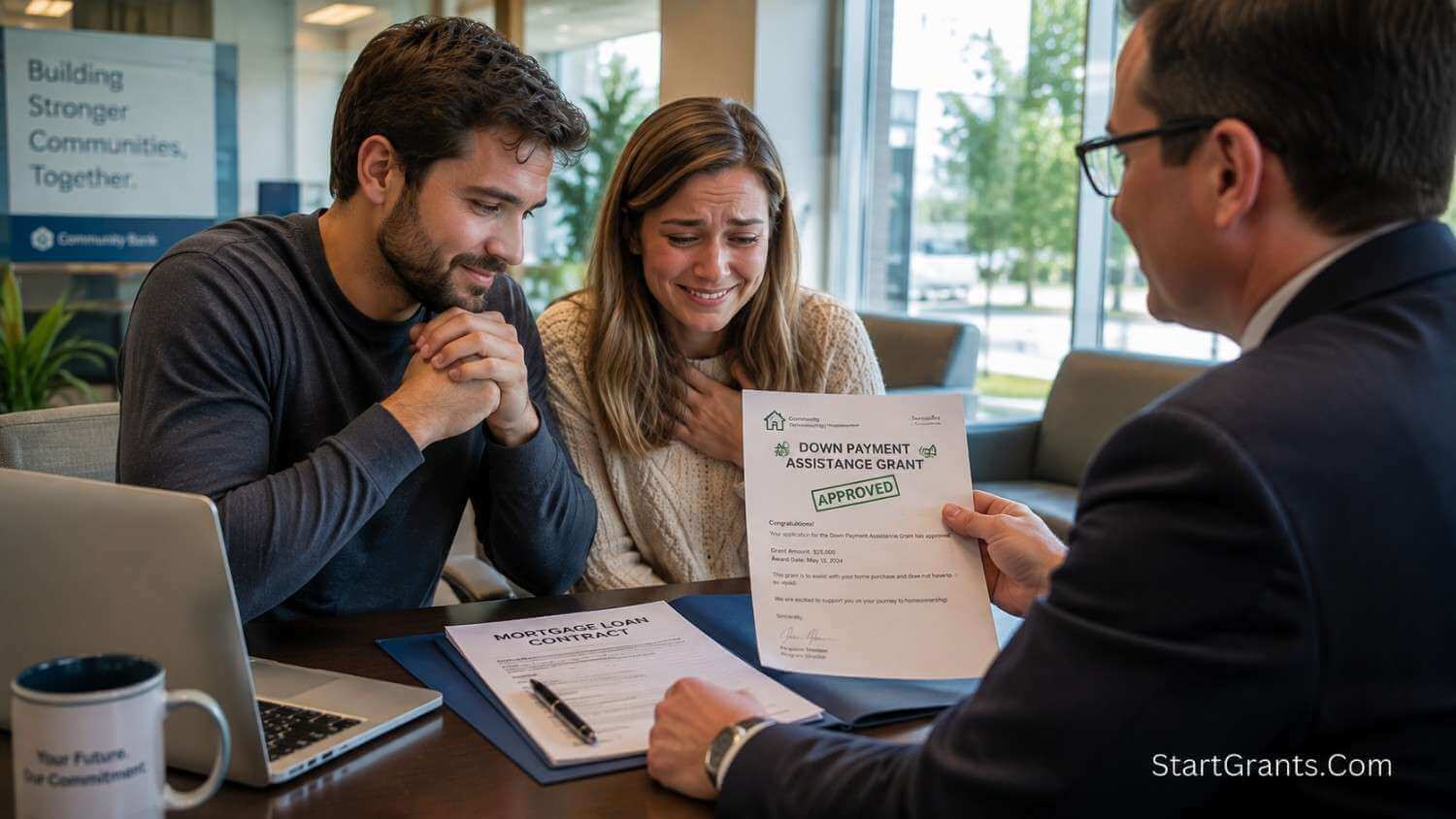
Securing a Down Payment Assistance (DPA) grant is a massive victory, but it fundamentally alters the underwriting process of your mortgage. You must understand how lenders calculate your Debt-to-Income (DTI) ratio when government funds are involved.
Phase 1: The Illusion of “Free Money” (Types of DPA)
To understand how a grant affects your mortgage, you must understand how the bank classifies the money. Not all Down Payment Assistance programs are “true grants.” Lenders categorize government assistance into three distinct structures, and each affects your Debt-to-Income (DTI) ratio differently:
- The True Grant (Gift Aid): This is the rarest and best form. The government gives you $10,000, and it never has to be repaid. Because there is no repayment, it does not negatively affect your DTI. It simply acts as cash equity, lowering the total amount you need to borrow from the bank.
- The Forgivable Loan: The government gives you the money as a 0% interest loan. However, if you live in the house for a set period (usually 5 to 10 years) without selling or refinancing, the loan is 100% forgiven. Banks generally treat this favorably, but it acts as a lien on your property during that 5-year window.
- The Silent Second Mortgage: This is where buyers get trapped. The government gives you the down payment, but it is structured as a second mortgage that must be paid back either monthly or in a lump sum when you eventually sell the house. This severely affects your mortgage. Because it is debt, the bank must add this repayment to your DTI. If your DTI goes too high, the bank will deny your primary mortgage application entirely.
Phase 2: FHA Loans & Sourcing the Funds
The vast majority of first-time homebuyers utilizing DPA grants also utilize FHA (Federal Housing Administration) loans because they only require a 3.5% down payment and accept lower credit scores.
FHA underwriters are incredibly strict about where your grant money comes from. The government has aggressively cracked down on “Seller-Funded DPA.” You cannot accept a grant from the person or corporation selling you the house, as this artificially inflates the home’s appraisal price.
For a grant to be approved by an FHA underwriter, the money MUST be sourced directly from:
- A federal, state, or municipal government agency (like your local housing authority).
- An officially recognized, IRS-approved 501(c)(3) charitable nonprofit organization.
- A direct relative or family member (as a documented gift).
Pro-Tip: Weighing the True Cost of DPA
Down Payment Assistance is rarely a simple “free money” handout; it often comes with strict bureaucratic strings attached that can severely impact your future financial flexibility. Before you accept any state or local funds, you must weigh the immediate benefits against the hidden long-term restrictions. Watch this essential real estate breakdown: Down Payment Assistance Pros & Cons | What Homebuyers Must Know About DPA Loans:
Phase 3: Synergizing Real Estate Strategies
Understanding how government capital interacts with real estate opens the door to massive financial expansion. Depending on your goals or your current crisis, you must navigate different bureaucratic pipelines:
- The Investor Pivot: If you are not a first-time homebuyer, but an entrepreneur looking to use government funds to purchase multi-family properties, revitalize neighborhoods, or build affordable housing, the rules of residential DPA do not apply to you. You must master commercial acquisition via our guide: Government Grants for Real Estate Investors.
- The Foreclosure Crisis: What happens if you bought a home but suddenly cannot afford the mortgage due to a job loss or divorce? State and federal governments offer highly specific stabilization grants to stop foreclosures. Protect your asset by reading: Mortgage Assistance Programs for Single Mothers (Note: these federal programs are accessible to all demographics, not just mothers).
Phase 4: The Bureaucratic Trap (Recapture Tax)
There is a hidden cost to utilizing federal and state down payment grants that banks rarely explain clearly: The Recapture Tax.
Many government housing grants are funded through Mortgage Revenue Bonds. If you use this specific type of government money to buy your house, you are essentially signing a contract stating that you intend to live there long-term. If your income rises significantly and you decide to sell the house or refinance it within the first nine years, the IRS has the legal authority to “recapture” (take back) a portion of the grant money you received by adding it as a harsh penalty to your federal tax bill.
You must factor this bureaucratic trap into your 5-to-10-year financial plan before accepting the funds.
Phase 5: The Muslim Perspective (Riba, Halal Mortgages, Gharar, & Zakat)
For Muslim families in the United States, purchasing a home is not just an American dream; it is an exercise in profound spiritual endurance. The American real estate market is engineered entirely around compounding interest. Navigating government grants while attempting to purchase a home requires strict, uncompromising adherence to Islamic financial jurisprudence (Shariah) to ensure the sanctuary of the family remains pure.
The Paradox of Grants and Riba
Receiving a Down Payment Assistance grant from the state government is classified as Hibah (a gift given without expectation of return). Because it requires no interest, the grant itself is 100% Halal.
However, a terrifying spiritual paradox occurs at the closing table. Many Muslim families take the Halal government grant and use it as a down payment on a conventional, 30-year bank mortgage (like an FHA or Conventional loan). A conventional mortgage requires the repayment of principal plus compounding interest.
In Islam, intentionally engaging in a contract that stipulates the payment of interest is explicitly Riba, which is one of the most severe major sins in the religion. Taking Halal grant money and using it to initiate a Haram, Riba-laced contract completely eradicates the Barakah (divine blessing) from the home. A Muslim family must adamantly refuse conventional mortgages.

For Muslim homebuyers, combining a government down payment grant (Hibah) with a Shariah-compliant financing model (like Musharaka Mutanaqisa) is the ultimate strategic move to achieve homeownership while strictly avoiding the spiritual trap of Riba (interest).
Integrating Grants with Islamic Finance (Musharaka)
Does a government grant affect a Halal mortgage? Yes, and it is highly encouraged! Muslim homebuyers must seek out verified U.S. Islamic financial institutions (such as Guidance Residential or UIF Corporation). These institutions utilize Halal contracts like Musharaka Mutanaqisa (Declining Balance Co-Ownership) or Murabaha (Cost-Plus Financing).
In the Co-Ownership model, you and the Islamic financier buy the house together. If you secure a $15,000 state grant, you use that Halal money to buy your initial “share” of the house. Over time, you make monthly payments to buy out the financier’s shares, while paying a rental usage fee for the portion you do not yet own. There is no loan, and no compounding interest. You must verify with your specific Islamic financier that their underwriting department is set up to process your state’s DPA grant program.
Gharar and Homeowner’s Insurance Mandates
Whether you use a grant, a conventional bank, or an Islamic financier, you will be legally mandated to carry comprehensive Homeowner’s Insurance. Traditional commercial insurance involves Gharar (excessive uncertainty) and elements of gambling.
Ideally, Muslim homeowners should use Takaful (Islamic cooperative insurance). Because genuine residential Takaful is practically non-existent in the U.S. market, contemporary Islamic scholars (including the Fiqh Council of North America) widely apply the principle of Dharurah (legal and operational necessity). This permits the Muslim homebuyer to purchase the mandated commercial policy to protect the family from absolute financial ruin and satisfy the contract, provided the intent is survival, not speculative profit.
Zakat Exemption on Your Sanctuary
When property values skyrocket, many Muslims fear a massive tax burden. If my home is worth $600,000, do I owe 2.5% Zakat on it?
The answer is an absolute No. In Islamic jurisprudence, items required for basic personal necessity—such as the clothes on your back, your primary vehicle, and your primary residence—are completely exempt from Zakat. The sanctuary you live in is not a hoarded asset. You are only obligated to pay Zakat on liquid cash, gold, or investment properties that are expressly meant to generate income, once they reach the Nisab threshold.
Conclusion
So, does a government grant affect your mortgage? Immeasurably. By understanding how lenders categorize True Grants versus Silent Seconds, you can protect your Debt-to-Income ratio and secure loan approval. Securing DPA funds is the ultimate equalizer, allowing working-class families to bypass the impossible hurdle of a 20% cash down payment.
For the Muslim homebuyer, navigating this transaction requires an unyielding commitment to spiritual purity. By fiercely rejecting the cultural normalization of Riba-laced conventional mortgages, combining Halal government grants with ethical Islamic Co-Ownership models, and understanding the protective Zakat exemptions on a primary residence, your new house becomes a true sanctuary—economically fortified and radiating with absolute divine Barakah.
Frequently Asked Questions (FAQs)
Q1: Does a government grant affect my mortgage approval process?
A: Yes. Government Down Payment Assistance (DPA) grants change how the underwriter views your loan. If the DPA is a “True Grant” (no repayment), it helps your approval by lowering the loan amount. If the DPA is structured as a “Silent Second Mortgage,” the lender must add that future repayment into your Debt-to-Income (DTI) ratio, which can sometimes negatively affect your approval.
Q2: Can I get a down payment grant if I am not a First-Time Homebuyer?
A: Yes, depending on the program. While many state grants are restricted to first-time buyers (usually defined as not having owned a principal residence in the last 3 years), there are specific neighborhood revitalization grants and federal programs that assist repeat buyers, provided they meet strict income and geographic limits.
Q3: What is the “Recapture Tax” on a government grant?
A: If your DPA grant was funded by Mortgage Revenue Bonds, federal law requires you to live in the home for a specific period (usually up to 9 years). If your income rises significantly and you sell or refinance the home before that period ends, the IRS may “recapture” a portion of the grant money by adding it to your tax bill.
Q4: Why is it Haram for a Muslim to use a grant with a conventional FHA mortgage?
A: While the grant itself is Halal (Hibah), an FHA or conventional mortgage requires the homebuyer to sign a contract to pay compounding interest to the bank. In Islamic finance, paying interest is explicitly classified as Riba, which is one of the most severe major sins (Haram). Muslims must combine their Halal grants with Shariah-compliant financing (like Musharaka or Murabaha) instead.
Q5: Do I have to pay an annual Zakat tax on the market value of my home?
A: No. According to Islamic law, your primary residence—the home you and your family actively live in for shelter—is considered a basic life necessity and is 100% exempt from Zakat, regardless of how much its market value increases. Zakat is only due on liquid assets, gold, and investment properties meant for trading/renting.
Disclaimer: The information provided in this article is for educational and informational purposes only. We are not a federal housing agency, a mortgage lender, a real estate law firm, or a religious fatwa council. FHA guidelines, DPA grant availability, and IRS Recapture Tax laws are subject to constant legislative changes. Always consult directly with a licensed mortgage broker or loan officer before signing a contract, and seek guidance from a qualified Islamic finance scholar regarding Halal home financing, Riba avoidance, and specific Zakat exemptions.