
Last Updated: May 2026 | Author: Zee
When most people think of charitable giving, they picture financial contributions or dropping off clothing at a shelter. However, one of the most profound acts of philanthropy comes from within. If you are a lactating mother with an abundant milk supply, your excess breast milk is a highly sought-after biological resource.
For premature and medically fragile infants, human milk is not just nutrition; it is life-saving medicine. However, because it is a bodily fluid, the collection, processing, and distribution of donor milk fall under strict medical scrutiny. Before you begin the process, it is vital to understand where biological gifts fit into the broader philanthropic landscape by reviewing our guide on medical and health donations.
This master guide will decode the 2026 clinical landscape of breast milk donation. We will explore the rigorous medical screening protocols, expose the dangers of informal milk sharing, and walk you through the exact logistics of shipping your liquid gold to an accredited milk bank.

Human donor milk acts as life-saving medicine for premature infants in the NICU, significantly reducing the risk of fatal intestinal diseases.
Phase 1: The NICU Reality (Why Donate?)
To understand the urgency of this donation, you must look inside the Neonatal Intensive Care Unit (NICU). Premature babies have severely underdeveloped digestive and immune systems. According to the American Academy of Pediatrics (AAP), human milk acts as an essential clinical therapy for these infants.
When a mother’s own milk is unavailable—due to maternal illness, medication, or delayed lactation—pasteurized donor human milk is the standard of care. Providing donor milk drastically reduces the risk of Necrotizing Enterocolitis (NEC), a devastating and frequently fatal intestinal disease that primarily affects premature infants fed with cow’s milk-based formula.
Phase 2: The 4-Step Screening Protocol (HMBANA)
Because donor milk is administered to the most vulnerable patients in the hospital, safety is the absolute priority. You cannot simply mail a cooler of milk to a hospital. You must go through an accredited non-profit organization, specifically a bank governed by the Human Milk Banking Association of North America (HMBANA).
To become a registered donor in 2026, you must pass a rigorous 4-step medical screening process:
- The Initial Phone Interview: A brief conversation with a milk bank coordinator to discuss your basic health, lifestyle, and current medications.
- The Medical Questionnaire: You will complete a comprehensive written health history, very similar to the paperwork required for a blood donation.
- Physician Clearance: The milk bank will contact both your primary care physician/OB-GYN and your baby’s pediatrician to secure written confirmation that you and your baby are healthy enough for you to donate.
- Blood Testing: You will undergo a serological blood test to screen for infectious diseases, including HIV, HTLV, Hepatitis B and C, and Syphilis. The milk bank covers 100% of the cost for this test.
Phase 3: Medication and Lifestyle Restrictions
Because whatever you ingest can pass through your milk to a medically fragile infant, milk banks maintain strict lifestyle and pharmacological restrictions. While guidelines may vary slightly between individual banks, the standard HMBANA rules include:
- Prescription Medications: Most daily medications, including certain antidepressants, disqualify you from donating. However, prenatal vitamins, standard birth control, and asthma inhalers are generally acceptable.
- Herbal Supplements: Fenugreek and other lactation-boosting herbal supplements are often prohibited because their effects on premature infants have not been fully clinically studied.
- Alcohol and Caffeine: Moderate caffeine intake is usually permitted. Alcohol consumption requires a specific “pump and dump” waiting period (typically 12 hours) before the milk can be saved for donation.
- Nicotine and Tobacco: The use of tobacco products, nicotine patches, or vaping completely disqualifies a candidate from donating.
Phase 4: Logistics (Pumping, Freezing, and Shipping)
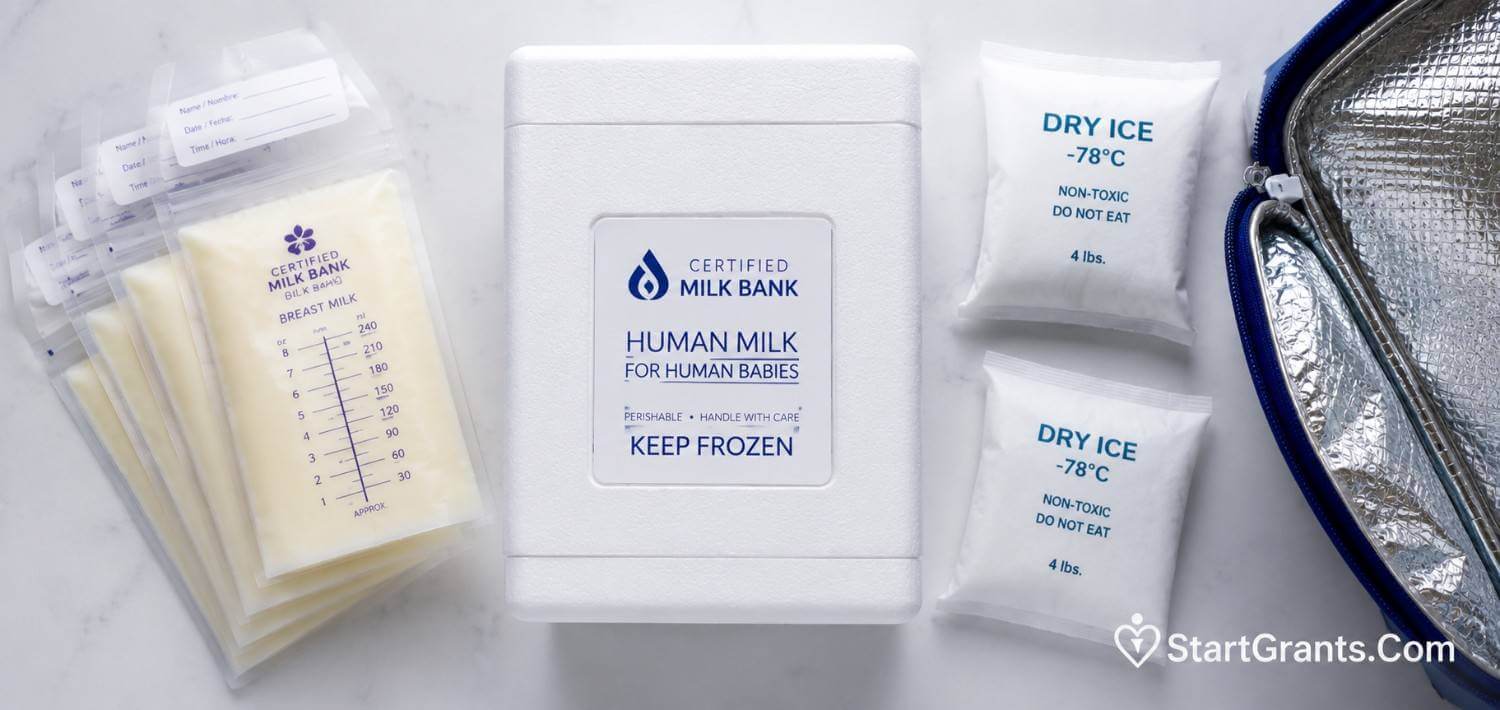
Accredited milk banks provide donors with medical-grade shipping materials and cover all transit costs, ensuring you never pay out of pocket.
Once you are medically cleared, the physical act of donating should never cost you money. Non-profit milk banks strive to make the logistics as seamless as possible for busy mothers.
You can donate milk that you have already pumped and frozen, provided it was pumped in a sterile manner and has been stored in a deep freezer for less than 6 to 8 months. For ongoing donations, the milk bank will ship you sterile storage bags.
The Shipping Process: When you accumulate the minimum required donation (often 100 to 150 ounces), the milk bank will send you a pre-paid, medical-grade shipping cooler lined with dry ice. You simply pack your frozen milk, apply the pre-paid FedEx or UPS label, and drop it off. The milk arrives at the lab, where it is thawed, pooled, nutritionally analyzed, pasteurized, and microbiologically tested before being dispatched to NICUs.
Pro-Tip: Inside the Milk Bank Laboratory
Seeing firsthand how a milk bank processes and tests your donation can provide a tremendous sense of security. Watch this short tour inside an accredited milk bank facility to see your breast milk’s journey from the shipping box, through the pasteurization process, and finally to your premature baby in the NICU:
Phase 5: Bereavement Donation (Healing Through Giving)
One of the most profoundly moving aspects of milk banking is the bereavement donation program. When a mother tragically loses her infant, her body will often continue to produce milk. For many grieving mothers, the painful physical reminder of lactation can be channeled into an act of profound healing.
Milk banks treat bereavement donors with immense compassion. The standard minimum ounce requirements are entirely waived, and the screening process is handled with the utmost sensitivity. Providing sustenance to another fragile infant allows many grieving families to find a spark of light in the darkest of times. This emotional recovery process mirrors the vital support systems we discuss in our guide to donations to cancer survivors, where the act of giving facilitates profound personal healing.
Warning: The Dangers of Peer-to-Peer Milk Sharing
With the rise of social media, informal “peer-to-peer” milk-sharing networks have exploded in popularity on platforms like Facebook. While often well-intentioned, this practice is incredibly dangerous.
The U.S. Food and Drug Administration (FDA) explicitly warns against feeding your baby breast milk acquired directly from individuals over the internet. Milk shared casually is not screened for infectious diseases (like HIV), it is not tested for illegal drug or prescription medication contamination, and it is not pasteurized to destroy harmful bacteria. Furthermore, milk shipped casually without medical-grade dry ice is highly susceptible to spoiling and bacterial overgrowth.
To protect both your own baby and the babies of others, always utilize the official channels of an accredited HMBANA milk bank.
Conclusion: The Ultimate Biological Gift
Donating breast milk is a labor-intensive commitment. It requires hours attached to a breast pump, meticulous sanitization of pump parts, and strict adherence to medical guidelines. However, the reward is immeasurable.
By passing the medical screenings and shipping your milk to an accredited bank, you are providing a clinical shield against fatal illnesses for the most fragile members of society. You are not just feeding a baby; you are actively giving them a chance to survive and thrive.
Frequently Asked Questions (FAQs)
Q1: Do you get paid to donate breast milk?
A: Generally, no. Accredited non-profit milk banks governed by HMBANA operate on a strictly volunteer basis to ensure safety and ethical sourcing. While you are not paid for the milk, the milk bank covers 100% of your expenses, including blood tests, storage bags, and overnight shipping coolers.
Q2: Can I donate milk I pumped months ago?
A: Yes, but there is a time limit. Most accredited milk banks will accept milk that has been stored in a standard freezer for up to 3 to 6 months, or in a deep chest freezer for up to 8 months. The milk must have been pumped in a clean environment and stored in sterile bags.
Q3: Does the milk bank test for drugs and diseases?
A: Yes. The medical screening process is incredibly strict. Every donor must pass a serological blood test that screens for HIV, HTLV, Hepatitis B and C, and Syphilis. Furthermore, the pooled milk is pasteurized and microbiologically tested for bacterial growth before it is shipped to hospitals.
Q4: Can I donate breast milk if I take medication?
A: It depends on the medication. Standard prenatal vitamins and certain birth controls are generally accepted. However, most daily prescription medications, including some antidepressants, and certain herbal supplements (like Fenugreek) will disqualify you. You must disclose all medications during your initial phone interview.
Q5: What happens to the milk after I ship it?
A: Once the frozen milk arrives at the milk bank, it is thawed, pooled with milk from other thoroughly screened donors (to ensure an even distribution of nutrients), nutritionally analyzed, pasteurized to destroy any potential viruses or bacteria, and then frozen again before being dispatched to hospital NICUs.
Important Disclaimer: StartGrants.com is an independent information portal. We are not a medical facility. The information provided is for educational purposes only. Always consult your primary care physician or a certified lactation consultant before initiating the medical screening process for biological donations.