
Last Updated: | Author: Munir Ardi
Pfizer RxPathways connects patients with several types of access support, but Pfizer RxPathways and the Pfizer Patient Assistance Program (PAP) are not identical. RxPathways is the broader navigation service. The PAP is one program that may provide selected Pfizer medicines without charge to eligible patients.
Eligibility depends on the exact medicine, FDA-approved indication, insurance type, household income, residence, outpatient prescriber, required documents, and current program rules. Approval is not automatic, and a medicine associated with Pfizer is not necessarily included on the current PAP free-medicine list.
For non-Pfizer programs and other prescription-cost routes, use our Financial Assistance for Prescription Drugs guide. For the broader healthcare-assistance hierarchy, see Medical Bills and Prescription Assistance.
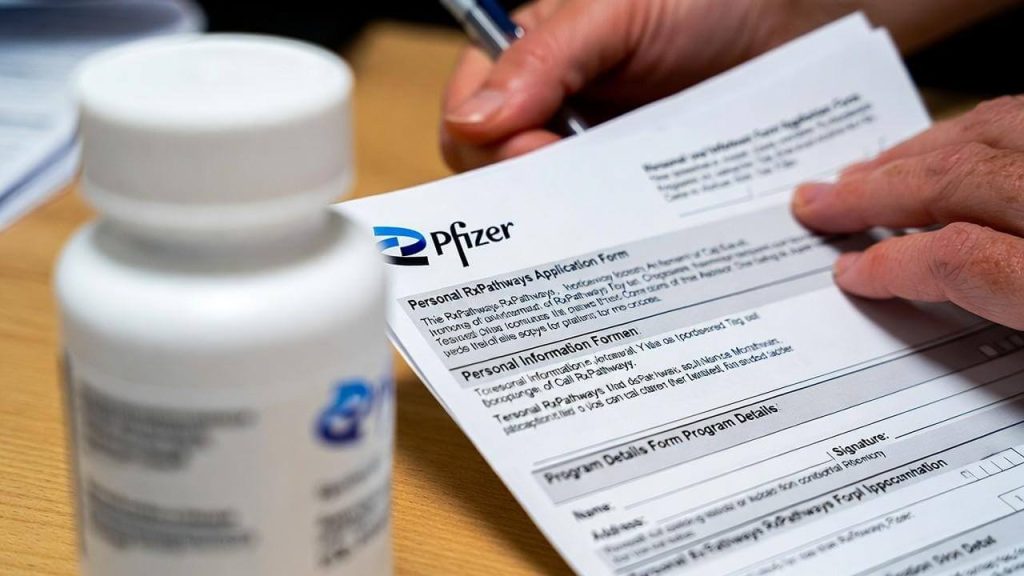
What Pfizer RxPathways Offers
The official Pfizer RxPathways patient page describes several distinct routes:
- Pfizer Patient Assistance Program: selected Pfizer medicines without charge for eligible uninsured or government-insured patients who cannot afford their prescription costs.
- Pfizer Institutional Patient Assistance Program: selected medicines for eligible uninsured patients through participating federally qualified health centers, disproportionate-share hospitals, and free clinics.
- Treatment-specific hub programs: insurance and financial-support navigation for selected oncology or specialty medicines.
- Copay and savings offers: separate offers for eligible patients and medicines, subject to their own terms. Government-program beneficiaries generally are not eligible for Pfizer copay assistance.
Call 1-844-989-PATH (1-844-989-7284) to speak with a Pfizer Medicine Access Counselor or use the official Program Finder. Pfizer lists 1-866-706-2400 for enrolled PAP patients and detailed program questions. Verify current contact information on the official site before sending documents.
Pfizer PAP Eligibility in 2026
Pfizer’s current program eligibility page states that a PAP applicant generally must:
- Seek a Pfizer medicine available through the PAP for an FDA-approved indication.
- Be uninsured or government insured and unable to afford the required prescription cost.
- Have annual household pre-tax income no higher than 300% of the Federal Poverty Level, adjusted for household size.
- Attest to an inability to afford prescription costs.
- Live in the United States or an applicable U.S. territory.
- Have a valid prescription from a healthcare provider licensed in the United States or an applicable U.S. territory.
- Receive treatment in an outpatient setting.
- Submit a completed enrollment form with the healthcare provider and provide required proof of income.
Pfizer states that commercially insured patients, including people with employer coverage or a Federal Employee Plan, are not eligible for the PAP free-medicine route. They may still find a different RxPathways service, treatment hub, or eligible copay/savings offer. Terms and medicine availability vary.
Eligibility rules can change, and additional medicine-specific requirements may apply. Use the Program Finder rather than relying on an old income table or third-party form.
Special Rules for Medicare Patients
Pfizer’s current rules say that, for applicable products covered and reimbursed by Medicare Part D or a Medicare Advantage plan with drug coverage, an applicant must:
- Obtain prior authorization when the insurer requires it.
- Enroll in the voluntary Medicare Prescription Payment Plan.
- Confirm that the annual out-of-pocket threshold has not already been met, meaning the covered medicine does not yet have a $0 copayment.
- Work with the physician’s office, pharmacy, and insurer to understand the copayment and expected annual prescription costs.
The Medicare Prescription Payment Plan spreads qualifying out-of-pocket costs over the calendar year but does not reduce the total drug cost. Enrollment in that plan does not itself guarantee Pfizer PAP approval.
Medicare and other government-program beneficiaries are not eligible for Pfizer’s commercial copay assistance, but they may be considered for the PAP free-medicine route if they satisfy its current requirements.
Check Whether the Exact Medicine Is Available
Do not assume that every Pfizer-branded, co-promoted, acquired, or widely recognized medicine appears in the PAP. Search by exact name and formulation using the Program Finder and review the current Pfizer PAP free-medicine list.
As of this review, the current PDF includes medicines such as Ibrance, Nurtec ODT, Paxlovid, Vyndamax, and Xalkori, among others. The list can change. Eliquis and Xeljanz do not appear on the current PAP free-medicine PDF reviewed for this article; patients prescribed those products should use the Program Finder and current product-specific resources instead of assuming PAP coverage from an older article or advertisement.
Medicine name alone is not enough. Confirm:
- Brand name, generic name, strength, dosage form, and quantity.
- That the diagnosis is an FDA-approved indication accepted by the program.
- Whether the medicine uses PAP Connect, a manual form, or a treatment-specific hub.
- Whether prior authorization or another funding application is required first.
- Where the medicine will be delivered and how refills are requested.
Eligibility and Application Summary
| Requirement | Current PAP rule | What to verify |
|---|---|---|
| Medicine | Must be available through the PAP for an accepted indication | Current list, formulation, diagnosis, and program route |
| Insurance | Uninsured or government insured; commercial insurance is not eligible for PAP | Exact coverage type and alternate RxPathways services |
| Income | Household pre-tax income at or below 300% FPL | Current household definition, FPL table, and accepted proof |
| Residence | United States or applicable U.S. territory | Current address and any requested residency evidence |
| Prescription | Valid outpatient prescription from a properly licensed provider | Prescriber certification, signature, license details, and prescription |
| Medicare Part D/MA | Additional requirements apply for applicable products | Prior authorization, Prescription Payment Plan enrollment, copay, and annual out-of-pocket status |
How to Apply
Pfizer says patients and healthcare providers should begin with the RxPathways Program Finder by entering the prescribed medicine and answering the requested questions.
- Confirm the medicine and program. Determine whether the medicine uses PAP Connect, a downloadable/manual application, or a treatment-specific hub.
- Review insurance requirements. Identify whether the patient is uninsured, commercially insured, or covered by Medicare, Medicaid, TRICARE, VA, or another government program.
- Gather income evidence. Pfizer lists documents such as a W-2, pay stub, or prior-year tax return as possible proof. Use the exact checklist generated for the application.
- Complete the patient section. Provide accurate household, contact, insurance, consent, and attestation information.
- Coordinate with the healthcare provider. The provider must complete the required medical and prescribing portions and submit a valid prescription.
- Submit through the stated channel. Do not use an old fax number or third-party form unless Pfizer confirms it remains valid.
- Keep proof and follow up. Save the complete application, attachments, submission confirmation, and the name or reference number from each call.
Pfizer says applicants are generally notified of enrollment status within two to three weeks. That is an estimate, not a guaranteed delivery date. Incomplete applications, missing documentation, insurance review, medicine-specific requirements, or requests to seek alternative funding can extend the process.
Online and Manual Application Paths
Pfizer PAP Connect allows patients and healthcare providers to apply and manage enrollment online for selected primary-care medicines. It is not available for every product. Pfizer maintains a manual process for patients who cannot use the online system and directs other medicines to the existing RxPathways or treatment-hub process.
The applicant should not assume that the provider must submit a DEA number for every medicine or that one form fits every product. Follow the current form generated by Pfizer.
If the Application Is Denied or the Medicine Is Not Listed
Ask Pfizer for the specific reason and whether missing information can be corrected. Then discuss these routes with the prescriber, pharmacist, and insurer:
- Insurance prior authorization, formulary exception, or appeal.
- A clinically appropriate covered alternative.
- Medicare Extra Help, Medicaid, or a State Pharmaceutical Assistance Program.
- An independent charitable disease fund.
- A community health center, nonprofit pharmacy, or verified lower-cost pharmacy arrangement.
- A different manufacturer program when the prescribed medicine changes.
For example, a patient prescribed a medicine made by another sponsor can consult our Johnson & Johnson Patient Assistance guide. This is an alternative research path, not a substitute for the medicine the clinician prescribed.
A Muslim Perspective on Pfizer Assistance
Muslim patients may wish to obtain necessary medicine without entering an interest-bearing credit arrangement. Medicine provided without repayment through a verified assistance program generally differs from a loan, but the current enrollment, consent, privacy, duplicate-benefit, and renewal terms should still be reviewed.
Apply for verified assistance and insurance benefits before considering credit. Other possible avenues include a genuine no-interest arrangement, a documented qard hasan, or help from a mosque or zakat committee under its own eligibility rules. No national Islamic organization guarantees payment for a Pfizer prescription.
Avoid declaring a program automatically permissible solely because it is described as “free.” A qualified Islamic-finance scholar can review the actual agreement, while medication decisions belong to qualified healthcare professionals. Do not delay urgent treatment or alter therapy while seeking a preferred payment arrangement. This article does not issue a fatwa.

Save This Pfizer PAP Checklist
Frequently Asked Questions
Is Pfizer RxPathways the same as the Pfizer Patient Assistance Program?
No. Pfizer RxPathways is a broader navigation service connecting patients to Pfizer and independent resources. The Pfizer Patient Assistance Program is one specific route that provides selected medicines without charge to eligible patients.
What is the Pfizer PAP income limit in 2026?
Pfizer’s current program page states that annual household pre-tax income cannot exceed 300% of the Federal Poverty Level, adjusted for household size. Additional requirements apply, and rules can change.
Can commercially insured patients qualify for the Pfizer PAP?
Pfizer’s current PAP rules say commercially insured patients are not eligible for the free-medicine PAP route. They may qualify for a separate copay or savings offer, treatment hub, or another resource, subject to its terms.
Can Medicare patients apply for the Pfizer PAP?
Potentially. For applicable Part D or Medicare Advantage products, Pfizer requires additional steps including prior authorization when required, Medicare Prescription Payment Plan enrollment, and confirmation that the annual out-of-pocket threshold has not been reached.
Does Pfizer require proof of U.S. citizenship?
Pfizer says it does not require proof of U.S. citizenship, but applicants must satisfy the current residence and address requirements for the United States or an applicable U.S. territory.
Are Eliquis and Xeljanz on the current Pfizer PAP free-medicine list?
They do not appear on the current PAP free-medicine PDF reviewed for this article. Use the official Program Finder and product-specific resources because lists and assistance routes can change.
Does PAP Connect work for every Pfizer medicine?
No. PAP Connect supports selected primary-care medicines. Other products use the existing RxPathways application or a treatment-specific hub, and a manual process remains available in qualifying situations.
How long does Pfizer take to decide an application?
Pfizer says patients are generally notified of enrollment status within two to three weeks. Missing documents, medicine-specific requirements, insurance review, or alternate-funding requirements can cause delays.
Where is approved Pfizer PAP medicine delivered?
Pfizer says eligible medicines may be provided through the doctor’s office or, in some cases, at home. The delivery and refill process depends on the medicine and program route.