
Last Updated: June 2026 | Author: Zee
Raising a child is expensive, but raising a child with severe disabilities introduces an entirely different financial reality. Between specialized pediatric physical therapy, speech-language pathology, accessible home modifications, and lifelong medical equipment, the costs can easily exceed tens of thousands of dollars a year. Many parents incorrectly assume that because they have middle-class jobs, they will not qualify for government assistance.
Before executing your funding strategy for your child, it is vital to review our command center on disability and mental health grants to understand how federal aid flows into state programs. Furthermore, because play is a crucial component of occupational therapy, parents should also cross-reference our guide on finding toys for children with disabilities and grants sources to pay for expensive adaptive equipment.
You do not have to bankrupt your family to give your child the care they deserve. The government has specific carve-outs designed to catch children who fall through the cracks of commercial health insurance. Here is your 2026 guide on how to get government grants for disabled children.
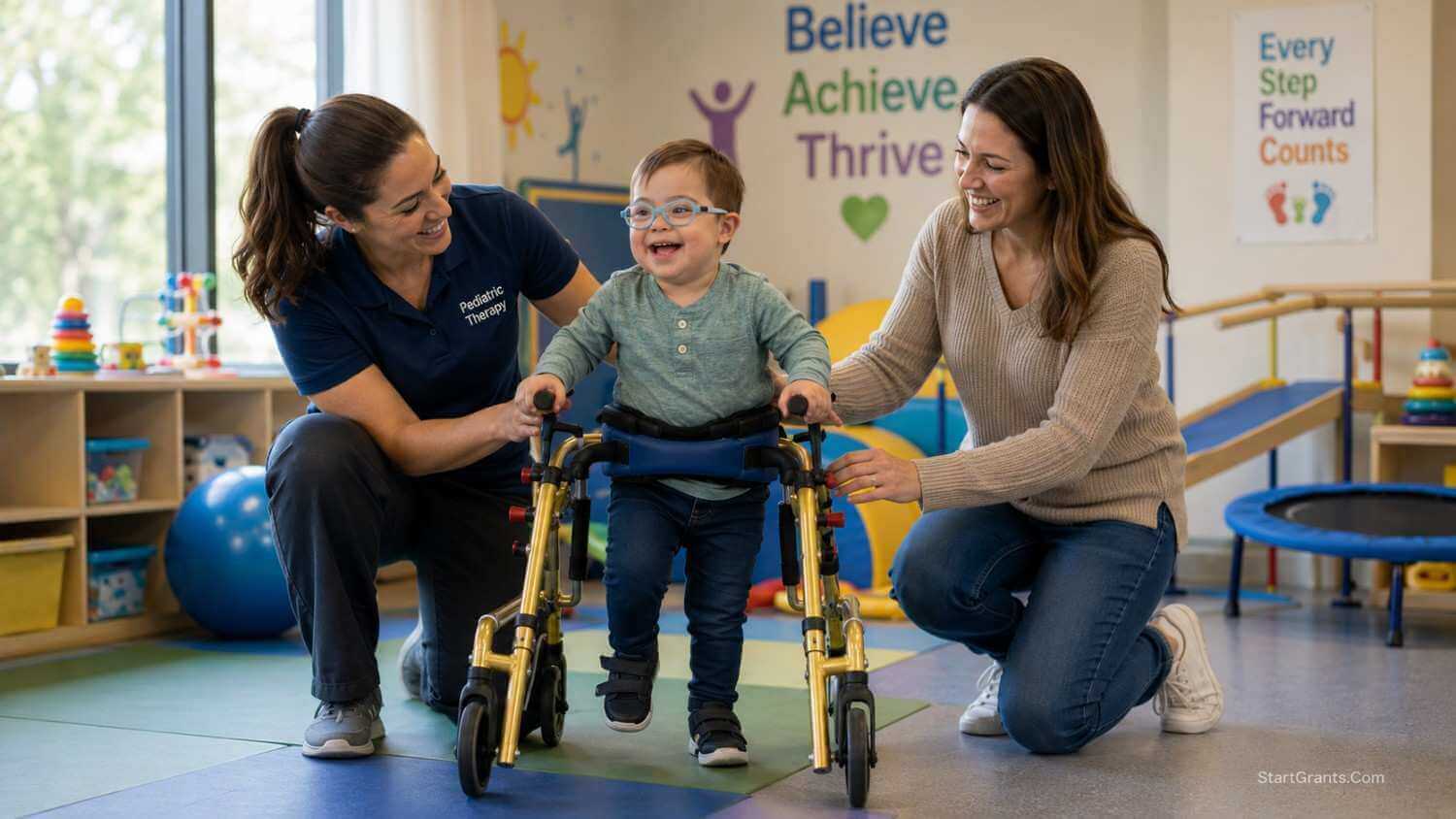
Early intervention therapies and specialized equipment are vital for a disabled child’s development. Government grants and Medicaid waivers are designed to ensure your child reaches their maximum potential without bankrupting your family.
Phase 1: Supplemental Security Income (SSI) for Children
The first line of defense is the Social Security Administration (SSA). The SSA provides Supplemental Security Income (SSI), which offers monthly cash payments to families of children with severe physical or cognitive disabilities.
To qualify for SSI, your child must meet the SSA’s strict medical definition of disability. However, the biggest hurdle for SSI is the “Deeming” process. The SSA “deems” (counts) the parents’ income and assets to determine the child’s eligibility. If your household income exceeds the strict federal poverty thresholds, your child will be denied SSI cash benefits, regardless of how severe their disability is. If you are denied due to income, do not panic—you must immediately move to Phase 2.
Phase 2: The “Katie Beckett” Medicaid Waiver (The Game Changer)
If you are a middle-class family making too much money for SSI, but your child requires institutional-level care (like at-home nursing or specialized feeding tubes), the Katie Beckett Waiver (also known as the TEFRA Waiver) is your lifeline.
Established in the 1980s, this specific Medicaid waiver allows states to ignore the parents’ income when determining the disabled child’s eligibility. The state only looks at the child’s income (which is usually zero). This loophole allows children of middle-income and even upper-income families to receive full Medicaid coverage to pay for expensive in-home care and therapies that private insurance refuses to cover.
Pro-Tip: Overcoming Income Limits
Watch this explanation to understand how the Katie Beckett Medicaid Waiver allows you to bypass parental income restrictions and secure comprehensive medical coverage for your disabled child:
Phase 3: Early Intervention (IDEA Part C)
If your child is under the age of 3 and shows signs of developmental delays (like not walking, talking, or making eye contact), you are legally entitled to federal assistance under the Individuals with Disabilities Education Act (IDEA) Part C.
Every state receives federal block grants to run an Early Intervention program. Regardless of your income, the state will send pediatric physical therapists, occupational therapists, and speech-language pathologists directly to your home to evaluate and treat your child, often entirely for free or on a very low sliding scale. Once your child turns 3, this funding transitions to the public school system under an Individualized Education Program (IEP).
Phase 4: The Muslim Perspective (Amanah, Cultural Stigma, & Zakat)

A child with disabilities is an Amanah (sacred trust), not a punishment. The immense Sabr (patience) required to care for them is heavily rewarded in Islam, and utilizing Zakat for their medical needs ensures your journey remains blessed.
For Muslim parents, a severe pediatric diagnosis can trigger a painful collision with toxic cultural superstitions, making a strong grounding in pure Islamic theology essential for the family’s survival.
1. Erasing the “Punishment” Myth
In many cultures, there is a horrific and un-Islamic stigma that a child born with a disability (like Autism, Down syndrome, or Cerebral Palsy) is a “punishment” from Allah for the parents’ past sins, or the result of the “Evil Eye” (Ain) that cannot be medically treated. This is entirely false. In Islam, a disabled child is a pure, sinless soul and a profound Amanah (sacred trust). They are a guaranteed path to Jannah for parents who raise them with love, dignity, and Sabr (patience).
2. Funding Therapies via Zakat
Seeking the absolute best medical care and early intervention for your child is an act of Tadawi (seeking treatment). However, the cost of specialized pediatric wheelchairs or private ABA therapy can drive a family into taking out high-interest medical loans.
Islam strictly forbids Riba (usury). A family drowning in debt to keep their disabled child alive falls under the Zakat category of Al-Gharimin (those overwhelmed by debt). It is a religious obligation for the Muslim community to support these families. You are fully justified in utilizing Zakat funds from local Islamic charities to pay for your child’s medical therapies, ensuring their development is funded through Halal, blessed means.
Conclusion: Building Your Child’s Safety Net
Securing funding for a disabled child requires aggressive advocacy. The systems are bureaucratic, and the waiting lists can be long, but the funds are real and life-changing.
Your action plan is clear: First, apply for SSI. If denied due to your income, immediately petition your state’s Department of Health for the Katie Beckett Medicaid Waiver. Concurrently, trigger your state’s Early Intervention program under IDEA Part C to get therapists into your home immediately. Do not let financial fear steal your child’s potential.
Frequently Asked Questions (FAQs)
Q1: Does the Katie Beckett Waiver cover autism?
A: Yes, depending on the severity. If a child with severe autism requires intensive, institutional-level care (such as constant supervision to prevent self-harm or wandering), many states will approve the Katie Beckett Waiver, which can then be used to pay for specialized behavioral therapies.
Q2: Can I get paid to be the caregiver for my disabled child?
A: Yes, in many states. Through Medicaid waivers (once your child is approved), programs like “Consumer Directed Personal Assistance Programs” (CDPAP) allow the state to pay a parent an hourly wage to act as the child’s official, full-time caregiver.
Q3: What happens to my child’s SSI when they turn 18?
A: When a disabled child turns 18, the SSA conducts an “Age-18 Redetermination.” The parental “deeming” of income completely stops. The child is now evaluated as a legal adult based solely on their own income and assets, meaning many children who were previously denied SSI due to their parents’ wealth suddenly become eligible.
Q4: Are there grants specifically for pediatric wheelchairs or adapted vans?
A: Yes. If Medicaid denies the equipment, philanthropic foundations like the UnitedHealthcare Children’s Foundation (UHCCF) and the Variety Children’s Charity provide direct cash grants to families to purchase adaptive bicycles, pediatric wheelchairs, and specialized car seats.
Important Disclaimer: StartGrants.com is an informational directory and does not provide legal or financial advice. Medicaid Waiver rules vary drastically by state. Always consult a pediatric social worker or a special needs trust attorney to structure your child’s financial future securely.