
Last Updated: June 2026 | Author: Robert
For military veterans, migraines are not just “bad headaches”; they are debilitating neurological events that destroy the ability to work, socialize, and function. The Department of Veterans Affairs (VA) recognizes this severity, but their rating system is notoriously rigid. If you do not use the exact terminology required by the VA schedule of ratings, a migraine that leaves you bedridden for days might only receive a 0% or 10% rating.
Before diving into VA claims, if you are looking for non-military philanthropic funding, please review our central directory for disease-specific financial assistance. Additionally, because migraines are almost always tied to head trauma or blast exposures, veterans should critically cross-reference our guide on how to get traumatic brain injury grants to ensure you are capturing all available resources for cognitive care.
The maximum schedular rating you can receive for migraines from the VA is 50%. Getting there requires more than just a doctor’s diagnosis; it requires a tactical assembly of evidence. Here is your 2026 blueprint on how to get 50% VA disability for migraines and build an undeniable claim.
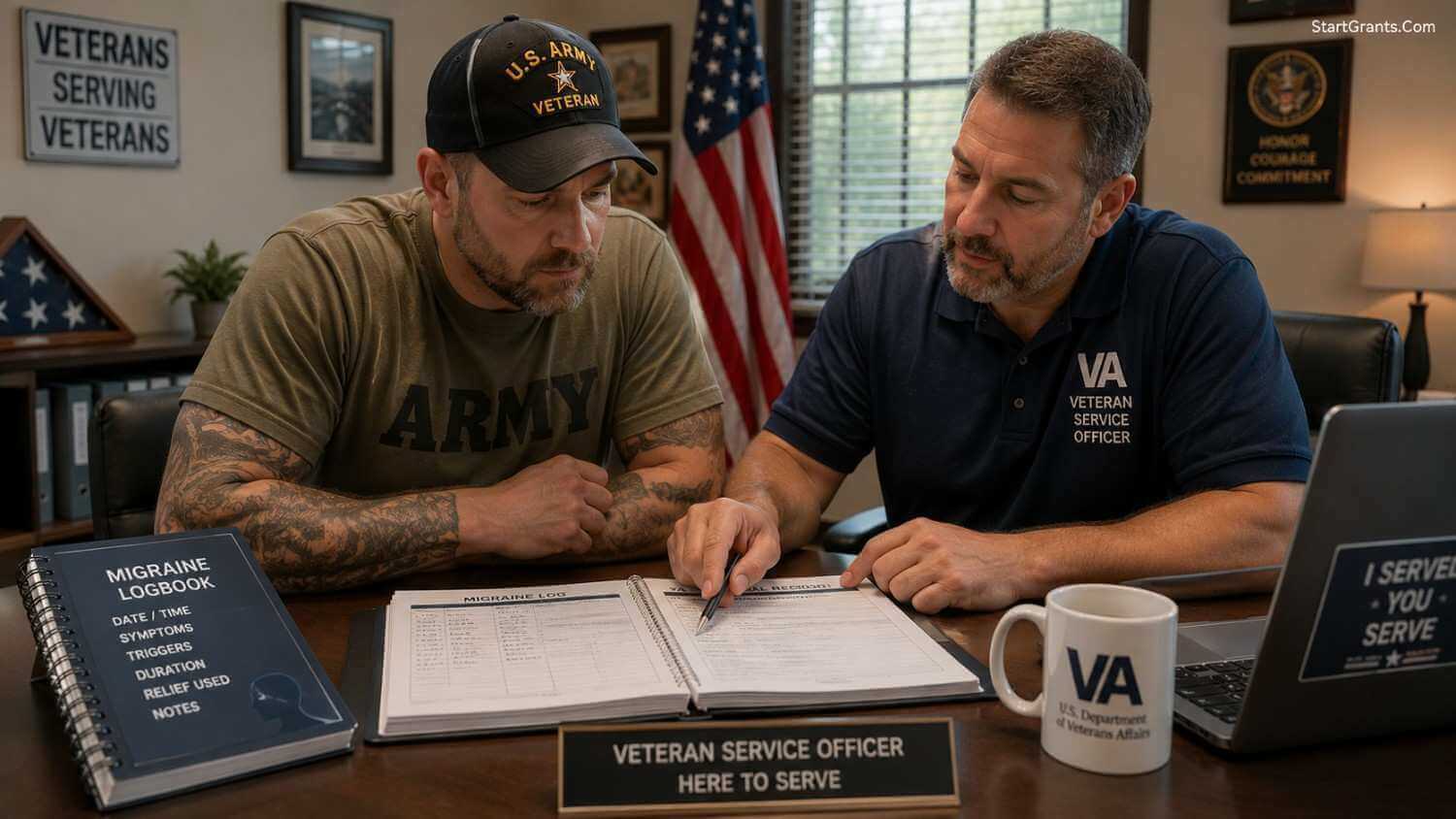
Getting a 50% rating for migraines is the maximum allowed by the VA. To achieve it, you must legally prove that your headaches are completely “prostrating” and cause severe economic loss.
Phase 1: The Magic Word (“Prostrating”)
Under 38 CFR 4.124a (Diagnostic Code 8100) of the official VA disability rating schedule, the VA rates migraines at 0%, 10%, 30%, or 50%. The difference between a 30% rating and the coveted 50% rating boils down to two highly specific legal phrases.
To secure a 50% rating, your medical evidence must prove that your migraine attacks are:
- Completely Prostrating: The VA defines “prostrating” as an attack so severe that it forces you to stop all activity and lay down in a dark, quiet room to seek relief. If you can “push through” the headache and keep working, the VA will not consider it prostrating.
- Productive of Severe Economic Inadaptability: This means the migraines happen so frequently that they severely impact your ability to hold down a job or cause excessive missed days at work (absenteeism).
Pro-Tip: Translating Symptoms to VA Language
Watch this deep dive by a VA claims expert to understand exactly how the VA evaluator looks for “prostrating” evidence during your Compensation and Pension (C&P) exam:
Phase 2: Primary vs. Secondary Service Connection
Proving you have migraines is only half the battle; you must prove they were caused by your military service. If you do not have medical records of reporting headaches while on active duty (Primary Connection), you must file a Secondary Service Connection claim.
A secondary claim states that an already service-connected disability is causing your migraines. The most successful secondary links for migraines include:
- Secondary to TBI: Traumatic Brain Injuries and concussions are leading triggers for chronic migraines.
- Secondary to Tinnitus: The constant ringing in the ears is clinically proven to induce severe tension and migraine headaches.
- Secondary to PTSD: The severe stress, anxiety, and sleep apnea associated with Post-Traumatic Stress Disorder frequently manifest physically as crippling migraines.
To win a secondary claim, you must obtain an Independent Medical Opinion (IMO) or a “Nexus Letter” from a private doctor stating that your migraines are “at least as likely as not” caused by your primary service-connected condition.
Phase 3: Building the Evidence (The Migraine Log)
The VA rater reading your file has never met you. You cannot just tell them you have severe migraines; you must paint a data-driven picture of your suffering.
- The 6-Month Migraine Log: Download a free app like Migraine Buddy. For at least 3 to 6 months before filing your claim, log every single attack. Note the date, duration, severity, and crucially, whether you had to lay down (prostrating) and if you missed work.
- Employment Evidence: Submit copies of your timecards showing sick leave taken on the days you logged a migraine. This proves the “economic inadaptability” requirement for the 50% rating.
- Buddy Statements (VA Form 21-10210): Have your spouse or a coworker write a sworn statement describing what they witness when you have an attack (e.g., “He locks himself in the bedroom with the blackout curtains drawn for two days and throws up from the pain”).
Phase 4: The Muslim Perspective (Haqq, Sabr, & Avoiding Sharks)

Disability compensation is a rightful entitlement (Haqq) for your injuries, not charity. Protecting your backpay from predatory “Claim Sharks” ensures your financial recovery remains ethical and blessed.
For Muslim veterans, navigating the VA system requires a blend of spiritual endurance (Sabr) and strict adherence to Islamic financial ethics.
1. VA Compensation is Haqq (A Rightful Claim)
It is important to understand that VA disability compensation is not welfare, charity, or Zakat. It is legal restitution (Haqq) for injuries sustained while fulfilling a contractual obligation of military service. Claiming your rightful compensation to provide for your family is highly commendable in Islam. It falls under the obligation of ensuring your dependents are taken care of financially.
2. The Danger of “Claim Sharks” (Unethical Contracts)
Because the VA system is complex, unaccredited consulting companies—often called “Claim Sharks”—prey on frustrated veterans. They promise to get you a 50% migraine rating but force you to sign a contract surrendering 5 or 6 months of your VA backpay (often amounting to thousands of dollars).
In Islamic finance, such contracts are highly problematic. Charging exorbitant, unverified contingency fees borders on Gharar (deception/uncertainty) and financial exploitation. To keep your wealth Halal, entirely avoid these predatory companies. Instead, utilize free, legally accredited Veteran Service Officers (VSOs) through organizations like the Disabled American Veterans (DAV), VFW, or American Legion, who are legally bound to assist you without taking a dime of your hard-earned backpay.
Conclusion: Executing the Mission
Securing a 50% VA disability rating for migraines requires treating your claim like a military operation. Do not go into a C&P exam unprepared.
Arm yourself with a detailed 6-month migraine log, secure a strong Nexus letter linking the headaches to your PTSD or TBI, and explicitly document every hour of work you have missed. By speaking the VA’s language of “prostrating” attacks and protecting your backpay from unaccredited sharks, you can successfully secure the maximum compensation you have earned.
Frequently Asked Questions (FAQs)
Q1: Can I get more than 50% for migraines?
A: No. Under the current VA rating schedule (38 CFR 4.124a, Diagnostic Code 8100), 50% is the absolute maximum schedular rating you can receive for migraines alone. However, if your migraines completely prevent you from holding any job whatsoever, you can apply for TDIU (Total Disability based on Individual Unemployability), which pays you at the 100% rate.
Q2: What is a VA Nexus Letter?
A: A Nexus Letter is an official document written by a qualified medical professional that explicitly links your current medical condition (migraines) to an event or illness that occurred during your military service. It is the crucial bridge required to prove “Service Connection.”
Q3: Does the VA consider Gulf War Syndrome a cause for migraines?
A: Yes. Under the Gulf War Presumptive conditions (and expanded by the PACT Act), veterans who served in the Southwest Asia theater of operations and suffer from medically unexplained chronic multisymptom illnesses (which frequently include severe headaches and migraines) can be granted service connection without needing to prove a specific inciting incident.
Q4: Can I use an outside doctor for my C&P Exam?
A: No. The Compensation and Pension (C&P) exam must be conducted by a VA doctor or a VA-contracted examiner (like QTC, VES, or OptumServe). However, you can and should bring outside medical evidence, like your private neurologist’s notes and Nexus letter, to the exam to submit to the evaluator.
Important Disclaimer: StartGrants.com is an informational directory, not a legal entity or accredited VA representative. Laws regarding VA claims change frequently. Always consult an accredited Veteran Service Officer (VSO) or a VA-accredited attorney before filing or appealing a disability claim.