
Last Updated: July 2026 | Author: Munir Ardi
Every year, billions of dollars in federal and private funding are left on the table simply because nonprofit organizations do not know how to ask for it. The truth is, government agencies actively want to give you money—they rely on local charities to solve community problems they cannot solve themselves.
However, securing these funds is not about writing a passionate plea; it is about providing a logical, data-driven argument. This is the precise science of writing grants for nonprofits. A winning proposal bridges the gap between your organization’s mission and the funding agency’s strategic goals.
Before you begin typing a single word of your proposal, you must ensure your organization is legally qualified to receive federal funds. Verify your 501(c)(3) compliance by reviewing our central operational pillar: Government Grants for Nonprofit Organizations & 501(c)(3) Opportunities.

Writing a successful federal grant requires meticulous data gathering, a compelling narrative, and an airtight budget.
Phase 1: The Anatomy of a Winning Grant
Grant writing is highly formulaic. While every federal agency has its specific format, 90% of all government grants require the same core components: the Executive Summary, the Needs Statement, the Project Design (Methodology), the Evaluation Plan, and the Budget. Failing to align these five elements is the number one reason proposals are rejected.
Phase 2: Defining the Need (The Problem Statement)
The “Needs Statement” is the beating heart of your proposal. This is where you prove to the government that a severe problem exists in your community and that it demands immediate financial intervention.
A fatal mistake rookie grant writers make is assuming the reviewer automatically understands the problem. You must prove it using hard, verifiable data. Do not say, “Many kids in our city are failing math.” Instead, state: “According to the 2025 State Department of Education report, 68% of middle school students in District 4 are performing below the national average in mathematics.”
Pro-Tip: Modern Grant Architecture
Grant requirements evolve rapidly. The format that worked last year may get you rejected today. To stay ahead of shifting federal guidelines, watch this updated guide, How To Write A Grant Proposal Step-by-Step | Things Have Changed!, which breaks down the modern architecture of a winning federal proposal:
Phase 3: Structuring the Solution & Budget
Once you have proven the problem exists, your project design must offer a logical, step-by-step solution. Your timeline must be realistic, and your budget must be mathematically flawless. Reviewers will cross-reference your narrative with your budget spreadsheet; if you ask for $50,000 for “equipment” but do not detail it in the narrative, your application will be red-flagged.
Because mastering the narrative flow and budget layout requires highly specific templates, we have isolated these tactics into specialized Tier-3 guides. Expand your grant writing arsenal by exploring these sibling resources:
- The Master Template: Learn exactly how to format your narrative, goals, and objectives by studying how to write a government grant proposal.
- The Scientific Pivot: If your nonprofit conducts medical, environmental, or STEM-based initiatives, standard rules do not apply. You must adapt your writing by reading our tips on applying for research grants.
Phase 4: Official Outlets & Federal Gatekeepers
You cannot submit a federal grant proposal via a generic email. All official federal grant applications must be written for and submitted through the government’s highly secure, centralized clearinghouse.
Once your proposal draft is pristine, your grant administrator must navigate to Grants.gov, locate the specific Notice of Funding Opportunity (NOFO), and upload the required PDF narratives and SF-424 budget forms through your organization’s secure workspace.
Phase 5: The Muslim Perspective (Ethical Budgets, Riba & Takaful)
For Islamic charities, Masjids, and Muslim-led NGOs operating in the United States, writing a grant proposal introduces unique ethical challenges—particularly when drafting the financial budget and compliance sections of the application.
The Danger of Bridge Loans and Riba
Many government grants are “reimbursement grants.” This means the nonprofit must spend the money upfront to run the program, and the government reimburses them later. In the West, standard practice dictates that nonprofits take out short-term “bridge loans” from commercial banks to float the costs, paying Riba (interest) in the process.
In Islamic finance, engaging in Riba is explicitly Haram (forbidden). When writing your grant’s financial sustainability plan, Muslim grant writers must explicitly outline Halal liquidity strategies. Instead of forecasting commercial bridge loans, your proposal should highlight robust internal cash reserves, zero-interest Qard Hasan (benevolent loans) from community members, or dedicated Waqf (endowment) yields to float program costs.
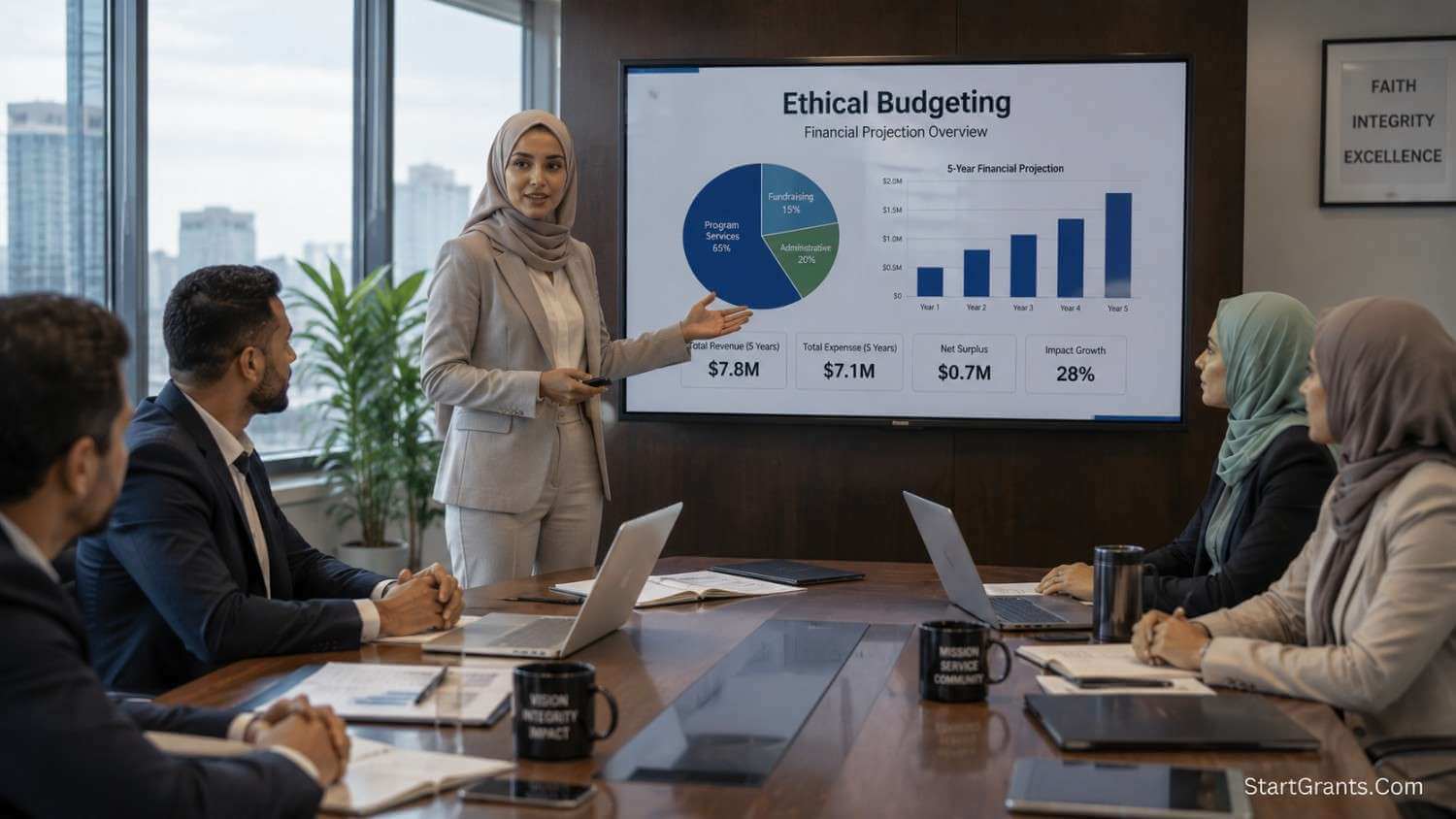
When drafting a grant budget, Muslim nonprofits must prioritize ethical risk management (Takaful) and completely avoid forecasting interest-bearing debt (Riba).
Navigating Commercial Insurance (Gharar) with Takaful
Federal grants almost universally require the grantee to purchase extensive liability insurance to protect the government’s investment. However, traditional commercial insurance is plagued by Gharar (excessive uncertainty and speculation) and Maisir (gambling elements), rendering standard policies highly problematic for strict Islamic compliance.
To write an ethically compliant proposal, Muslim organizations should seek out Takaful (Islamic cooperative insurance) providers where risk is shared collectively rather than transferred for profit. While full Takaful options are still developing in the U.S., organizations like the Islamic Society of North America (ISNA) provide guidance to Masjids on securing the most ethically compliant liability coverage available to satisfy federal grant requirements without compromising core values.
Pro-Tip: Mastering the Needs Statement
The “Needs Statement” is the beating heart of your proposal. You must prove a severe problem exists using hard, verifiable data. Many rookie writers fail by being too vague. Watch this masterclass, How to write a need statement for your grant proposals, to learn exactly how to frame your data in a way that commands the attention of funding agencies:
Conclusion
Writing grants for nonprofits is a highly structured, data-driven endeavor. It requires stripping away emotion and replacing it with verifiable community needs, logical methodologies, and pristine budgeting. By mastering the core fundamentals of the Needs Statement and the Project Design, your organization can tap into massive federal resources.
For Muslim organizations, the grant writing process extends beyond mere compliance; it is an exercise in ethical financial planning. By proactively engineering your budgets to avoid Riba-based bridge loans and navigating mandatory insurance requirements through cooperative Takaful principles, your nonprofit can secure transformative government Hibah (gifts) while maintaining absolute spiritual integrity.
Frequently Asked Questions (FAQs)
Q1: Can I hire someone to write a grant for my nonprofit?
A: Yes. Many nonprofits hire professional freelance grant writers. However, ethical grant writers charge a flat hourly rate or a project fee. It is widely considered unethical (and against the rules of many federal grants) to pay a grant writer a “percentage” or “commission” of the grant if it is awarded.
Q2: What is the most important part of a grant proposal?
A: While the budget is critical, the “Needs Statement” (or Statement of Need) is generally considered the most important narrative section. If you cannot convince the reviewer using hard data that a severe problem exists, they will not care about your proposed solution.
Q3: How long should a government grant proposal be?
A: It varies drastically by agency. A local foundation grant might require a 3-page narrative, while a federal grant from the Department of Education or NIH NOFO might require a strict 25-to-50-page narrative, excluding budget spreadsheets and appendices. Always strictly follow the NOFO guidelines.
Q4: Is it Haram to use a commercial bridge loan while waiting for a reimbursement grant?
A: Yes. If a commercial bridge loan involves paying or accumulating Riba (interest) to the bank, it is strictly Haram in Islamic finance, regardless of the charitable nature of the project. Islamic nonprofits must use existing reserves, Qard Hasan (interest-free community loans), or Waqf funds to float costs.
Q5: What is Takaful, and why is it preferred over standard insurance in grants?
A: Takaful is the Islamic alternative to commercial insurance. It is based on mutual cooperation, shared responsibility, and joint indemnity, eliminating the forbidden elements of Gharar (uncertainty) and Maisir (gambling) found in standard policies. Muslim nonprofits should prioritize Takaful models to fulfill the liability requirements of federal grants.