
Last Updated: | Author: Munir Ardi
Losing someone is hard enough without being asked to make expensive decisions in a few hours. If there is no insurance, savings, or usable estate, pause before signing a funeral contract or borrowing money. A dignified farewell does not require the most expensive package, and several public or community routes may help. However, there is no single nationwide “free funeral” program, and being poor does not automatically qualify a family for payment.
This guide explains the last-resort options available in the United States, including local indigent-disposition programs, state burial benefits, Social Security and veterans benefits, crime-victim compensation, Tribal assistance, charities, fundraising, and lower-cost arrangements. For a wider overview, see our guide to financial assistance for funeral expenses.
Funeral prices vary by provider and location. The latest national study available from the National Funeral Directors Association reported a 2023 median of $8,300 for an adult funeral with viewing and burial and $6,280 with viewing and cremation; those figures exclude some cemetery, monument, and cash-advance charges. See the NFDA study release and scope. The figures are useful context—not a quote for your family. Ask providers for itemized prices before agreeing to services.

If the Death Just Occurred: Take These Steps Before Paying
- Tell the hospital, medical examiner, hospice, or funeral home that the family cannot pay. Ask who controls the remains now and how long you have to make arrangements.
- Do not authorize services you cannot afford. A relative who signs a contract may become personally responsible under that contract even when the deceased left no money.
- Call the city or county office that handles indigent or unclaimed deaths. Depending on the location, this may be the coroner, medical examiner, social services department, public administrator, health department, human services office, or township trustee. The USA.gov local-government directory can help you locate the correct jurisdiction.
- Ask whether approval is required before disposition. Some programs do not reimburse a funeral that has already been paid or completed. Maryland’s burial-assistance program, for example, says it cannot reimburse expenses already paid.
- Call 211 and two or three funeral homes. Ask 211 for burial assistance, faith-community funds, victim services, veterans help, and low-cost funeral providers. Then request comparable, itemized prices from funeral homes.
If the deceased had a bank account, insurance policy, prepaid plan, union benefit, employer benefit, pension, veterans eligibility, or claim against another party, disclose it accurately. A public program may count those resources, seek reimbursement from the estate, or deny assistance when another payer is available.
How Indigent Burial and Public Disposition Actually Work
“Indigent burial” is not one national program. State and local laws determine who has responsibility for unclaimed remains, who must apply, which financial records are reviewed, whether relatives have a legal duty, and what services are provided. Never assume that simply declining to claim a body transfers every cost to the county without consequences.
| Possible local model | What it may provide | Important limitation |
|---|---|---|
| Family burial assistance | A capped payment or direct payment to an approved provider | The family may need approval first and may owe costs above the limit |
| County or municipal disposition | Basic cremation or burial arranged under a public contract | The family may have little choice over provider, timing, service, container, or return of remains |
| Unclaimed-remains process | Disposition after required efforts to identify or notify relatives | This is not necessarily an application-based funeral benefit for a family |
Local rules can differ sharply. Napa County, California, requires both the deceased and the person legally responsible for disposition to be indigent; its county process does not include a service or viewing and does not return remains to the family. By contrast, New York City’s Burial Assistance program may contribute toward eligible funeral expenses within its own cost rules. These examples show why advice from another state or county should not be treated as your local policy.
Questions to Ask the Local Program
- Who may apply, and does the deceased need to have lived or died in this jurisdiction?
- Must the applicant be the legally responsible next of kin?
- What income, asset, estate, insurance, or family-resource tests apply?
- Is this a payment toward a family-arranged funeral or a government-controlled disposition?
- Is cremation required? Is burial available for documented religious reasons?
- May the family hold a separate memorial, witness the burial, or receive cremated remains?
- Which funeral homes participate, and must the program approve the provider first?
- What is the deadline? Are already-paid expenses ineligible?
- Can the government recover costs from the estate, insurance, or later-discovered assets?
Request the answer in writing or ask for the program policy. If a staff member says the family must sign away control, authorize cremation, or accept financial liability, read the document carefully before signing.
Public Benefits That May Help With Funeral Costs
State, County, City, or Township Burial Assistance
Some human-services agencies provide burial or cremation assistance for people who received certain benefits or died with insufficient resources. Others limit help to people who were indigent, unclaimed, or members of a specified eligibility group. Payment may go directly to a funeral provider rather than to the family. There is no reliable national dollar range: benefits and deadlines differ by program and can change.
Search the official website for the place where the deceased lived or died using terms such as “burial assistance,” “indigent disposition,” “public cremation,” or “unclaimed remains.” If no result appears, call the medical examiner, coroner, or local human-services office.
Social Security Lump-Sum Death Payment
Social Security does not provide a general funeral grant. A one-time $255 lump-sum death payment may be payable to a qualifying surviving spouse or, when there is no eligible spouse, certain eligible children. The Social Security Administration says an application generally must be filed within two years of the death. Review the official SSA eligibility and application instructions rather than assuming every spouse or child qualifies.

Veterans Burial Benefits
Eligible veterans may qualify for burial in a VA national cemetery, a government headstone or marker, a burial flag, and—in some cases—a burial allowance. Eligibility and reimbursement depend on service history, discharge status, cause of death, burial location, and who paid the expenses. The VA burial-allowance page lists current rates and claim requirements.
For help reporting a military death, reaching emergency communications, and understanding the difference between Red Cross support and VA benefits, use our guide to funeral help for military members and their families. Do not describe the Red Cross as a universal funeral payer; its role and available assistance depend on the circumstances.
Crime-Victim Compensation
When a death resulted from a qualifying crime, the state or territorial victim-compensation program may reimburse some funeral or burial expenses. Reporting, cooperation, filing deadlines, payer-of-last-resort rules, and benefit caps vary. The U.S. Department of Justice’s Office for Victims of Crime explains the system and links to state programs. A victim advocate, prosecutor’s office, or law-enforcement agency can also help identify the correct application.
Burial Assistance for Eligible American Indians and Alaska Natives
The Bureau of Indian Affairs Financial Assistance and Social Services program may provide burial assistance for an eligible indigent Indian when the estate lacks sufficient resources. In 2024, BIA announced an increase to as much as $3,500 per burial, but eligibility and access depend on program rules and local administration. Contact the serving BIA agency or Tribal social-services office and verify the current amount through the official BIA announcement.
Help Related to a Terminal Illness
A cancer diagnosis does not create an automatic federal funeral benefit, but a hospital social worker, hospice team, disease-specific nonprofit, employer, union, or local charity may identify limited assistance. Families whose resources were exhausted during cancer treatment can use our guide to funeral-cost help after a cancer death. Apply only through organizations you can verify, and ask whether payment is made to the family or directly to a provider.
Charities, Faith Communities, and Fundraising
Charitable help is usually local, limited, and not guaranteed. A church, mosque, synagogue, mutual-aid group, community foundation, fraternal organization, employer, union, or funeral home may contribute a small amount, provide a cemetery plot, waive a fee, or pay a vendor directly. Ask for a specific need—such as the cremation fee, grave opening, transportation, or death certificates—rather than requesting an undefined “funeral grant.”
Our review of charities that may help with funeral costs explains how to verify eligibility and avoid assuming that a national nonprofit pays every applicant. Contact several local sources because one organization may cover only a single line item.
If no program can decide in time, a transparent fundraiser can bridge a documented gap. State who is organizing it, name the deceased, explain the arrangement selected, show the amount still needed, and say what will happen to excess funds. Our guide on how to ask for funeral donations respectfully includes wording and documentation tips. Remember that crowdfunding platforms and payment processors may charge fees and do not guarantee donations.
Whole-Body Donation Is Not an Emergency “Free Funeral” Guarantee
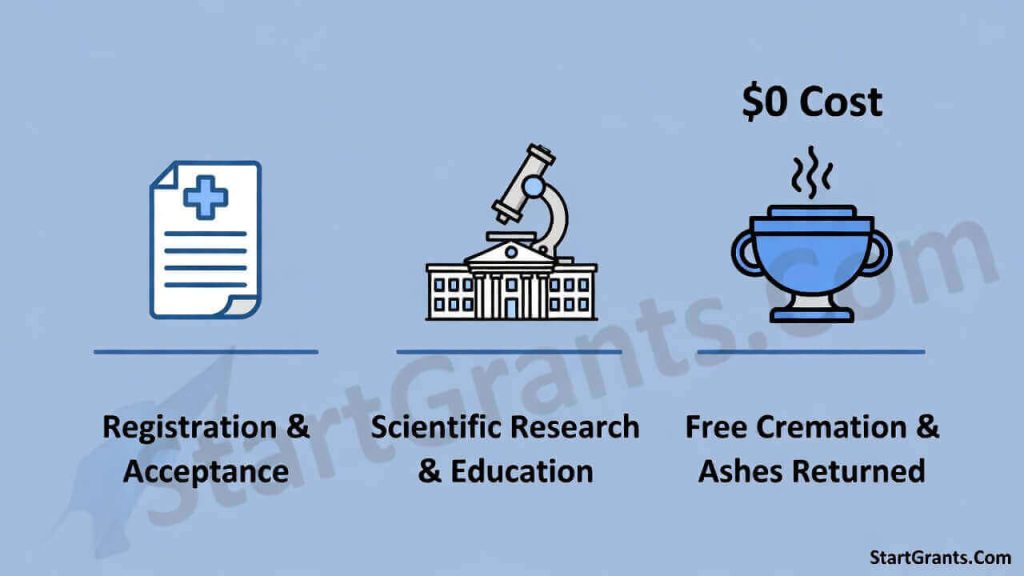
An anatomical donation is a gift to education or research, not a financial-assistance program. Some university programs cover transportation, required preparation, cremation, and return of cremated remains after an accepted donation. Others have geographic limits, require preregistration, exclude certain causes or conditions, or leave some costs to the family.
Acceptance is never assured until the program completes its screening at death. Indiana University School of Medicine, for example, explains that a donor must be preregistered, screening still determines acceptance, and the family needs an alternative plan if the body cannot be accepted. It also notes that optional funeral-home services and certain documents may remain the family’s responsibility. Read the university’s body-donation requirements as an example, then verify the exact policy of the program you are considering.
Do not pay a broker or send sensitive documents merely because a website promises “free cremation.” Confirm that the organization is the named university, medical school, or legitimate donation program; ask where the body will go, how consent works, which costs are covered, how long studies may last, whether ashes are returned, and what happens after a rejection.
Use the FTC Funeral Rule to Reduce the Bill
If the family can pay for a basic arrangement, compare identical services rather than packages. The federal FTC Funeral Rule gives consumers important rights when dealing with covered funeral providers:
- Funeral homes must provide price information by telephone when asked.
- You must receive a written General Price List when you visit.
- You may select individual goods and services instead of buying a package, with limited exceptions.
- A provider must disclose when law requires a particular item or service.
- Routine embalming is not legally required for every death.
- For direct cremation, a funeral home offering cremation cannot require you to purchase a casket and must disclose an alternative container.
“Direct cremation” or “immediate burial” may cost less because it omits a viewing and many ceremonial services, but there is no guaranteed national price. Cemetery charges, transportation distance, permits, death certificates, oversized remains, pacemaker removal, and after-hours transfer can affect the total. Ask for an itemized statement showing every selected charge and every third-party cash advance.
Muslim Perspective: Protecting a Low-Income Family’s Janazah
Muslim funeral practice generally prioritizes respectful washing (ghusl), shrouding (kafan), Janazah prayer, and earth burial, while avoiding cremation. Religious details and emergency exceptions should be discussed with a trusted local scholar; this article does not issue a fatwa. Civil law, public-health rules, cemetery policy, and funding rules still apply.
If a Muslim dies and the family has no money, contact the mosque’s imam or Janazah coordinator immediately—before signing a cremation authorization or a county disposition form. Ask the hospital or medical examiner to note the family’s religious objection to cremation and to allow time for the mosque to coordinate. A local authority may consider a religious accommodation, but burial at public expense is not guaranteed and timelines differ.
A Practical Janazah Checklist
- Ask the mosque which Muslim funeral home and cemetery it normally uses and whether it has a negotiated low-cost package.
- Request an itemized quote for transfer, refrigeration, permits, ghusl facilities, kafan, grave, opening and closing, and required cemetery charges.
- Ask whether volunteers can perform permitted tasks and whether the cemetery has a community-funded or donated plot.
- Ask the mosque whether zakat, sadaqah, a Janazah fund, or an interest-free community loan is locally available. Availability and religious eligibility are not automatic.
- If a public program is involved, ask in writing whether earth burial is possible and what documents establish the religious request.
- Do not assume a national Muslim organization will pay. Confirm the service area, available funds, application deadline, and whether payment goes directly to the provider.
Keep the arrangement simple and do not let social pressure create unaffordable debt. A modest burial can still be respectful. If a family wants guidance about whether zakat may be used or how necessity affects a particular religious decision, consult a qualified scholar who understands both the family’s circumstances and local practice.
Documents to Gather
- Death certificate or a preliminary record from the hospital, hospice, coroner, or medical examiner
- Government-issued identification for the applicant and deceased
- Proof of relationship or authority to make disposition decisions
- Proof of the deceased’s address and, when required, the applicant’s residency
- Bank statements, benefit letters, income records, and evidence of assets
- Life-insurance, prepaid-funeral, pension, union, employer, and veterans records
- Estate information and any funeral-home estimate or contract
- Police report or victim-compensation claim information when the death involved a crime
- Military discharge document, usually DD Form 214, when seeking veterans benefits
Never alter or conceal financial information to meet an indigency test. Ask which documents are truly required before transmitting Social Security numbers, bank records, or identity documents, and use an official portal or verified office.
A Realistic 24-Hour Action Plan
- Identify who currently has custody of the remains and the decision deadline.
- Tell that office in writing that funds are unavailable and assistance is being sought.
- Call the relevant local-government office and ask for the exact indigent-disposition or burial-assistance policy.
- Check Social Security, VA, Tribal, employer, union, insurance, victim-compensation, and state-benefit eligibility.
- Contact 211, the family’s faith community, and reputable local charities.
- Obtain itemized quotes for the least expensive acceptable arrangement.
- Calculate the verified shortfall only after confirmed benefits and contributions.
- If needed, begin a transparent fundraiser and pay the funeral provider directly when practical.
Funeral-Assistance Scam Warning
Be cautious if someone promises guaranteed government funeral money, requests an upfront “release fee,” demands gift cards or cryptocurrency, pressures you to sign immediately, or asks for account credentials. Government and established charity applications may require sensitive documents, but they should identify the administering agency, eligibility rules, privacy practices, and payment process. Independently find the agency’s official phone number instead of relying on an unsolicited message.
Frequently Asked Questions
What happens when no one claims a body?
The responsible local authority follows state and local law for identification, notice to relatives, custody, and final disposition. The process and timing differ by jurisdiction. It should not be treated as a guaranteed free-funeral application for relatives.
Can a family get a completely free funeral when it has no money?
Sometimes a public program or charity covers a basic disposition, but a traditional funeral is not guaranteed. Eligibility, covered services, and family control vary. Apply before authorizing or paying for services because some programs do not reimburse completed arrangements.
Who pays when the deceased has no estate?
Responsibility depends on state law, contracts, family status, and local policy. The estate normally pays when assets exist, but a person who signs a funeral contract can become responsible. Some states also impose duties on certain relatives. Ask the local program or legal-aid office rather than assuming the county must pay.
Does Medicaid pay funeral expenses?
Federal Medicaid is health coverage, not a universal funeral benefit. Some states separately provide burial assistance for people who received specified public benefits, but eligibility and payment rules are state-specific.
Is direct cremation always the cheapest option?
It is often among the least expensive commercial options, but prices and required charges vary. Immediate burial may be competitive in some locations. Compare itemized General Price Lists and include cemetery, transportation, permits, and death-certificate costs.
Is whole-body donation guaranteed to cost the family nothing?
No. Acceptance is subject to the program’s consent, geography, timing, medical screening, and current needs. Covered transportation and cremation differ, and optional services or documents may remain the family’s responsibility. Always keep a backup disposition plan.
What should a family do if a public program offers only cremation but the family’s religion requires burial?
Notify the authority immediately, request its written religious-accommodation policy, and contact a local faith leader or burial coordinator before signing authorization. A burial exception or public payment is not guaranteed, so the community may need to arrange and fund an alternative promptly.
How can a low-income Muslim family seek Janazah help?
Contact the local mosque’s imam or Janazah coordinator immediately and ask about a community funeral home, Muslim cemetery, donated plot, volunteers, zakat or sadaqah funds, and direct provider payment. Availability and religious eligibility vary, so no organization or fund should be assumed to pay automatically.
Important disclaimer: StartGrants.com is an independent information portal. It is not a government agency, funeral provider, insurer, law firm, religious authority, or grant administrator, and it does not award money or guarantee assistance. Program eligibility, funding, deadlines, legal responsibility, and religious accommodations vary by jurisdiction and can change. Verify every claim directly with the official agency or provider before signing a contract, authorizing disposition, or sharing personal information.