Last Updated: | Author: Munir Ardi
If a prescription is unaffordable, do not stop taking it, split doses, substitute another medicine, or change how you use it without speaking with the prescriber or pharmacist. The best assistance route depends on the medicine, diagnosis, insurance, formulary, income, state, pharmacy network, and whether the sponsor is accepting applications.
Prescription assistance is not one nationwide grant. Help may come through insurance coverage, Medicare Extra Help, Medicaid, a State Pharmaceutical Assistance Program, a drug-manufacturer Patient Assistance Program (PAP), an independent charitable foundation, a community health center, or a verified discount arrangement.
For the broader relationship between hospital bills and medication costs, begin with our Medical Bills and Prescription Assistance guide.
Start With the Prescription and Insurance Decision
Write down the brand and generic names, dosage, quantity, diagnosis, prescriber, pharmacy, and the price quoted. If you have insurance, ask the plan and pharmacy why the medicine costs that amount. Common reasons include:
- The drug is not on the plan’s formulary.
- Prior authorization, step therapy, or quantity limits apply.
- The pharmacy is out of network or not a preferred pharmacy.
- The deductible has not been met.
- The claim used incorrect insurance or coordination-of-benefits information.
- A lower-cost formulation, generic, biosimilar, or therapeutic alternative is available.
Ask the prescriber whether a covered alternative is clinically appropriate. If the prescribed drug is medically necessary, request the plan’s formulary-exception, coverage-determination, or appeal instructions. Keep the denial notice, reference numbers, and submission confirmation.
Prescription Assistance Options Compared
| Option | Who administers it | Possible help | Important limitation |
|---|---|---|---|
| Insurance exception or appeal | Health or prescription plan | Coverage of a medically necessary drug or lower cost-sharing | Clinical evidence, deadlines, and plan rules apply. |
| Medicare Extra Help | Medicare and Social Security | Part D premiums, deductible, and cost-sharing for qualifying beneficiaries | Income, resources, enrollment, and territory rules apply. |
| Medicaid or state assistance | State program | Covered outpatient prescriptions or qualifying state support | Eligibility, formulary, prior authorization, and cost-sharing vary by state. |
| Manufacturer PAP | Drug manufacturer or its program administrator | A selected medicine at no or reduced cost for eligible patients | Not every manufacturer, drug, dosage, or patient is covered. |
| Independent charitable fund | Independent nonprofit foundation | Help with qualifying copayments, premiums, or related costs | Disease funds can open, close, or wait-list applicants as funds change. |
| Coupon or discount price | Manufacturer or discount provider | A lower cash or commercial-insurance cost in qualifying situations | It is not insurance, may exclude public coverage, and may not count toward deductibles or out-of-pocket limits. |
| Prescription Payment Plan | Medicare drug or health plan | Spreads covered Part D out-of-pocket costs across the calendar year | It does not reduce the total cost. |
Medicare Prescription Help in 2026
Medicare Part D assistance and payment options are often confused. They serve different purposes.
Extra Help
Medicare’s Extra Help information states that qualifying beneficiaries in 2026 can have a $0 plan premium and $0 deductible, with participating-pharmacy costs of up to $5.10 for each generic drug and $12.65 for each brand-name drug. Once total qualifying drug costs reach $2,100, the beneficiary pays $0 for each covered drug. Eligibility and individual costs must be confirmed with Medicare or Social Security.
People who receive full Medicaid benefits, assistance from a Medicare Savings Program with Part B premiums, or Supplemental Security Income may qualify automatically. Others can apply. Medicare advises people to reapply if their income or resources change.
Part D out-of-pocket limit
Medicare states that 2026 Part D out-of-pocket spending for covered drugs is capped at $2,100. The cap concerns drugs covered by the plan and qualifying out-of-pocket amounts; it does not mean every medicine or noncovered purchase becomes free. Review the plan’s formulary, pharmacy network, and coverage determination.
Medicare Prescription Payment Plan
The Medicare Prescription Payment Plan is voluntary and available through Medicare plans with drug coverage. It changes when qualifying out-of-pocket costs are paid by spreading them across the calendar year. Medicare explicitly states that the plan does not save money or reduce drug costs.
Medicaid and State Prescription Programs
Although outpatient prescription drugs are an optional Medicaid benefit under federal law, the official Medicaid prescription-drug page states that all states currently provide this coverage to categorically eligible beneficiaries and most other enrollees. Each state controls important details such as preferred-drug lists, prior authorization, dispensing limits, pharmacy participation, and permitted cost-sharing.
Some states also operate State Pharmaceutical Assistance Programs. Medicare provides a state lookup through its prescription-cost resources. A state program may help with premiums or cost-sharing, but availability and eligibility differ.
Ask the state Medicaid or SPAP administrator:
- Whether the exact medicine and dosage are covered.
- Whether prior authorization or step therapy applies.
- Which pharmacies participate.
- Whether an emergency supply or expedited review is available.
- How to appeal a denial.
Manufacturer Patient Assistance Programs
A manufacturer PAP may provide a selected medication at no or reduced cost to an eligible patient. There is no universal PAP income limit, citizenship rule, insurance rule, delivery method, supply length, or renewal period. Some programs support uninsured patients, some consider underinsured patients, and some provide different forms of assistance.
Use the exact drug name to identify the manufacturer and official program. Medicare includes a Pharmaceutical Assistance Program lookup among its tools. A prescriber may need to certify medical information or provide a valid prescription.
For medicine-specific research, see our Pfizer Patient Assistance eligibility guide and Johnson & Johnson Patient Assistance guide. These articles should be used only when the prescribed medicine is connected to the relevant sponsor and its current program.
Before sending personal information, confirm:
- The sponsor’s official website, telephone number, and submission channel.
- That the exact medicine, dosage, and formulation are included.
- Income, residence, insurance, and clinical requirements.
- Required patient and prescriber signatures.
- Where medicine will be delivered and how refills work.
- Renewal dates and what happens if the program or prescription changes.
Never pay a supposed program representative with gift cards, cryptocurrency, wire transfer, or a large advance fee. Do not buy medicine from an unverified website merely because it advertises a low price.
Independent Charitable Foundations
Independent foundations may help eligible insured patients with costs tied to a covered disease fund. They are not open-ended grants for every prescription, and funding status can change quickly.
Examples include the official portals for the PAN Foundation and HealthWell Foundation. Check the fund status, diagnosis, insurance requirement, income rule, covered expenses, award period, renewal terms, and whether a waitlist or alert system is available.
Do not assume that a foundation is funded by or acting on behalf of the manufacturer of your medicine. Independent charitable assistance and manufacturer copay programs have different legal and eligibility structures.
Coupons, Discount Cards, and Cash Prices
A manufacturer coupon or pharmacy discount card is not a grant and is not health insurance. Compare the discounted cash price with the price obtained through insurance, but understand the consequences before choosing one.
Ask:
- Can the offer be used with my type of insurance?
- Does the purchase count toward my deductible or out-of-pocket limit?
- Is the quoted price temporary, pharmacy-specific, or quantity-specific?
- What personal or health information will the service collect or share?
- Will using cash affect a coverage appeal or future refill?
People enrolled in Medicare, Medicaid, TRICARE, or another government-funded program should not assume they can use a commercial manufacturer coupon. Read the sponsor’s exclusions and ask the plan or program administrator.
A Muslim Perspective on Prescription Assistance
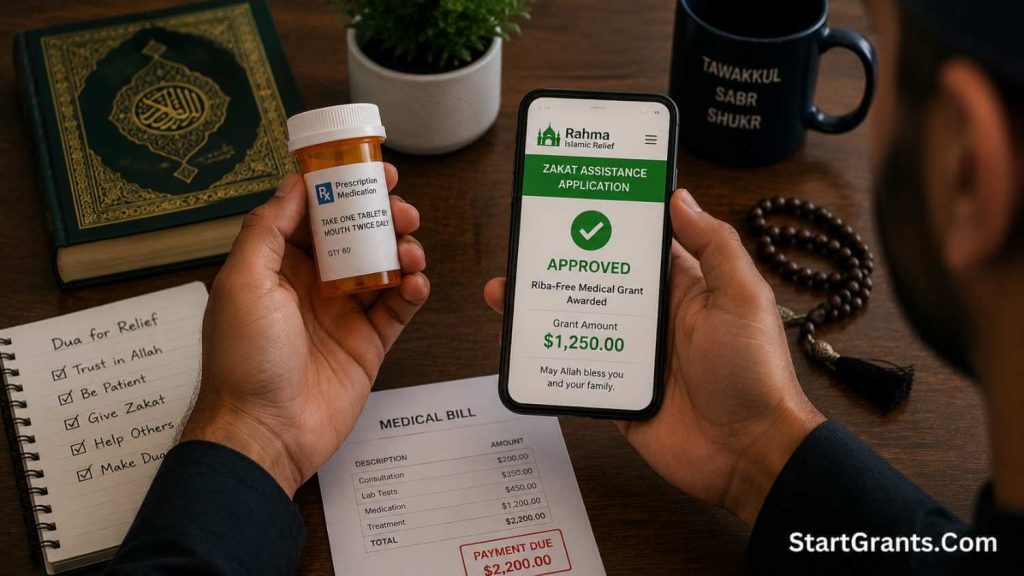
Muslim patients may wish to obtain necessary medicine without taking interest-bearing debt. A genuine manufacturer benefit, charitable payment, discount, zakat award, or donated medicine generally differs from a loan, but the written terms and source of assistance should still be reviewed.
Practical steps include exhausting insurance appeals and public benefits, applying for verified assistance, comparing lawful cash prices, requesting a no-interest arrangement where available, and asking family or community organizations about a documented qard hasan. A local mosque or zakat committee may consider necessary medication under its own policy, but assistance is not guaranteed and eligibility decisions belong to that organization.
Avoid absolute religious claims based only on the words “grant,” “free,” or “insurance.” A program may include data-sharing consent, repayment after duplicate benefits, recurring charges, credit terms, or other conditions. A qualified Islamic-finance scholar can review the actual agreement, while a healthcare professional must guide medication decisions. This article does not issue a fatwa.
Save This Prescription-Assistance Checklist
Frequently Asked Questions
Does every drug manufacturer offer free medicine?
No. Assistance depends on the manufacturer, medicine, dosage, program status, patient eligibility, and available support. Some programs provide medicine without charge, while others offer discounts or no assistance for that product.
Is there one income limit for all Patient Assistance Programs?
No. Each sponsor establishes its own income calculation, household rules, insurance requirements, residence requirements, documents, and renewal process.
Can insured patients qualify for prescription assistance?
Sometimes. Certain programs help underinsured patients, while others primarily serve uninsured patients or require specific coverage. Independent foundations may require insurance that covers the medicine.
Can Medicare beneficiaries use manufacturer copay cards?
Do not assume they can. Commercial copay offers commonly exclude prescriptions paid in whole or in part by Medicare or another government-funded program. Check the official terms and ask the plan or program administrator.
What does Medicare Extra Help cover in 2026?
For qualifying beneficiaries, Medicare lists a $0 plan premium and deductible and participating-pharmacy costs of up to $5.10 for each generic drug and $12.65 for each brand-name drug in 2026. Confirm eligibility and individual costs with Medicare or Social Security.
Does the Medicare Prescription Payment Plan lower drug costs?
No. It spreads covered out-of-pocket Part D costs across the calendar year but does not reduce the total cost.
Does Medicaid cover prescription drugs?
All states currently provide outpatient prescription coverage to categorically eligible Medicaid beneficiaries and most other enrollees, but eligibility, formularies, prior authorization, pharmacy networks, and cost-sharing vary by state.
Are independent copay foundations always open?
No. Disease funds can open, close, use waitlists, or stop accepting applications as funding changes. Verify the current status directly with the foundation.
Can I stop taking a medicine while waiting for assistance?
Do not stop, split, substitute, or change a prescribed medicine without clinical guidance. Contact the prescriber, pharmacist, and health plan promptly to discuss a safe supply or covered alternative.