
Last Updated: April 2026 | Author: Zee
For college students navigating the world as Deaf or Hard of Hearing (DHH), higher education presents a unique dual financial burden. You are not just trying to figure out how to pay for tuition and textbooks; you are also facing the staggering costs of accessibility technology—such as hearing aids, cochlear implant maintenance, FM systems, and specialized alarms—which are frequently excluded by commercial health insurance.
If you are searching for financial aid, you must approach your funding strategy on two separate fronts: securing medical grants to fund your hardware, and securing collegiate endowments to fund your tuition.
This master guide will break down the exact organizations that provide free hearing technology, highlight the massive national scholarships dedicated exclusively to DHH students, and reveal the hidden federal programs that can pay your entire tuition bill.
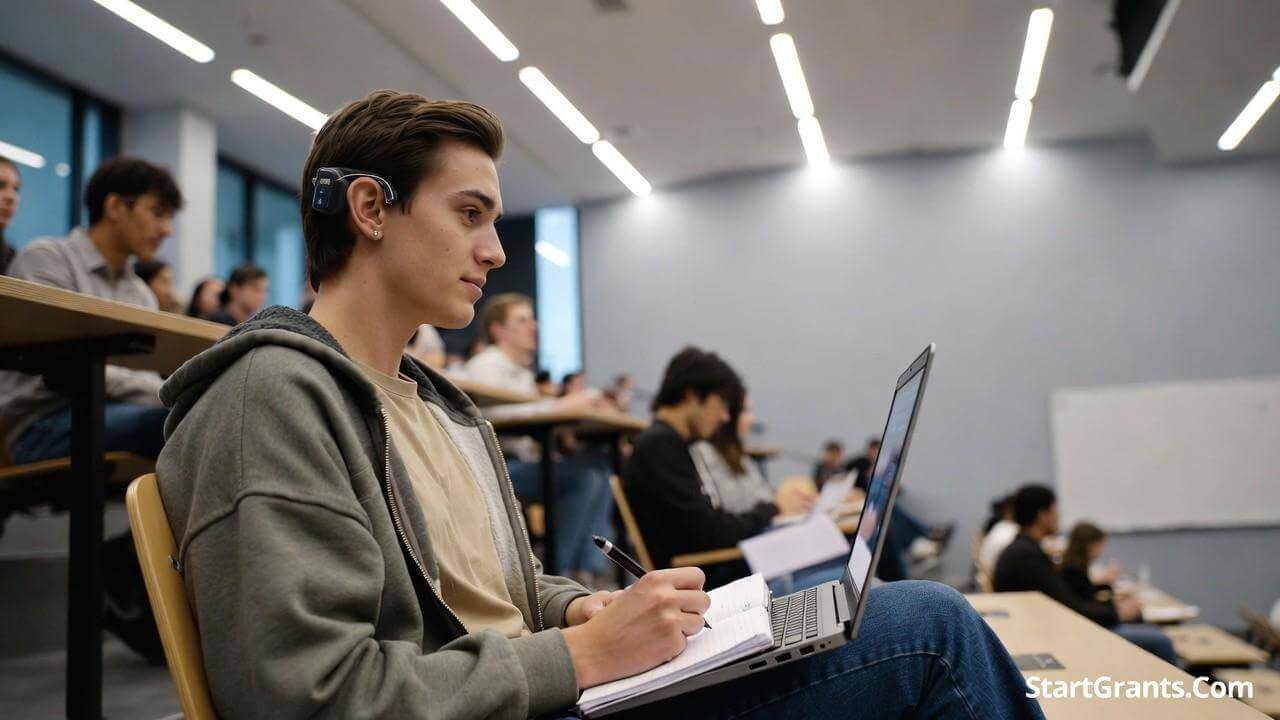
Deaf and Hard of Hearing students must secure both medical grants for their hardware and collegiate scholarships for their tuition.
Phase 1: The Hardware Barrier (Grants for Hearing Aids)
Before you can succeed in a college lecture hall, you need the proper auditory access. A pair of premium hearing aids can easily cost between $4,000 and $6,000, and many insurance providers still classify them as “elective” devices. If you cannot afford your hearing technology, you must apply for device-specific grants before applying for college tuition aid.
1. Help America Hear Program
The Foundation for Sight and Sound provides the Help America Hear grant, which acts as a lifeline for individuals with limited financial resources. They provide brand-new, high-quality hearing aids to individuals who exhaust their insurance options. If your family’s income falls below their threshold, this grant entirely removes the hardware barrier.
2. Starkey Hearing Foundation
Through their “Hear Now” program, Starkey provides hearing aids to low-income Americans. While the program requires an application fee and you must meet strict poverty guidelines, it is one of the most reliable ways to secure state-of-the-art hearing assistance without taking out a medical loan.
Note: If your hearing loss is a secondary effect of early birth complications, we highly recommend cross-referencing your medical grant search with our dedicated guide on scholarships for premature babies to capture additional emergency funding.
Phase 2: National Scholarships for DHH Students
Once your technological needs are secured, you can focus on tuition. The following philanthropic organizations maintain massive endowments specifically to ensure that hearing loss never prevents a capable student from obtaining a degree.
1. The Alexander Graham Bell Association (AG Bell)
AG Bell offers some of the most prestigious and lucrative merit-based scholarships for mainstreamed DHH students. To qualify, you must have a bilateral hearing loss diagnosed before the age of four, and your primary mode of communication must be spoken language (Listening and Spoken Language / LSL). The competition is fierce, but the payout can heavily reduce your tuition burden. Check their application windows at the AG Bell official website.
2. Sertoma Scholarships
Sertoma (Service to Mankind) is the premier civic organization dedicated to hearing health. Their scholarship program provides $1,000 grants to students with clinically significant bilateral hearing loss pursuing bachelor’s degrees at four-year universities. Because these grants can be won multiple years in a row, they serve as excellent supplemental funds to buy textbooks or cover dorm fees.
3. The Cochlear Graeme Clark Scholarship
If your hearing loss is managed specifically through a Nucleus® Cochlear Implant, you have access to exclusive funding. This scholarship honors the inventor of the multi-channel cochlear implant and awards substantial funds to students who demonstrate strong academic achievement and a commitment to leadership.
Pro-Tip: Overcoming the Academic Barrier
If you feel overwhelmed by the prospect of affording college with a cochlear implant, watch this inspiring spotlight meeting previous winners of the Cochlear Graeme Clark Scholarship, showcasing how this specific fund empowers DHH students to achieve their ultimate career goals:
Phase 3: The “Secret Weapon” (State Vocational Rehabilitation)
While private scholarships are excellent, the most powerful funding source for a Deaf or Hard of Hearing student is often completely ignored: State Vocational Rehabilitation (VR).
Every single state in the U.S. operates a federally funded VR agency (sometimes called the Department of Rehabilitation). Their legal mandate is to help individuals with disabilities secure and maintain employment. Because a college degree is often required to secure high-paying employment, VR agencies have massive budgets dedicated to paying for higher education.
How the VR Hack Works
If you qualify for VR services based on your audiogram, the agency can act as your ultimate financial sponsor. Depending on your state’s specific funding levels and your financial need, VR can completely cover:
- Your remaining college tuition (after the Pell Grant is applied).
- The cost of textbooks and mandatory campus fees.
- Assistive technology required for classes, such as specialized laptops, FM microphones, or flashing alarm clocks for your dorm.
The Action Step: Stop relying solely on private scholarships. Search online for “[Your State] Department of Vocational Rehabilitation” and open a case file immediately. Inform your VR counselor that your specific vocational goal requires a college degree.

Your state’s Vocational Rehabilitation agency can be your most powerful ally, often paying for remaining tuition, textbooks, and assistive technology.
Phase 4: The Intersection of Faith (The Muslim Perspective)
For Muslim students facing the reality of hearing loss, the financial pressure can become a spiritual crisis. When health insurance denies a $5,000 hearing aid, or when tuition bills pile up, the temptation to take out interest-bearing (Riba) medical or student loans can be overwhelming.
You must understand that within the Muslim community, ensuring accessibility for the disabled is a high priority. You do not have to compromise your faith to hear or to learn.
1. Zakat for Medical Devices
If you cannot afford a hearing aid and organizations like Help America Hear have a long waitlist, you qualify for emergency Zakat distribution. Contact your local Islamic center or the National Zakat Foundation. Clearly state that you need emergency funds to purchase a medical necessity (hearing aids) to function in society.
2. Interest-Free Tuition
If your Vocational Rehabilitation and Pell Grants do not cover your full tuition, do not turn to federal loans. Organizations like A Continuous Charity (ACC) provide interest-free educational loans specifically for Muslim students. To fully leverage your religious identity for financial support, study our dedicated directory on how to get grants and scholarships for Muslim college students in the U.S.
Phase 5: University ADA Accommodations (Free Access)
Finally, you must never pay out-of-pocket for classroom accessibility. Under the federal Americans with Disabilities Act (ADA), your university is legally required to provide equal access to education.
This means your college’s Disability Support Services (DSS) office must pay for your ASL interpreters, CART captioning (live typing during lectures), or note-takers. To understand how to navigate university disability offices effectively, cross-reference our guide on colleges for students with learning disabilities.
Conclusion: Engineering Your Success
Hearing loss makes the college journey more expensive, but the funds to eliminate that burden exist. You simply need a systematic approach.
Your Action Plan:
- Secure Your Tech: Apply to the Starkey Hearing Foundation or Help America Hear if you need hardware.
- Open a VR Case: Contact your state’s Vocational Rehabilitation office to get your tuition and technology paid for.
- Apply to the Giants: Submit your essays to the AG Bell Association or the Cochlear Graeme Clark Scholarship.
- Demand Access: Register with your university’s Disability Support Services to secure free ADA accommodations.
By leveraging federal Pell Grants, state VR funds, and private medical endowments, you can graduate completely debt-free. For a masterclass on how to combine all these funding sources, read our ultimate blueprint on how to apply for grants for college.
Frequently Asked Questions (FAQs)
Q1: Can I get financial aid specifically to buy hearing aids for college?
A: Yes. Because health insurance often does not cover hearing aids, philanthropic organizations step in. Programs like Help America Hear and the Starkey Hearing Foundation provide free or heavily discounted hearing aids to low-income students. Additionally, your state’s Vocational Rehabilitation agency can often purchase hearing aids for you if they are required for your education.
Q2: What is Vocational Rehabilitation, and how can it pay for my college?
A: Vocational Rehabilitation (VR) is a state-level agency funded by the federal government designed to help people with disabilities get jobs. If your career goal requires a college degree, VR can pay your remaining college tuition, buy your textbooks, and purchase necessary assistive technology (like FM systems or laptops).
Q3: Are there specific scholarships for students with cochlear implants?
A: Yes. The most prominent is the Cochlear Graeme Clark Scholarship, awarded to students who utilize a Nucleus® Cochlear Implant and demonstrate strong academic achievement and leadership.
Q4: Does the AG Bell Association offer scholarships for deaf students?
A: Yes, the Alexander Graham Bell Association offers highly competitive scholarships. However, you must meet specific criteria: your hearing loss must have been diagnosed before age four, and your primary mode of communication must be Listening and Spoken Language (LSL), not sign language.
Q5: Do I have to pay for my own ASL interpreter or CART captioner in college?
A: No. Under the Americans with Disabilities Act (ADA), your university is legally mandated to provide reasonable accommodations free of charge. You must register with your campus Disability Support Services (DSS) office, and they will arrange and pay for your interpreters or captioners.
Q6: What if I am a Muslim student and refuse to take out interest-bearing medical loans for my hearing loss?
A: Muslim students facing catastrophic medical costs for hearing aids can apply for Zakat emergency funds from local Islamic centers. For tuition assistance, organizations like A Continuous Charity (ACC) provide interest-free (Halal) educational loans.
Q7: Do I qualify for the Pell Grant if I have a hearing loss?
A: Hearing loss does not automatically qualify you for the Pell Grant, as the Pell Grant is based entirely on financial need, not medical status. However, you should still file the FAFSA, as many DHH students qualify based on their family’s income level.
Q8: Are there scholarships for students who use American Sign Language (ASL)?
A: Yes. While organizations like AG Bell focus on spoken language, many private foundations and universities with large Deaf populations (such as Gallaudet University or the National Technical Institute for the Deaf/NTID) offer massive scholarships specifically for culturally Deaf students who use ASL.
Important Disclaimer: StartGrants.com is an independent information portal. We are not a government agency and do not provide direct grants or products. Always verify the current status of programs with the providing organization.