
Last Updated: | Author: Munir Ardi
There is no single federal program that gives startup money to a business simply because it is owned by a woman. Federal agencies fund specific activities—such as research and development, agricultural production, exporting, or delivery of community services—and each opportunity has its own applicant rules. Some awards go directly to eligible small businesses. Others go to states, nonprofits, universities, Tribes, or business-support organizations that may later provide services or assistance to entrepreneurs.
That distinction matters. A program can support women entrepreneurs without allowing an individual woman or her company to apply for the federal grant itself. This verified federal grants for women list explains which programs may fund qualifying businesses, which ones work through intermediaries, and which commonly cited opportunities are actually contracts rather than grants.
The Most Important Correction
The federal government’s 5% women-owned small-business goal applies to federal contracting dollars—not to all federal grants. WOSB certification can help an eligible company compete for selected government contracts, but it does not create a reserved grant fund or guarantee an award.
This is a Tier 3 article focused on federal pathways. Begin with the parent resource, How Women-Owned Businesses Can Find Legitimate Grants, for the broader search process covering federal, state, local, nonprofit, and corporate opportunities.

Federal grants, government contracts, loans, and technical-assistance programs have different eligibility and compliance rules.
Federal Grants, Contracts, Loans, and Assistance Are Not the Same
| Funding mechanism | What it means | Key question |
|---|---|---|
| Federal grant | Funds an approved public-purpose project or activity under an assistance award. | Is a for-profit small business an eligible direct applicant? |
| Federal contract | Pays a vendor to deliver goods or services required by an agency. | Can the business perform the solicitation at the proposed price and terms? |
| Government-backed loan | Provides repayable financing, often through an approved lender or intermediary. | What are the APR, fees, collateral, guarantee, payment schedule, and total repayment? |
| Pass-through assistance | Federal funds go first to a state, local agency, nonprofit, utility, or other eligible entity. | Which local organization administers the benefit, and is it a grant, reimbursement, service, or loan? |
| Business counseling | Offers training, mentoring, procurement support, or capital-readiness assistance. | Does the program give money to the business, or only provide services? |
Award terms can restrict costs, require matching funds, pay only after expenses are documented, or demand repayment after noncompliance. “Non-dilutive” means the funder does not take ownership merely for providing the award; it does not mean the money has no conditions or tax consequences.
Federal Programs That May Fund an Eligible Small Business Directly
1. Small Business Innovation Research and Small Business Technology Transfer
The SBIR and STTR programs, often called America’s Seed Fund, support eligible U.S. small businesses conducting research and development with commercialization potential. Participating agencies publish their own technical topics, schedules, award instruments, and requirements. Awards may be grants or contracts.
These programs are not reserved for women-owned companies, and gender does not replace technical merit. A boutique, ordinary restaurant, general consulting practice, or routine software implementation will not qualify simply because it needs startup capital. The proposed innovation must fit an agency’s research objective and satisfy the applicable small-business, ownership, place-of-performance, principal-investigator, and registration rules.
For example, the current NSF SBIR/STTR process requires a prospective Phase I applicant to submit a Project Pitch and receive an invitation before submitting a full proposal. A proposing firm must qualify as a small-business concern; NSF’s current solicitation notes that the 500-employee size limit includes affiliates. Other agencies use different processes, so never copy NSF instructions into a Department of Defense or NIH application.
2. USDA Value-Added Producer Grants
The Value-Added Producer Grant program can provide planning or working-capital grants to eligible agricultural producers pursuing qualifying value-added activities. It is not a women-only program and is not a general grant for any rural business.
The application window typically opens in the first quarter of the year (for example, the FY 2026 cycle ran from February 17 through April 22 and is now closed). Prospective applicants should monitor the official USDA page for a future notice and speak with the applicable state program official. Confirm applicant category, match, eligible product, project stage, use of funds, and deadline before preparing an application.
3. Other Agency-Specific Small-Business Opportunities
Federal agencies occasionally publish opportunities that permit for-profit entities or small-business concerns to apply. Eligibility can be narrow—for example, a particular technology, domestic manufacturing process, energy project, or federally defined service outcome. There is no reliable permanent list covering them all.
Search the current federal funding opportunities database using the business activity rather than gender alone. Filter by eligible applicant when available, but still open the complete Notice of Funding Opportunity and attachments. Search results and summaries do not override the official eligibility section.
Federal Programs Commonly Mistaken for Direct Business Grants
USDA Rural Business Development Grants
Rural Business Development Grants support rural economic development, technical assistance, training, planning, incubators, and related activities. However, the ordinary small-business owner is generally not the direct federal applicant. Eligible applicants include public bodies, government entities, rural cooperatives, nonprofit organizations, institutions of higher education, federally recognized Tribes, and other entities specified by the program.
An eligible grantee may operate a project that benefits small rural businesses. That does not mean every rural company can request equipment or land money directly from USDA. The FY 2026 RBDG deadlines—June 15 for qualifying Strategic Economic and Community Development applications and June 30 for the remaining applications—have passed. Check the official RBDG page and state office for future availability.
SBA State Trade Expansion Program
The State Trade Expansion Program helps eligible small businesses pursue approved export activities, but SBA awards STEP funds to state and territory governments. A business accesses assistance through its current state administrator. Depending on the state plan, support may cover activities such as trade missions, export training, international marketing, website globalization, or eligible trade-show costs.
Therefore, STEP should be described as state-administered export assistance—not as an automatic direct SBA grant for women. Award structure, reimbursement percentage, match, eligible activities, and application dates vary by state.
MBDA Grants and Women’s Entrepreneurship Initiatives
The Minority Business Development Agency may publish federal grant competitions that support entrepreneurship programs, including initiatives serving women and underserved entrepreneurs. MBDA states that it does not provide loans or grants directly to start or expand an individual business; its grants generally fund organizations that operate centers or deliver technical assistance.
A business owner may receive counseling, procurement matching, capital-readiness services, or referrals through an MBDA-supported organization. That benefit is useful, but it should not be advertised as a personal federal startup grant. Women who meet relevant demographic requirements can also review funding resources for Black women entrepreneurs and verified search channels for immigrants and minority founders.
Women’s Business Centers
SBA-supported Women’s Business Centers provide free or low-cost counseling and training. Federal grants may fund the organizations that operate these centers, but the center’s clients do not automatically receive those grant dollars as business capital. Use a WBC to improve financial projections, evaluate funding fit, prepare for contracting, or locate state and local programs.
Child Care and Development Fund
The Child Care and Development Fund is administered through state, territory, and Tribal lead agencies to improve access, affordability, and quality. It is not a permanent federal startup-grant account available to every daycare owner. Provider payments, quality-improvement support, facility assistance, and eligibility depend on the administering jurisdiction and current plan.
Childcare entrepreneurs should contact their licensing and CCDF lead agencies before relying on an old “stabilization grant” article. Our contextual resource on how childcare assistance may fit a daycare startup explains the due-diligence questions to ask.
WOSB Certification Is a Federal Contracting Tool
The SBA Women-Owned Small Business Federal Contract Program permits certain contracts in eligible industries to be set aside for certified WOSBs or Economically Disadvantaged Women-Owned Small Businesses. The federal government’s goal is to award at least 5% of federal contracting dollars to women-owned small businesses each year.
According to the SBA’s WOSB requirements, a business generally must:
- Meet the applicable SBA small-business size standard.
- Be at least 51% owned and controlled by women who are U.S. citizens.
- Have women manage day-to-day operations and make long-term decisions.
SBA offers a free certification route through MySBA Certifications. Approval makes the business eligible to compete for applicable set-asides; it does not guarantee that the business will win. A contract requires the company to deliver goods or services, comply with the solicitation, invoice correctly, and meet performance obligations. An APEX Accelerator can help assess contracting readiness and identify appropriate opportunities.
Women immigrants should note that the WOSB citizenship rule does not control every grant or financing program. A lawful permanent resident or another noncitizen may qualify elsewhere if that program’s rules permit it. See resources for immigrant women business owners for additional context.
How to Search and Apply Without Wasting Time
- Define the project. State exactly what the money would fund: qualifying research, value-added agricultural production, export development, equipment, workforce training, or another measurable activity.
- Identify the real applicant. Determine whether the notice accepts a for-profit small business, an individual, a nonprofit, a state, a Tribe, a university, or an intermediary.
- Read the current federal notice. Check eligibility, award instrument, deadline, time zone, match, registration, scoring, reporting, and prohibited costs.
- Confirm the submission system. Grants.gov is common but not universal. For example, NSF SBIR/STTR uses its own Project Pitch and Research.gov process.
- Start registration early. An organization applying through Grants.gov must register with SAM.gov, obtain a Unique Entity Identifier, use Login.gov, and create the appropriate Grants.gov profile. Official registrations are free but validation can take time.
- Build the budget from the rules. Include only allowable, reasonable, and properly allocated expenses. Do not assume the award can pay owner draws, old debt, or purchases made before authorization.
- Plan cash flow. Determine whether payments are advanced, milestone-based, or reimbursed after documented expenses. An award can create a cash shortage if costs must be paid first.
- Save the record. Keep the notice, attachments, application, budget, submission confirmation, correspondence, award agreement, and compliance calendar.
Use our step-by-step government grant application process for more detail. If no suitable grant exists, compare alternative business financing options for immigrants rather than forcing the business into an unsuitable program.
Save This Federal Funding Checklist
- [ ] Confirm whether the opportunity is a grant, contract, loan, cooperative agreement, reimbursement, or service.
- [ ] Open the current official notice and every required attachment.
- [ ] Verify that a for-profit small business can apply directly.
- [ ] Check ownership, citizenship, location, industry, size, research, and project requirements.
- [ ] Confirm the deadline, time zone, award amount, match, and period of performance.
- [ ] Identify permitted expenses, excluded costs, pre-award restrictions, and reimbursement timing.
- [ ] Complete SAM.gov, UEI, Login.gov, Grants.gov, or agency-specific registration early.
- [ ] Review intellectual-property, data-rights, cybersecurity, audit, and reporting terms.
- [ ] Model the cash needed before the first federal payment arrives.
- [ ] Ask a tax professional about income and expense treatment.
- [ ] Save the submitted package and official confirmation.
A Muslim Perspective: Federal Awards, Riba, and Cash-Flow Planning
For a Muslim woman entrepreneur seeking to avoid riba, receiving a federal award is only one part of the analysis. Review the full transaction: the award instrument, permitted business activity, matching funds, reimbursement schedule, bridge financing, late-payment provisions, guarantees, insurance, intellectual-property terms, and any subcontract.
A grant may not require ordinary repayment when its conditions are met, but it can still contain restricted uses, repayment after noncompliance, or other binding obligations. A federal contract is payment for performance, not a gift. Neither label automatically determines the religious treatment of every connected arrangement.
Cash flow deserves special attention. Some awards reimburse documented expenses or pay by milestone, while others use different payment methods. Do not assume every agency waits 30 to 90 days, and do not sign interest-bearing bridge financing based on a guessed payment date. Obtain the award’s actual payment terms and build a monthly cash-flow forecast.
Potential funding alternatives may include retained earnings, owner capital, customer prepayments with clear delivery obligations, equity or profit-and-loss sharing, a genuinely interest-free community loan, or appropriately structured murabaha, ijara, or musharaka. The substance of the contract matters more than an “Islamic” label. Ask a qualified scholar familiar with modern commercial transactions and a U.S. attorney to review the actual documents.
Zakat treatment also should not be reduced to “2.5% of every federal payment.” The analysis may differ based on ownership, restrictions, liabilities, cash, receivables, inventory, fixed assets, business purpose, timing, and the scholarly method followed. Obtain individualized guidance from a trusted scholar and tax advice from a qualified professional. This article is not a fatwa.
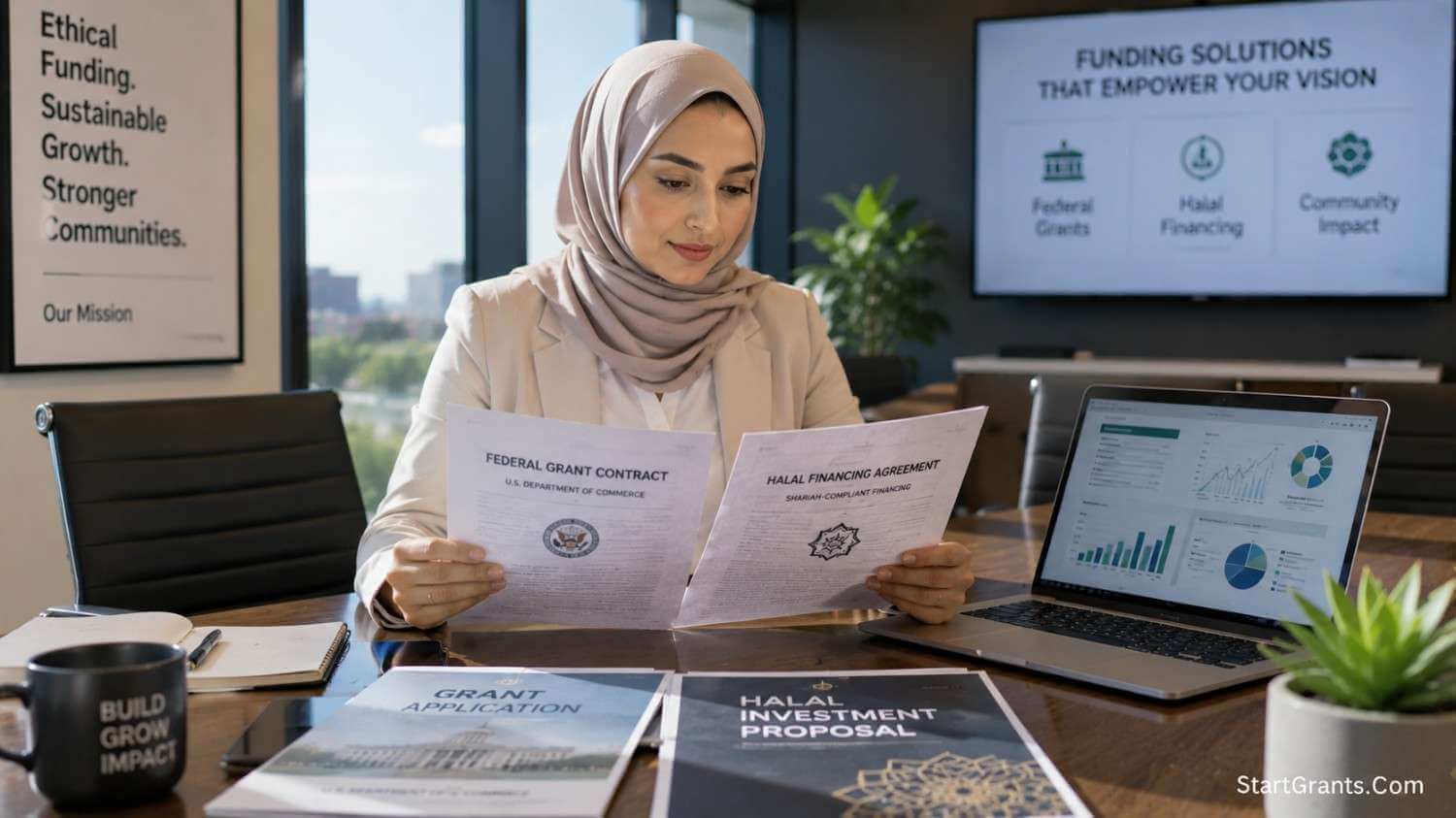
Muslim entrepreneurs should examine the award and any connected financing rather than deciding from the funding label alone.
Avoid Federal Grant Scams
SAM.gov, Grants.gov, Login.gov, and the government’s Unique Entity Identifier are free. Be cautious of a caller, text, social-media account, or website that says you were selected without applying, promises guaranteed approval, or demands a release fee through gift card, cash reload card, wire transfer, or cryptocurrency.
The Federal Trade Commission’s grant-scam guidance recommends verifying offers independently. A consultant may charge for legitimate professional services, but the fee does not purchase a federal award and should never be represented as a government charge.
Frequently Asked Questions
Is there a federal startup grant exclusively for women-owned businesses?
No general federal program gives startup money to a business solely because a woman owns it. A women-owned company may apply for a federal opportunity when its applicant type, project, industry, ownership, and other qualifications meet the specific notice.
Does the federal government reserve 5% of grant dollars for women?
No. The 5% goal applies to federal contracting dollars awarded to women-owned small businesses. It should not be presented as a reserved percentage of federal grant funding.
Is WOSB certification a grant?
No. WOSB certification is a federal contracting credential that can make a qualified business eligible to compete for certain set-aside or sole-source contracts in eligible industries.
Can a women-owned company apply for SBIR or STTR?
Yes, if the company and proposed research meet the applicable agency’s SBIR or STTR eligibility and technical requirements. The programs are competitive and are not reserved for women-owned companies.
Can my rural business apply directly for an RBDG?
Usually not. RBDG applicants generally include public bodies, government entities, rural cooperatives, nonprofits, institutions of higher education, and federally recognized Tribes. Their funded projects may assist qualifying rural businesses.
Does MBDA give startup grants directly to women-owned businesses?
MBDA states that it does not provide direct grants or loans to start or expand an individual business. Its grants generally support organizations that operate centers or provide technical assistance.
Are federal applications and SAM.gov registration free?
Yes. Official SAM.gov entity registration, UEI assignment, Grants.gov registration, and federal grant submission do not require a government application fee. Optional professional assistance is separate.
Are federal business grants tax-free?
Do not assume so. The IRS states that a government grant received by a business generally is included in gross income unless a specific exclusion applies. The award’s purpose and governing law can affect treatment, so consult a qualified tax professional.
Is every federal grant automatically halal?
No universal religious conclusion should be made from the label alone. Review the award’s source, purpose, conditions, repayment provisions, required activity, and connected financing with qualified legal, tax, and Islamic-finance advisers.
What is the best first step?
Define the exact project and check whether a for-profit small business is an eligible direct applicant. Only then should you invest time in registrations, budgets, and proposal writing.
Bottom Line
A useful federal grants for women list must be honest about who receives the money. SBIR/STTR and selected agency programs can fund eligible businesses directly. VAPG may support qualifying agricultural producers. RBDG, STEP, MBDA initiatives, Women’s Business Centers, and childcare funds often operate through public or nonprofit intermediaries. WOSB is a contracting program, not a grant.
Search by project and industry, verify the eligible applicant, use the current official notice, and plan for compliance and cash flow. Those steps are more valuable than a long list of program names that may be closed, indirect, or unsuitable.