
Last Updated: August 2026 | Author: Munir Ardi
Attending dental school in the United States is a dream for thousands of international students and foreign-trained dentists. U.S. dental programs (DDS/DMD) offer world-class clinical training, access to cutting-edge technology, and the pathway to highly lucrative licensing. However, this dream comes with a massive, seemingly insurmountable roadblock: the cost.
Unlike U.S. citizens, international students (holding F-1 or J-1 visas) and DACA recipients are legally barred from receiving federal financial aid. You cannot fill out the FAFSA, you cannot receive the Pell Grant, you cannot take out federal Grad PLUS loans, and you are entirely excluded from military or NHSC full-ride scholarships. When a single year of tuition can exceed $100,000, how does a non-citizen pay for it?
If you are searching for “dental school scholarships for international students,” you must bypass the U.S. government entirely and look toward institutional endowments, private global foundations, and home-country sponsorships.
Before focusing exclusively on international funding, ensure you understand the foundational architecture of medical tuition by reviewing our master directory on dental school grants and scholarships.
International students face unique financial barriers in the U.S. because they are ineligible for federal financial aid. However, by leveraging institutional endowments and private foundations, foreign students can successfully fund their DDS or DMD degrees.
Phase 1: Institutional Aid (University-Specific Scholarships)
Because you cannot get money from the U.S. government, your primary source of funding will be the dental school itself. Private U.S. universities heavily recruit top-tier international talent and maintain massive private endowments to fund them.
Merit-Based Institutional Grants
When you apply through the ADEA AADSAS (or the CAAPID for foreign-trained dentists), your application is automatically evaluated for institutional merit scholarships.
- How it Works: Universities like UPenn, NYU, and Boston University offer internal scholarships ranging from $10,000 to half-tuition waivers based entirely on exceptional DAT scores, high undergraduate GPAs, and outstanding research backgrounds.
- The Catch: Many schools require international students to prove they can pay for the entire first year in cash (placing funds in an escrow account) before they will even issue the I-20 form required for your F-1 Visa. Institutional scholarships can help lower this upfront escrow requirement.
Pro-Tip: Funding the Advanced Standing Program
If you are already a licensed dentist in your home country, you do not need to repeat all four years of dental school. You can apply to a 2-to-3 year Advanced Standing Program to earn your U.S. license. However, because these condensed programs are incredibly expensive, securing institutional merit grants requires a flawless application.Watch this insider breakdown from Dr. Ryan of Mental Dental (one of the most trusted educators in the industry). He explains exactly how to navigate the CAAPID centralized application, the importance of the INBDE and TOEFL exams, and what U.S. admissions committees are actually looking for in foreign-trained applicants:
Phase 2: Private Global Foundations & Fellowships
If institutional aid is not enough, you must apply to private philanthropic foundations that specifically sponsor international education.
1. The Aga Khan Foundation (AKF)
The AKF provides a limited number of scholarships each year for postgraduate studies to outstanding students from developing countries who have no other means of financing their studies. The awards are structured as a 50% grant and a 50% loan.
2. The Leo S. Rowe Pan American Fund
If you are an international student from a Latin American or Caribbean country that is a member of the Organization of American States (OAS), you can apply for the Rowe Fund. They provide highly subsidized, interest-free supplementary loans (up to $15,000) to help cover tuition gaps.
3. Home Country Government Sponsorships
Many international students are fully funded by their home country’s government. For example, the Saudi Arabian Cultural Mission (SACM) and Kuwait’s Ministry of Higher Education frequently pay 100% of the tuition for their citizens to attend U.S. dental schools, provided they return home to practice or fulfill specific national requirements.
Phase 3: U.S. Government Programs (With Nuance)
While you cannot use the FAFSA, there are specific U.S. State Department initiatives designed to bring global talent to America.
The Fulbright Foreign Student Program
Operating in over 160 countries, the Fulbright program enables graduate students, young professionals, and artists from abroad to study and conduct research in the U.S. While rarely used for full 4-year clinical DDS programs, it is an exceptional pathway for foreign dentists pursuing Master’s degrees in dental public health, oral biology, or specific residencies. Learn more and find your country’s specific application guidelines via the official EducationUSA Portal.
Phase 4: Strategic Integration (Overcoming Federal Limits)
Because you are excluded from federal aid, you must understand exactly what you are missing and how to compensate for it. Integrate your strategy with these comparative guides:
- Why You Can’t Use Forgiveness: Programs that wipe out debt are strictly for citizens holding federal loans. Understand what you are excluded from by reading our guide on dental school loan forgiveness programs.
- The J-1 Visa Waiver: If you secure private funding and graduate, you can sometimes stay in the U.S. by working in underserved areas (the Conrad 30 Waiver). Explore the locations in dental scholarships for rural practice.
- Minority Endowments: Many private diversity endowments do not require U.S. citizenship, only that you meet the demographic criteria. Check your eligibility in scholarships for minority dental students.
Phase 5: The Islamic Perspective (The Trap of International Loans)
For Muslim international students, studying in a non-Muslim country presents severe financial and spiritual tests. Because they cannot access federal aid, many foreign students are targeted by private international lenders (such as MPOWER Financing or Prodigy Finance). These lenders do not require a U.S. cosigner, but they charge exorbitant interest rates, often exceeding 13% to 15%.
1. The Absolute Prohibition of Riba
In Islamic jurisprudence (Fiqh al-Mu’amalat), taking a loan that mandates the payment of interest is unequivocally classified as Riba (usury). It is a major sin. Signing a contract with a private lender for $200,000 at 14% interest will result in financial ruin and the total loss of spiritual blessings (Barakah) in your career. Ignorance or desperation (Darurah) is rarely a valid excuse when studying abroad is a choice, not a matter of life or death.
2. Halal Alternatives for Muslim Expatriates
Muslim international students must protect their faith by seeking strictly Halal funding:
- Qard Hasan (Goodly Loan): The most traditional Halal method is seeking a Qard Hasan—a zero-interest loan from family members, local community members in your home country, or wealthy benefactors.
- A Continuous Charity (ACC): While primarily for American Muslims, A Continuous Charity (ACC) sometimes provides interest-free educational loans to DACA recipients or international students, provided they have a strong, financially capable U.S. citizen willing to cosign and guarantee the loan.
- Institutional Grants: Accepting merit scholarships directly from the university is completely Halal, as it is a philanthropic discount on tuition, not a loan.
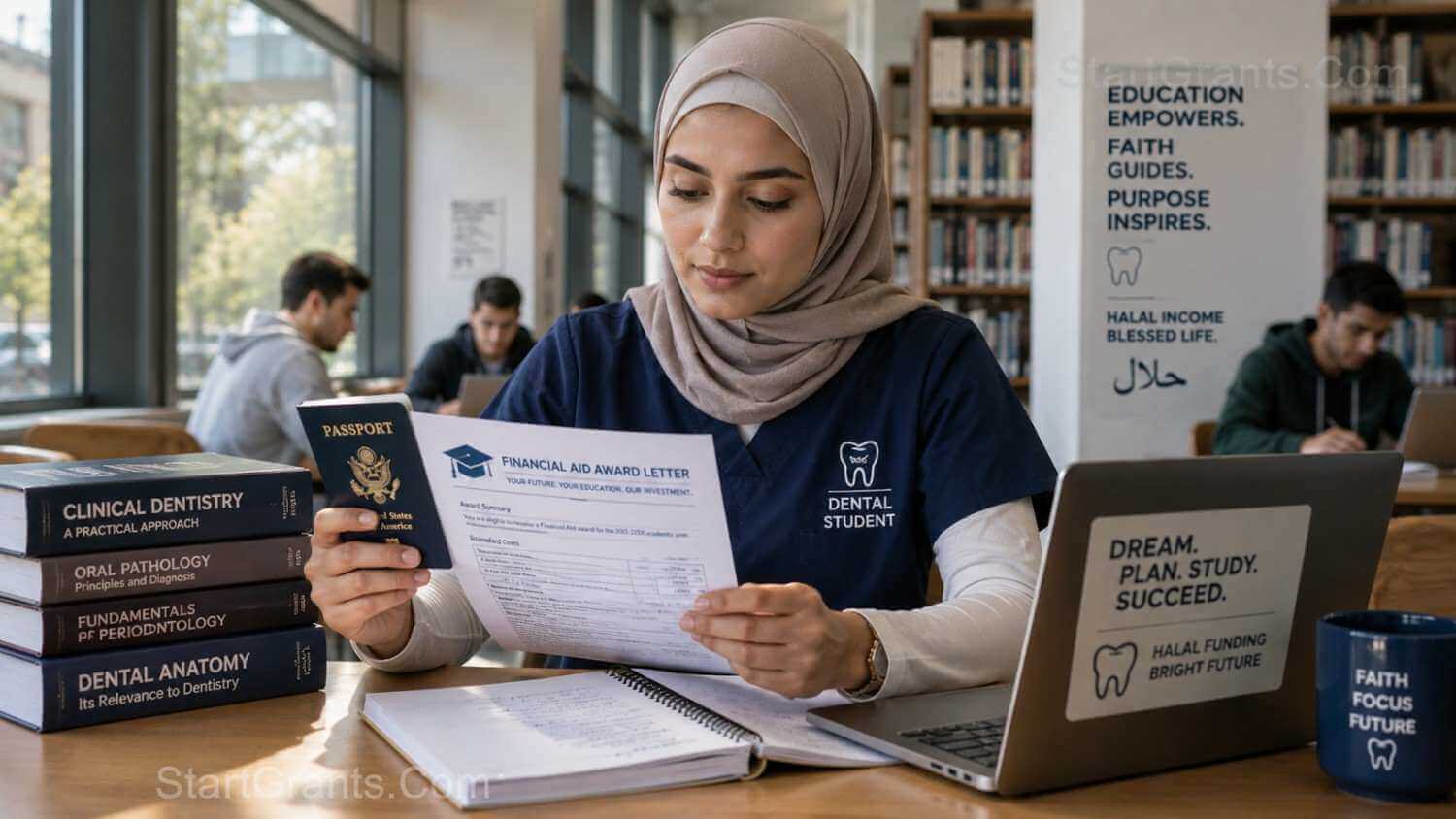
For Muslim international students, navigating the U.S. financial system is a spiritual minefield. Because they lack access to federal grants, many are pushed toward predatory private loans. Seeking Halal sponsorships and institutional aid is vital to protecting the Barakah of their future income.
Conclusion: Your International Funding Action Plan
Studying dentistry in the U.S. as a foreign national is incredibly difficult, but not impossible. Securing “dental school scholarships for international students” requires securing private funds long before you step foot in an embassy.
Execute this strategic checklist:
- Crush the DAT/INBDE: As an international applicant, you are considered a high-risk investment by the university. Your Dental Admission Test (DAT) scores must be significantly higher than the average U.S. applicant to secure institutional merit scholarships.
- Secure a U.S. Cosigner: If you must borrow money, having a creditworthy U.S. citizen or Permanent Resident as a cosigner will drastically lower your interest rates and open up access to standard private loans (like Sallie Mae or Discover).
- Apply to Home-Country Ministries: Before looking at the U.S., exhaust all sponsorship opportunities from your home country’s Ministry of Education or Ministry of Health.
- Reject Predatory Riba: Muslim students must categorically refuse private loans with 15% interest rates. Seek Halal community funding, Qard Hasan, or reconsider the financial viability of studying in the U.S. if Halal funds are unavailable.
The U.S. dental system values global diversity and top-tier talent. Prove your excellence, secure your institutional endowments, and build your international dental career.
Comprehensive Frequently Asked Questions (FAQs)
Q1: Can international students get a full-ride scholarship to U.S. dental schools?
A: It is exceedingly rare. Unlike undergraduate programs or PhDs, dental schools (DDS/DMD) rarely offer full-ride scholarships to anyone, including U.S. citizens. Most international students piece together partial institutional scholarships, personal savings, and family support.
Q2: Are DACA recipients eligible for federal financial aid?
A: No. DACA (Deferred Action for Childhood Arrivals) recipients are classified as undocumented immigrants for financial aid purposes. They cannot receive federal Pell Grants or federal student loans. However, they are eligible for some state-level aid (in states like California or Texas) and private institutional scholarships.
Q3: What is the CAAPID program?
A: The ADEA CAAPID (Centralized Application for Advanced Placement for International Dentists) is the application service used by foreign-trained dentists who want to enter a U.S. dental school with advanced standing (usually skipping the first two years of basic sciences) to earn a U.S. DDS/DMD degree.
Q4: Can I get a student loan in the U.S. without a U.S. cosigner?
A: Yes, but it is dangerous. Companies like MPOWER Financing and Prodigy Finance offer loans to international students without a U.S. cosigner. However, their interest rates are exceptionally high (often 12% to 16%), which can lead to crippling debt upon graduation.
Q5: Does the NHSC or military accept international students?
A: No. The National Health Service Corps (NHSC) and all U.S. military Health Professions Scholarship Programs (HPSP) strictly require applicants to be U.S. Citizens by federal law.
Q6: Can international students work in the U.S. to pay for dental school?
A: F-1 visa regulations strictly limit employment. During your first year, you can only work on-campus for up to 20 hours a week (which pays very little). You cannot work off-campus to pay your tuition. Furthermore, dental school is incredibly demanding, making significant employment practically impossible.
Q7: What is the escrow requirement for international dental students?
A: Because international students cannot get federal loans, many U.S. dental schools require accepted international applicants to place the entire first year’s total cost of attendance (tuition plus living expenses, often over $100,000) into a university escrow account before they will issue the I-20 visa document.
Q8: Is it Halal for Muslim students to use MPOWER or Prodigy Finance?
A: No. Both MPOWER and Prodigy Finance are traditional lenders that charge compound interest on their loans. Under Islamic law, this is strictly classified as Riba and is Haram (forbidden). Muslim students must seek Halal alternatives such as Qard Hasan (interest-free loans from family), university grants, or Zakat funds.
Important Disclaimer: StartGrants.com is an independent educational portal. We are not immigration attorneys or a financial institution. Visa regulations and financial aid policies for non-citizens change frequently. Always consult your university’s International Student Office (DSO) for official guidance.