
Last Updated: May 2026 | Author: Robert
Every election cycle, billions of dollars are poured into the American political machine. From grassroots local mayoral races to massive presidential campaigns, citizens who are deeply passionate about their country’s future open their wallets to support the candidates and ideologies they believe in.
Because Americans are culturally accustomed to receiving a tax break when they donate to a church, a local food bank, or a disaster relief fund, a dangerous misconception has taken root: many taxpayers assume that writing a check to a political candidate will also lower their tax bill come April.
If you are wondering, are donations to political campaigns tax deductible, you need to know the absolute, uncompromising truth before you file your return.

The IRS draws a hard line during tax season: genuine charitable contributions can lower your tax bill, but partisan political donations do not qualify for deductions on your federal return.
Phase 1: The Blunt Truth (Federal Law & The IRS Stand)
Let us eliminate the confusion immediately: No. Contributions to political campaigns are never tax-deductible on your federal income tax return.
It does not matter if you donated $5 to a local city councilman or $5,000 to a presidential nominee. The federal government does not subsidize partisan political activity through the tax code. According to the strict guidelines outlined in IRS Publication 526 (Charitable Contributions), taxpayers are explicitly forbidden from deducting contributions made to political candidates, campaign committees, or newsletter funds.
If you attempt to list a political donation on your Schedule A (Itemized Deductions) as a charitable contribution, you are violating federal tax law. This will inevitably trigger an automated rejection from your tax software, or worse, a devastating manual audit from the Internal Revenue Service.
Phase 2: What Actually Counts as a “Political Contribution”?
The IRS definition of a “political contribution” extends far beyond simply writing a direct check to a candidate’s campaign headquarters. The federal government casts a very wide net to prevent taxpayers from finding creative loopholes.
Under federal tax law, you cannot claim a tax deduction for any out-of-pocket expenses related to the following political activities:
- Fundraising Gala Tickets: If you pay $1,000 to attend a political fundraising dinner, you cannot deduct the cost of the ticket. Even if the actual dinner you ate was only worth $50, the remaining $950 is still considered a non-deductible political contribution.
- Campaign Merchandise: Buying yard signs, bumper stickers, coffee mugs, or t-shirts from a candidate’s official website is considered a political donation. You are buying campaign materials, not making a charitable gift.
- PACs and Super PACs: Any money given to a Political Action Committee—organizations formed specifically to raise and spend money to elect or defeat candidates—is strictly non-deductible.
- Newsletter Subscriptions: Paying for a subscription to a political campaign’s newsletter or a partisan action group’s publication cannot be written off.
- Raffle Tickets: Buying a raffle or lottery ticket at a political rally, even if the proceeds go to a good cause supported by the candidate, is completely barred from tax deduction.
Phase 3: The Tax Code Minefield (501c3 vs. 501c4 vs. 527)
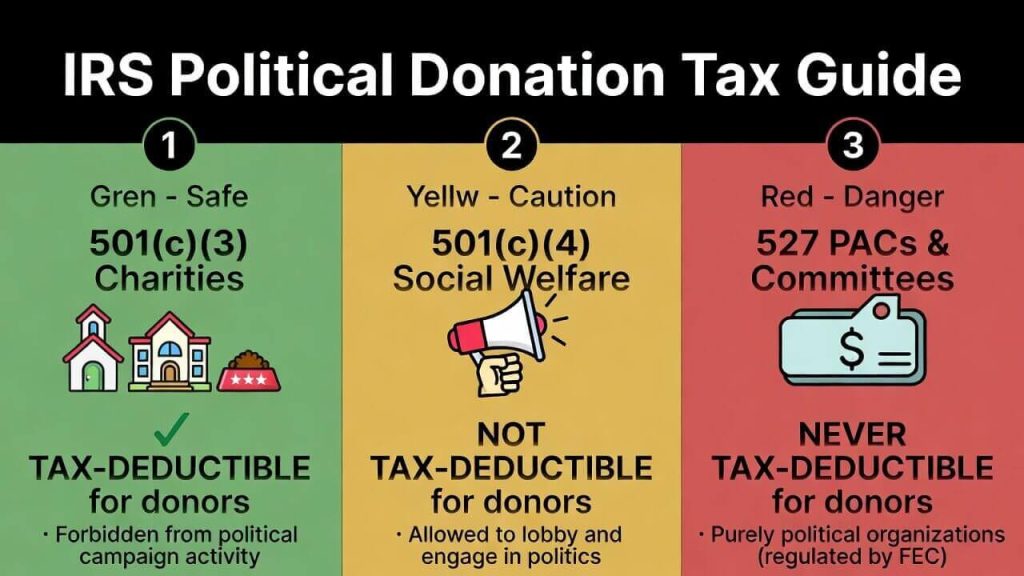
Before you swipe your card, check the designation. Only 501c3 organizations offer tax-deductible status, but they are strictly forbidden from engaging in partisan politics.
To understand why political donations are not deductible, you must understand how the IRS categorizes non-profit organizations. When you are asked to donate to a “cause,” you must always look at the organization’s official tax designation. The letters and numbers assigned by the IRS dictate exactly what you can and cannot deduct.
The Golden Ticket: 501(c)(3) Organizations
These are your traditional, bona fide charities—churches, animal shelters, universities, and disaster relief funds like the Red Cross.
- The Rule: Donations to a 501(c)(3) are strictly tax-deductible.
- The Catch: To maintain this golden tax status, the IRS absolutely forbids 501(c)(3) organizations from participating in any partisan political campaign. They cannot endorse a candidate, and they cannot donate to a political party. If a charity breaks this rule (known as the Johnson Amendment), they will instantly lose their tax-exempt status.
- The Federal Advantage: Because 501(c)(3) organizations are strictly non-partisan and heavily regulated by the IRS, they are the primary entities legally authorized to receive massive federal funding. If you operate a charity, navigating the tax codes for private donations is only half the battle; you must also master the tax liabilities and regulations surrounding government capital. Discover how this system operates by reading our master guide on what is the federal government grant program.
The Social Welfare Trap: 501(c)(4) Organizations
This is where millions of taxpayers get confused. A 501(c)(4) is a “social welfare” organization or a civic league. Massive advocacy groups (like the NRA, the ACLU, or the Planned Parenthood Action Fund) often operate as 501(c)(4)s.
- The Rule: These organizations are allowed to engage in heavy political lobbying and advocate for specific legislation.
- The Catch: Because they engage in politics, donations made to a 501(c)(4) are never tax-deductible for the individual donor as a charitable gift. Do not confuse donating to an advocacy group with donating to a charity.
The Purely Political: Section 527 Organizations
A 527 organization is created primarily to influence the selection, nomination, election, or appointment of any individual to a federal, state, or local public office. This includes political parties, campaign committees, and Super PACs.
- The Rule: They are entirely political. Therefore, as established by the federal tax code, absolutely zero cents of a donation to a 527 organization can be deducted from your income taxes.
The line between a charitable organization and a political advocacy group is heavily blurred in modern politics. Understanding these tax codes is the only way to protect your itemized deductions. Watch this excellent, detailed breakdown explaining the critical differences between 501(c)(3) and 501(c)(4) organizations:
Phase 4: The State-Level Loopholes (Political Tax Credits)
While the federal government and the IRS are incredibly strict about barring political deductions on your federal return (Form 1040), the United States operates under a dual tax system. Individual states have their own departments of revenue, and they write their own tax codes.
Here is the “secret” loophole that many taxpayers miss: While you cannot deduct political contributions on your federal taxes, several states offer highly lucrative tax credits for political donations on your state tax return.
It is crucial to understand the difference between a deduction (which simply lowers your taxable income) and a tax credit (which reduces your actual tax bill dollar-for-dollar).
Examples of State-Sponsored Political Credits
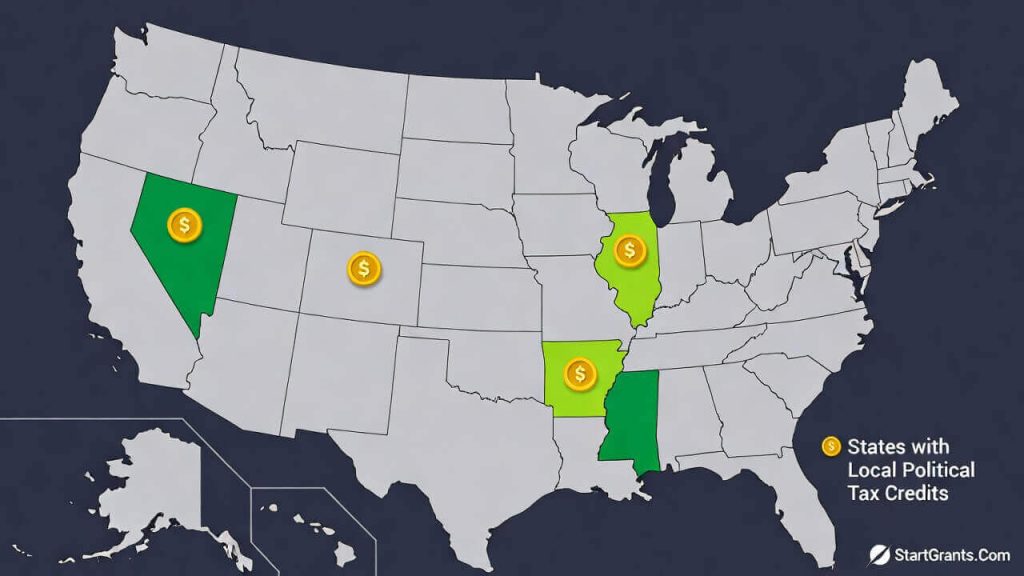
While the federal government says no, individual states have the power to encourage local civic engagement through lucrative dollar-for-dollar tax credits.
If you live in a state that encourages civic engagement, you might be able to get a portion of your political donations refunded directly to you:
- Oregon: The Oregon Political Tax Credit allows single filers to claim a credit of up to $50 (and married couples filing jointly up to $100) for contributions made to political parties or candidates running for state or local offices.
- Ohio: Ohio offers an income tax credit for contributions made specifically to the campaign committees of candidates for statewide offices (like Governor or Attorney General) or the Ohio General Assembly. The credit is capped at $50 for individual filers and $100 for joint filers.
- Arkansas: Arkansas allows a tax credit of up to $50 ($100 on a joint return) for cash contributions made to approved political action committees, candidates for public office, or registered political parties.
- Minnesota: Minnesota offers a highly aggressive Political Contribution Refund (PCR). Unlike a standard tax credit that just lowers your tax bill, Minnesota will literally mail you a cash refund check (up to $75 for individuals, $150 for married couples) within a few weeks of you mailing them your official donation receipt for qualifying state candidates.
The Caveat: These state-level credits usually only apply to state and local candidates, not federal candidates like the President of the United States. Always consult your state’s specific Department of Revenue guidelines to ensure your candidate qualifies for the credit.
Phase 5: The Audit Trap (What Happens if You Claim It?)
What happens if you ignore the rules, accidentally hand your accountant a stack of receipts from a presidential campaign rally, and those numbers end up on your federal Schedule A (Itemized Deductions)?
The Algorithmic Flag
The IRS does not manually review every single tax return, but their automated algorithms are specifically programmed to look for anomalies in charitable deductions. Political campaigns are legally required to report the names and addresses of their donors to the Federal Election Commission (FEC). If the IRS algorithm cross-references your claimed “charitable” deductions with FEC donor databases, your return will be instantly flagged.
The Financial Penalties
If you are caught attempting to deduct political contributions to lower your federal tax burden, the IRS will trigger an audit. At a minimum, they will recalculate your taxes, remove the illegal deduction, and send you a bill for the difference. However, it rarely stops there. The IRS will likely assess an Accuracy-Related Penalty, which is typically 20% of the underpaid tax amount. You will also be charged interest on the unpaid taxes dating back to the original due date of the return. Trying to save a few hundred dollars by illegally writing off a political donation can end up costing you thousands in fines and legal headaches.
Mixing political expenditures with charitable deductions is one of the fastest ways to trigger an IRS audit. Before you submit your Schedule A to the federal government, you must understand exactly what the IRS considers a “Red Flag.” Watch this comprehensive breakdown from a Certified Public Accountant (CPA) detailing the strict rules surrounding charitable vs. political contributions and the audit traps you must avoid:
Software Safeguards
Fortunately, modern tax preparation software (like TurboTax, H&R Block, and TaxAct) acts as a digital safety net. When you input a donation, the software will explicitly ask if the receiving organization is a registered 501(c)(3) charity. If you attempt to type in the name of a Super PAC or a political candidate, the software is designed to reject the entry and prevent you from illegally filing the claim. Do not try to bypass these software warnings.
Phase 6: Legal Alternatives for the Civically Engaged
If you desperately want a tax deduction but still want to influence the direction of your country, you must redirect your money away from politicians and towards 501(c)(3) charitable think tanks.
The Educational Workaround
While you cannot donate to a politician who promises to lower taxes, you can make a tax-deductible donation to a 501(c)(3) economic research institute that publishes educational papers advocating for lower taxes. While you cannot donate to a politician who promises to protect the environment, you can make a tax-deductible donation to a 501(c)(3) conservation charity that physically plants trees. You must fund the action, not the politician.
- For Non-Profit Organizers: If you run an educational 501(c)(3) organization that focuses on civic issues and you are ready to start accepting these tax-deductible contributions from the public, you must ensure your payment processing is flawless and compliant. Do not use a personal account. Before you launch your campaign, read our complete technical guide on how to setup a PayPal donation link to understand the fees, 1099-K tax reporting rules, and the discounted rates available strictly to verified charities.
Conclusion (Protecting Your Tax Return)
Civic engagement is the lifeblood of a functioning democracy, but the federal government will not subsidize your partisan preferences. The rule is absolute: contributions to political campaigns, PACs, and 501(c)(4) advocacy groups are strictly non-deductible on your federal tax return.
Before you write a check to support a cause, you must verify the organization’s IRS designation. If you are chasing a tax write-off, stick strictly to verified 501(c)(3) charities. If you want to fund a politician, do so proudly, but do not attempt to hide that donation on your Schedule A. Protect your financial integrity, avoid the IRS audit trap, and separate your charitable giving from your political warfare.
Frequently Asked Questions (FAQs)
Q1: Can I deduct my out-of-pocket expenses if I volunteer for a political campaign?
A: No. Unlike volunteering for a qualified 501(c)(3) charity where you can deduct mileage and travel expenses, you cannot deduct any out-of-pocket expenses (like gas, flights, or hotel rooms) incurred while volunteering for a political candidate or campaign.
Q2: Are GoFundMe donations to a politician tax-deductible?
A: No. The platform you use to donate does not change the tax law. Whether you use GoFundMe, PayPal, or a direct check, any money given to a political candidate, campaign, or PAC is strictly non-deductible on your federal tax return.
Q3: Can my small business deduct political contributions as a business expense?
A: No. The IRS strictly prohibits businesses from deducting political contributions, lobbying expenses, or in-kind donations to campaigns as standard business expenses. Attempting to hide these as ‘marketing’ or ‘advertising’ is a massive audit trigger.
Q4: Can I deduct a donation made to a politician’s charitable foundation?
A: Yes, but with strict conditions. If the politician’s foundation is officially registered and verified by the IRS as a 501(c)(3) tax-exempt charity, your donation is deductible. However, the money cannot be used for their campaign. Always verify the 501(c)(3) status using the IRS Tax Exempt Organization Search tool.
Q5: Is buying campaign merchandise like a t-shirt or hat tax-deductible?
A: No. Purchasing merchandise (t-shirts, hats, yard signs) from a political campaign is considered a political contribution, not a charitable donation. The entire purchase price is non-deductible.
Q6: Are donations to 501(c)(4) advocacy or dark money groups deductible?
A: No. Section 501(c)(4) organizations are ‘social welfare’ groups that can engage in political lobbying and do not have to disclose their donors (hence ‘dark money’). Because of this political activity, donations to 501(c)(4)s are not tax-deductible.
Q7: Are my mandatory union dues tax-deductible if my union donates to a political candidate?
A: No. Even if future tax laws reinstate deductions for unreimbursed employee expenses (which were temporarily suspended under the TCJA), federal law permanently forbids deducting the portion of your union dues that is funneled into the union’s Political Action Committee (PAC) or used for lobbying.
Q8: Can I get a deduction if I donate to the charitable arm of a political party?
A: No. Political parties (like the DNC or RNC) operate strictly under Section 527 of the tax code. Even if they have funds earmarked for educational or community outreach, the overarching organization is political. To get a tax deduction, you must donate to a completely separate, legally distinct 501(c)(3) organization.
Important Disclaimer: StartGrants.com is an independent information portal. We are not a government agency and do not provide direct tax advice. Always consult a Certified Public Accountant (CPA) regarding your specific deductions.