
Last Updated: July 2026 | Author: Munir Ardi
The defining characteristic of a government grant is that it is “gift aid.” Unlike a federal student loan or a commercial bank line of credit, a grant is essentially an injection of free capital designed to help you achieve a specific goal—whether that is earning a college degree, keeping your small business afloat, or funding a local community center. By definition, grants do not have to be repaid.
However, millions of Americans are shocked every year when they receive a threatening letter from the federal government demanding immediate repayment of their grant funds. How does “free money” suddenly transform into a devastating federal debt?
The reality is that government funding comes with strings attached. If you violate the legal terms of your funding agreement, the government has the absolute right to claw that money back. Before exploring the specific scenarios that trigger repayment, it is essential to understand the overarching rules governing these funds. Start by reviewing our master guide: What is the Federal Government Grant Program? (Taxes & Regulations).
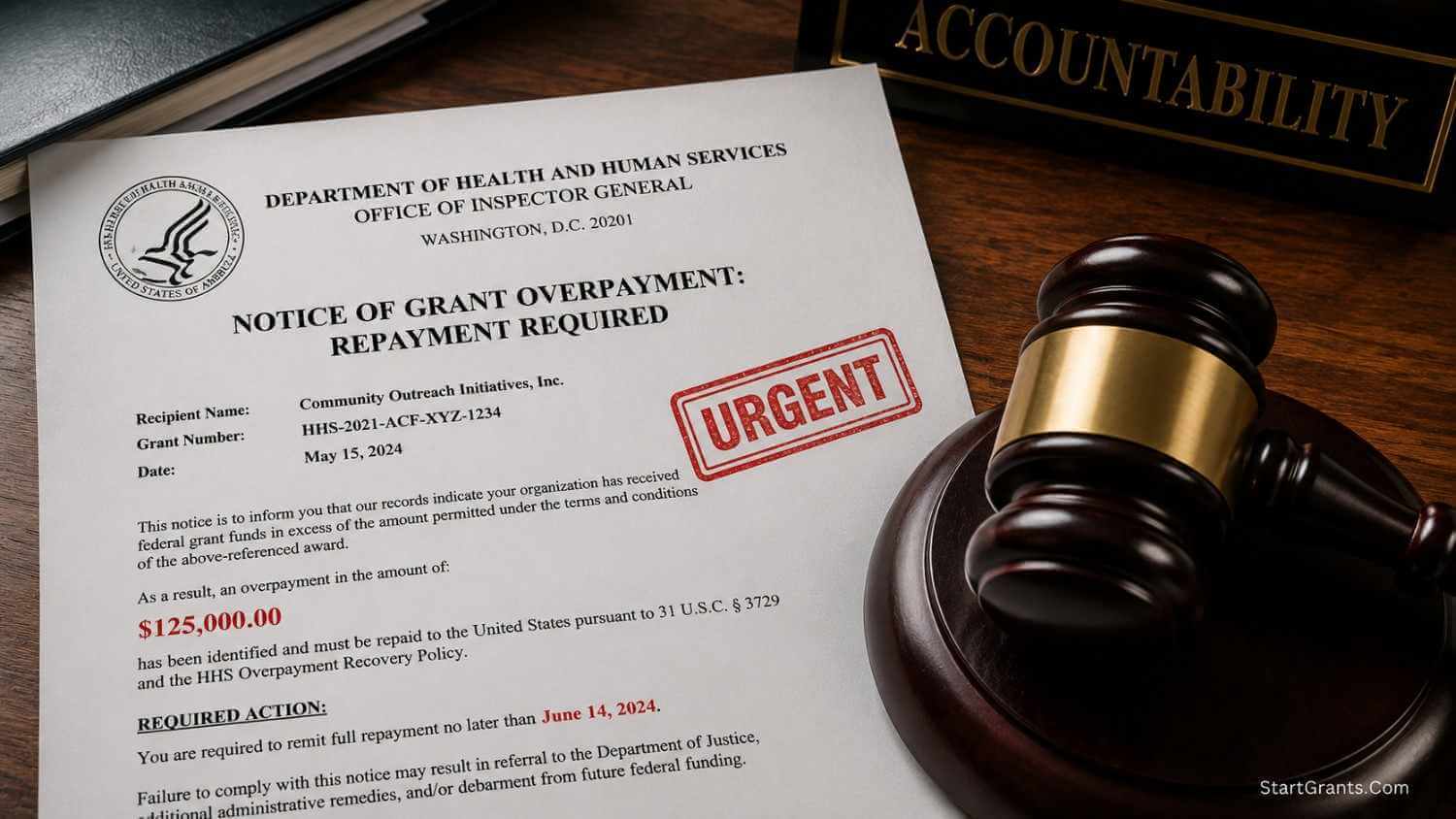
While government grants are legally classified as “gift aid,” violating the strict terms of your funding agreement can immediately transform the grant into a federal debt that must be repaid.
Phase 1: The “Gift Aid” Misconception and Recapture
To understand why you might have to pay back government grants, you must shift your perspective. The federal government does not give out money as an act of blind charity; it gives out money as a contractual investment.
When you accept a grant, you sign a legally binding agreement stating that you will use the funds exactly as prescribed. If you break that contract—either through intentional fraud, administrative negligence, or simply a change in your personal circumstances—the government initiates a process known as Recapture (or “Overpayment Recovery”). They will demand the return of the unearned or misused funds to protect the American taxpayer.
Phase 2: Individuals & Students (The Pell Grant Trap)
The most common grant repayment scenarios involve individual college students. The Federal Pell Grant is a lifeline for millions, but it is highly conditional based on your enrollment status.
The Department of Education utilizes a formula called Return of Title IV Funds (R2T4). You are only entitled to keep the portion of the grant that you “earned” by actually attending classes. You will be forced to repay your Pell Grant under the following circumstances:
- Dropping Out Early: If you withdraw from your university before completing at least 60% of the semester, you have not earned your full grant. The school will return the unearned portion to the government, and the school will then bill you for that balance.
- Changing Enrollment Status: If you are awarded a grant based on being a “full-time” student, but you drop two classes and fall to “part-time” status within the add/drop window, your grant eligibility decreases. You will owe the difference (an overpayment).
- Outside Scholarships: If you receive a massive private scholarship that, combined with your Pell Grant, exceeds your total cost of attendance, the federal government may demand a refund of the overage.
It is also crucial to remember that while the grant itself might not need to be repaid if you finish the semester, you still might owe money to the IRS if you spend it incorrectly. For a detailed breakdown of this trap, read: Do You Have to Pay Taxes on a Government Grant?
Pro-Tip: Avoiding Student Overpayments
Before you drop a class or withdraw from your university, you must understand exactly how much money it will cost you. To see how the government calculates your earned aid and why withdrawing early triggers a massive bill, watch this essential breakdown: What Happens If You Dropout Of College With Financial Aid?:
Phase 3: Businesses & Corporations (Fraud & Mismanagement)
For for-profit businesses, the stakes are exponentially higher. Corporate grants are heavily monitored. A business will be forced to repay a federal or state grant if they trigger any of the following recapture clauses:
- Misappropriation of Funds: If your business receives a $100,000 grant to purchase manufacturing equipment, but you use $20,000 of it to pay off old corporate debt or fund an executive retreat, that is misappropriation. You must repay the misused funds immediately.
- Failure to Meet Metrics: Many corporate grants (especially state-level economic development grants) require the business to create a specific number of new jobs within a timeframe. If you fail to meet those hiring metrics, the grant contract is breached, and the funds must be returned.
- Tax Evasion: Government business grants are almost always considered taxable gross income. If you attempt to hide this money from the IRS, you not only face tax evasion charges but also a breach of your grant contract. Learn more about this specific corporate liability in our guide: Are Government Grants Taxable to Corporations?
Phase 4: Non-Profits & Block Grants (Audit Failures)
Charities and 501(c)(3) non-profits are subject to the strictest oversight in the federal ecosystem, governed by the Office of Management and Budget (OMB) Uniform Guidance.
Often, non-profits receive funding via state sub-awards. If you are unsure how these funds cascade down to local charities, review What is a Block Grant in Government?.
If a non-profit expends more than $750,000 in federal funds in a single fiscal year, they must undergo a rigorous Single Audit. If the independent auditor discovers missing receipts, commingled funds (mixing grant money with general donation money), or unapproved budget deviations, the federal agency will issue an “Audit Resolution” demanding the repayment of the disallowed costs. Failing an audit is the fastest way a non-profit can bankrupt itself.
Pro-Tip: Surviving Federal Audits
To ensure your non-profit never faces a forced repayment scenario, you must understand the rules of federal oversight. If your organization is scaling up and managing large grants, watch this critical explanation to prepare your financial team: The Sample – What Is a Single Audit?:
Phase 5: The Federal Collection Process (TOP)
What happens if you refuse to pay back the government? The federal government is the most powerful debt collector on the planet. They do not need to take you to court to get their money.
If you ignore a notice of grant overpayment, your debt is eventually transferred to the Department of the Treasury. They will initiate the Treasury Offset Program (TOP). Through TOP, the government will automatically seize your annual IRS tax refunds, garnish a percentage of your corporate or personal wages, and intercept your Social Security benefits until the grant debt is paid in full.
Phase 6: The Muslim Perspective (Riba Penalties, Qard Hasan, & Takaful)
For Muslim students, business owners, and non-profit directors, a forced grant repayment is not just a financial disaster; it is a profound spiritual hazard. Navigating a federal debt collection process requires extreme vigilance to ensure you do not fall into the sin of Riba (interest).
The Trap of Riba in Federal Penalties
When the government demands repayment for a grant overpayment or an audit failure, they issue a deadline. If you fail to repay the principal amount by that deadline, federal law mandates that the agency begin charging compounding interest and late penalties on the debt.
In Islamic jurisprudence, paying this compounding penalty is explicitly Riba, which is strictly Haram (prohibited). Therefore, if a Muslim individual or organization owes the government a grant refund, it must be paid immediately to prevent the Halal principal debt from being corrupted by Haram interest penalties.

If forced to repay a government grant, Muslims must avoid using interest-bearing credit cards and instead seek out Qard Hasan (interest-free loans) to prevent falling into the sin of Riba.
Qard Hasan: The Ethical Repayment Solution
A major crisis occurs when a Muslim student drops a class, owes the university $1,500 for a Pell Grant refund, but has no cash. The immediate temptation is to put the debt on an interest-bearing credit card or take a payday loan. This is jumping from one Riba trap to another.
To preserve your faith and finances, you must seek Qard Hasan (a benevolent, zero-interest loan). For Muslim students facing educational debts, national organizations like A Continuous Charity (ACC) exist to provide Riba-free loans. Alternatively, if a family is in severe hardship and facing federal wage garnishment, they qualify as the needy and can rightfully request Zakat from their local Masjid or organizations like ICNA Relief to clear the debt.
Mitigating Risk through Takaful (Gharar)
For Islamic non-profits, grant recapture often happens accidentally. If a pipe bursts and floods the community center, a desperate board of directors might illegally dip into restricted federal grant funds to pay for the emergency repairs, immediately triggering a breach of contract and forced repayment.
This is why having robust property and liability insurance is vital. However, traditional commercial insurance involves Gharar (excessive uncertainty). To protect the organization ethically, Muslim non-profits should prioritize Takaful (Islamic cooperative insurance) models to cover catastrophic damages. If Takaful is unavailable, securing standard commercial policies under the principle of Dharurah (necessity) is permitted by most scholars to protect the charity from financial ruin and prevent the illegal misuse of federal grant funds.
Conclusion
Do you have to pay back government grants? Ideally, no. But practically, yes, if you break the rules. Grants are conditional investments. If a student drops out, a business misuses funds, or a non-profit fails an audit, the federal government will initiate aggressive recapture protocols to recover taxpayer dollars.
For the Muslim community, understanding these compliance rules is the ultimate safeguard against Riba. By maintaining pristine records to avoid repayment, and by utilizing Halal financial tools like Qard Hasan and Takaful if a crisis occurs, you can navigate the federal funding system without compromising your spiritual integrity.
Frequently Asked Questions (FAQs)
Q1: Do you have to pay back the Pell Grant if you fail a class?
A: Failing a class usually does not trigger immediate repayment as long as you actually attended the class and completed the semester. However, if you drop out entirely, stop attending early in the semester, or change your enrollment status from full-time to part-time, you will likely have to repay a portion of the unearned grant.
Q2: Can the government garnish my wages for an unpaid grant overpayment?
A: Yes. If you ignore repayment notices, the debt is sent to the Treasury Offset Program (TOP). The federal government can legally garnish your wages, seize your tax refunds, and withhold federal benefits to recover the grant money.
Q3: What causes a non-profit to repay a federal grant?
A: The most common cause is failing an audit due to missing documentation, commingling restricted grant funds with general operating accounts, or spending the money on “disallowed costs” that were not approved in the original grant budget.
Q4: Is it Haram to pay late penalties on a federal debt?
A: Yes. Late penalties assessed by the federal government are typically calculated as compounding interest on the principal debt. In Islamic finance, paying this interest is considered Riba and is strictly prohibited (Haram). You must strive to pay the principal immediately to avoid incurring Riba.
Q5: Can I use Zakat to pay off a federal grant debt?
A: Yes, if you are in genuine financial hardship. Someone who is overwhelmed by legitimate debt and does not have the means to pay it back falls under the category of Al-Gharimin (those in debt), which is one of the eight eligible categories to receive Zakat in Islam.