
Last Updated: May 2026 | Author: Zee
The ability to accept financial contributions instantly from anywhere in the world has revolutionized how creators, non-profits, and individuals fund their passions and causes. Whether you are a local animal rescue seeking emergency medical funds, a Twitch streamer building a community, or a neighbor organizing a memorial fund, setting up a digital collection jar is no longer optional; it is mandatory.
However, the internet is littered with horror stories of well-intentioned people who launched a successful fundraising campaign only to wake up the next morning and find their PayPal accounts permanently frozen and their funds locked for 180 days.
Why does this happen? Because accepting money online is not just about generating a clickable link; it is a complex financial transaction governed by strict anti-fraud algorithms, complex fee structures, and aggressive federal tax reporting requirements. If you set up your donation link incorrectly, you risk losing everything your supporters gave you.
This comprehensive guide will bypass the basic “click here” tutorials and provide you with the ultimate technical Standard Operating Procedure (SOP). You will learn how to choose the correct account architecture, how to navigate PayPal’s hidden fee structures, the three different types of donation tools at your disposal, and the vital tax implications you must prepare for.
By the end of this guide, you will know exactly how to setup a PayPal donation link that is secure, compliant, and optimized for maximum conversions.
Setting up a secure digital tip jar empowers your community to support your work, but it requires strict adherence to payment processing rules.
Phase 1: The Foundation (Personal vs. Business Accounts)
Before you generate a single link or button, you must establish the correct foundational architecture. PayPal operates two distinct ecosystems: Personal accounts and Business accounts. Choosing the wrong one for your fundraising efforts is the number one reason accounts get flagged for suspicious activity.
The Personal Account Trap
A Personal PayPal account is designed strictly for peer-to-peer (P2P) transactions. It is built for splitting a dinner bill with a friend, paying a babysitter, or sending birthday money to a relative.
- The Problem with Donations: If you use a Personal account to publicly solicit donations by posting your link on Twitter or YouTube, PayPal’s security algorithms will eventually notice a massive influx of small payments from hundreds of strangers across different geographic locations. To the algorithm, this mimics the behavior of an unregistered merchant bypassing commercial fees, or worse, a money-laundering operation.
- The Consequence: Your account will likely be temporarily limited, requiring you to provide extensive documentation to prove the source of the funds. Furthermore, Personal accounts force your legal name to be displayed to every donor, completely stripping you of your online privacy.
The Business Account Necessity
If you are accepting donations from the general public, you must upgrade to or open a dedicated PayPal Business account.
- The Professional Advantage: A Business account is free to open. It allows you to operate under a “Doing Business As” (DBA) name, a channel name, or your charity’s official title, protecting your personal identity.
- The Technical Advantage: Most importantly, a Business account unlocks access to PayPal’s advanced merchant tools, including customizable HTML donation buttons, recurring (monthly) subscription options for your supporters, and robust tax reporting dashboards.
Phase 2: The Anatomy of PayPal Fees (What They Don’t Tell You)
Nothing in the financial world is truly free. When a supporter clicks your link and donates $50, you will not receive the full $50 in your available balance. PayPal is a payment processor, and they take a cut of every commercial transaction to cover network costs and generate profit. Understanding this fee structure is critical for setting your fundraising goals.
The Standard Commercial Rate
As of recent updates, the standard domestic fee for processing a transaction through a PayPal donation button is generally 2.89% + a fixed fee (typically $0.49 USD) per transaction.
- The Micro-Donation Impact: This fixed fee severely impacts micro-donations. If a generous viewer donates $1.00 to your stream, PayPal takes $0.49 immediately, plus the 2.89% ($0.03). You only receive $0.48. To combat this, you must configure your donation buttons to encourage larger minimum tiers (e.g., $5, $10, or $20).
- International Surcharges: If a supporter from the UK donates to your US-based account, PayPal will apply an additional cross-border fee (often 1.50%) and a currency conversion spread, further reducing your net payout.
The 501(c)(3) Charity Advantage
If you are raising money on behalf of a legally registered non-profit organization, you do not have to pay the standard commercial rates.
- The Discounted Rate: Verified 501(c)(3) charities can apply for special status through PayPal’s official non-profit portal. Once approved, the processing fee drops significantly, often to 1.99% + $0.49 per transaction. Over the course of a $10,000 fundraising campaign, this discount saves your organization hundreds of dollars that can be redirected back to your cause. You must submit your IRS determination letter to PayPal to unlock this tier.
Phase 3: The 3 Types of Donation “Weapons”
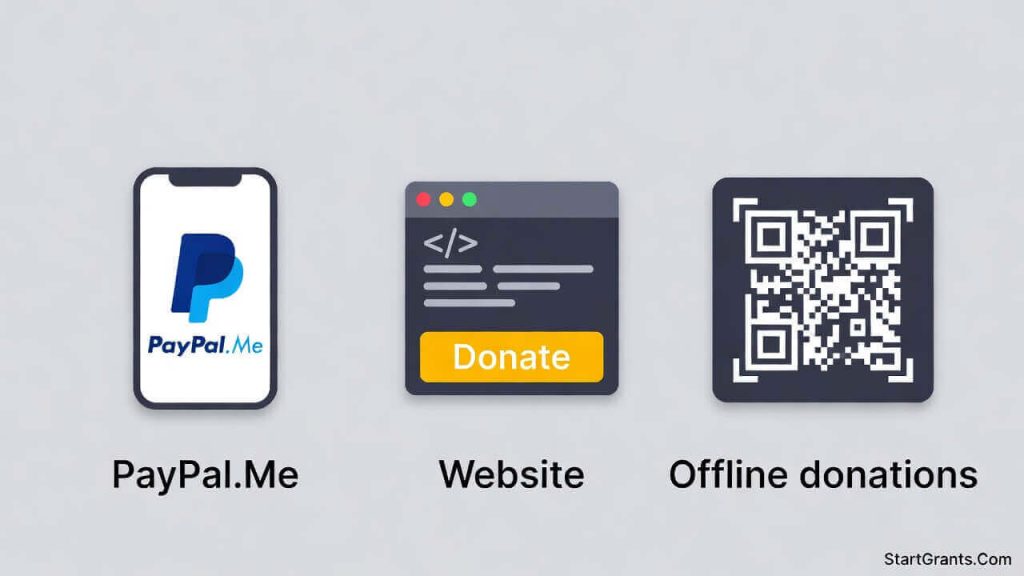
Do not rely on just one method. Deploy the specific PayPal tool that matches your audience’s platform, whether it is social media, a WordPress blog, or a live event.
PayPal does not offer a “one-size-fits-all” solution. Depending on where your audience lives on the internet, you must deploy the correct type of donation tool. There are three primary “weapons” in your fundraising arsenal:
1. The PayPal.Me Link (The Social Media Sniper)
- What It Is: A customized, incredibly short URL (e.g.,
paypal.me/YourChannelName). - Best Use Case: This is perfect for the fast-paced world of social media. You can drop this short link into your Instagram bio, your Twitter profile, or at the bottom of a YouTube video description. When a user clicks it, they are taken to a clean, mobile-friendly landing page where they can simply type in an amount and hit send. It requires zero coding knowledge.
2. The HTML Donate Button (The Website Heavy Artillery)
- What It Is: A snippet of HTML code generated by PayPal that renders as a clickable, branded yellow “Donate” button on your website.
- Best Use Case: If you run a WordPress blog, a charity homepage, or a professional portfolio, this is mandatory. The HTML button is highly customizable. You can program it to offer specific donation tiers (e.g., a dropdown menu for $10, $50, or “Other Amount”) and allow donors to set up recurring monthly contributions.
3. The QR Code (The Offline Enforcer)
- What It Is: A scannable barcode linked directly to your PayPal checkout flow.
- Best Use Case: Do not rely solely on digital links. If your charity is hosting an in-person gala, a bake sale, or a 5K charity run, you must print your PayPal QR code on flyers, table tents, and banners. Supporters can simply open their smartphone cameras, scan the code, and donate instantly without having to type in a long URL.
Phase 4: Step-by-Step Technical Setup (The Click-by-Click Guide)
PayPal frequently updates its user interface, meaning screenshots from last year are often obsolete today. However, the core architecture of their donation tool remains consistent. If you have successfully upgraded to a Business account, follow this technical Standard Operating Procedure (SOP) to generate your custom HTML Donate button and shareable link.
Step 1: Accessing the Donation Dashboard
- Log into your PayPal Business account.
- Navigate to the top menu bar. Depending on your current layout, click on “Pay & Get Paid” or access the “App Center”.
- Look for the sub-menu labeled “Accept Payments” and select the “Donate” or “PayPal Checkout” option. (You can also type “Donate Button” directly into the PayPal search bar).
- Click “Create a Button.”
Step 2: Customizing the Financial Tiers
Do not simply leave the donation amount blank. Psychology plays a massive role in fundraising. If you present donors with a blank box, they often default to the lowest possible amount (e.g., $1 or $5).
- Select the option that says “Specify exact amounts.” Create a three-tier psychological pricing structure: $10, $25, and $50.
- Always leave a fourth option checked for “Let the donor decide the amount” to accommodate high-net-worth supporters who may want to give $500.
Step 3: Enabling Recurring Revenue & Donor Notes
- Monthly Subscriptions: Check the box that says “Let donors set up recurring monthly donations.” Converting a one-time $20 donor into a $5/month recurring subscriber provides your channel or charity with predictable, stabilized income.
- Special Instructions: Open the “Advanced Variables” or “Optional Settings” tab. Check the box to “Let donors send a message with their donation.” For Twitch streamers and content creators, reading these messages live on the air is the primary incentive for the audience to donate.
Step 4: Extracting the Code
Once you click “Finish and Get Code,” PayPal will generate two distinct items:
- A block of raw HTML code (for websites).
- A direct URL link (for social media and emails). Copy both of these and paste them into a secure notepad document.
While the exact layout of the PayPal dashboard frequently changes, the core mechanics of generating your HTML code remain consistent. If you are a visual learner and want to see the exact click-by-click process of navigating the menus and customizing your dropdown pricing tiers, watch this comprehensive step-by-step walkthrough:
Phase 5: Deployment Strategy (Where to Put Your Link)
Generating the link is only 10% of the battle. The other 90% is deployment. If you bury your donation link at the bottom of a massive wall of text, your conversion rate will plummet. You must strategically place your PayPal link where user intent and visibility intersect.
1. For Streamers (Twitch & YouTube)
In the live-streaming ecosystem, impulse support is your primary revenue driver.
- Twitch Panels: Do not just paste the raw URL into your Twitch bio. Go to your “About” section, turn on “Edit Panels,” and upload a custom graphic (a JPEG of a button that says “Tip Jar” or “Support the Stream”). Link that specific graphic to your direct PayPal URL. When viewers click the image, it acts as a seamless button.
- YouTube Descriptions: The YouTube algorithm automatically truncates video descriptions after the first two lines, hiding everything else behind a “Show More” button. You must place your PayPal.Me link in the very first or second line of your video description to ensure it is immediately visible on mobile devices.
2. For Webmasters (WordPress Integration)
If you run a WordPress blog or a charity website, you must utilize the HTML code block you generated in Phase 4.
- Navigate to your WordPress Dashboard.
- Go to Appearance > Widgets.
- Drag a “Custom HTML” block into your primary sidebar or footer.
- Paste the raw PayPal code directly into the block and save. This will render a highly professional, interactive yellow “Donate” button on every single page of your website, constantly reminding readers that your platform is community-supported.
3. For Social Media (The Link-in-Bio Funnel)
Instagram and TikTok only allow one clickable link in your profile bio. If you use that single slot for your PayPal link, you cannot link to your latest video or article.
- The Solution: Use a dedicated link-aggregator tool like Linktree or Carrd. Place your Linktree URL in your social media bio. Inside your Linktree dashboard, create a prominent, highly visible button titled “Support My Work (PayPal)” right at the top of the list. This funnels all your followers to one specific, optimized landing page.
Phase 6: Compliance & Tax Implications (The IRS Reality)
Because accepting online donations is incredibly easy, thousands of individuals accidentally trigger massive tax liabilities every year. You must understand that the Internal Revenue Service (IRS) and international tax authorities do not view all “donations” the same way.
The Gift vs. Income Dilemma
If you are crowdfunding for a personal medical emergency or a neighborhood memorial, the IRS generally classifies these contributions as non-taxable “gifts” from individuals. However, if you are a content creator, a podcaster, or a blogger accepting donations from your audience, the IRS classifies that money as taxable business income, regardless of whether you call it a “tip,” a “donation,” or a “coffee.” You are exchanging entertainment or information for financial support.
The Form 1099-K Threshold (2026 Update)

Crowdfunding is not tax-free money. If you cross the reporting threshold, PayPal will report your gross donation volume directly to the IRS.
Crowdfunding is not tax-free money. Under the American Rescue Plan Act, the federal reporting threshold for third-party networks was drastically lowered from $20,000 to just $600. While the IRS implemented several phased transition periods and delays in previous years, content creators and fundraisers in 2026 must be prepared for stricter reporting.
If your gross commercial payments exceed $600 in a calendar year, PayPal is legally obligated to issue a Form 1099-K to both you and the IRS, regardless of the number of individual transactions you processed. Warning: Furthermore, several states (like Massachusetts, Maryland, and Illinois) maintain their own localized, aggressive reporting laws. It is highly recommended that you consult a CPA regarding your specific crowdfunding liabilities.
The Political Campaign Exception
It is also vital to understand that the rules change entirely depending on who the money is going to. For example, while giving to a registered 501(c)(3) charity is famously tax-deductible for the donor, the same rules do not apply to the political sphere. If you are setting up a PayPal link to fund a local mayoral run, you and your donors are subject to aggressive Federal Election Commission (FEC) regulations. To understand the complex boundaries of political fundraising, you must read our deep-dive analysis: Are Donations to Political Campaigns Tax Deductible?
The IRS reporting thresholds for third-party payment apps (like PayPal, Venmo, and CashApp) have undergone massive legislative changes recently. To avoid devastating audit penalties at the end of the year, you must understand exactly how the Form 1099-K applies to your crowdfunding efforts. Watch this critical update from a Certified Public Accountant regarding the newest tax rules:
Conclusion (Securing the Financial Bridge)
Setting up a digital tip jar or a massive crowdfunding campaign requires far more than just generating a clickable link. It requires a fundamental understanding of digital financial infrastructure. When you ask people to part with their hard-earned money to support your content, your cause, or your community, you owe them absolute transparency and a frictionless, secure checkout experience.
By upgrading to a dedicated Business account, you protect your personal privacy and unlock the professional tools necessary to scale your fundraising. By understanding the fee structures, you can accurately forecast your net revenue and adjust your goals accordingly. Most importantly, by anticipating the inevitable IRS Form 1099-K, you protect yourself from catastrophic tax liabilities at the end of the year.
The digital economy waits for no one. Do not let technical intimidation stop you from funding your community’s mission or your creative career. Upgrade your account to Business, customize your payment tiers, embed that button onto your platform today, and start converting your audience’s goodwill into tangible financial support.
Frequently Asked Questions (FAQs)
Q1: Why are my PayPal donations being held for 21 days?
A: This is the most common shock for new fundraisers. If you have a brand-new PayPal account, or if you suddenly receive a massive spike in donation volume that is unusual for your account history, PayPal’s automated security algorithm will place a temporary 21-day hold on those funds. They do this to protect buyers from fraud. To expedite the release of your funds, you must often verify your identity (uploading a photo ID) and build a consistent history of dispute-free transactions.
Q2: Can a donor give money if they don’t have a PayPal account?
A: Yes. This is one of the primary benefits of using a PayPal Business account to generate your HTML donation button. When a supporter clicks your link, they are taken to a landing page that offers them two options: log in to their own PayPal account, or simply check out as a “Guest” using any standard major credit card or debit card (Visa, Mastercard, Amex). They are not forced to create an account to support you.
Q3: How do I stop “chargeback trolls” from reversing their donations?
A: Unfortunately, the live-streaming community is often targeted by “chargeback trolls”—individuals who donate large sums of money ($500 or $1,000) simply to get a reaction on screen, only to call their credit card company the next day and claim the charge was unauthorized. If they win the dispute, PayPal pulls the money from your account and hits you with a $20 chargeback fee. To combat this, you must keep meticulous records. If you receive a suspiciously large donation from an unknown user, do not spend it immediately. Hold it in your balance for 90 days. Furthermore, explicitly state in your Twitch or YouTube bio: “All donations are final and non-refundable.” While not legally bulletproof, it helps your case during a PayPal dispute review.
Q4: Is GoFundMe better than a direct PayPal link?
A: It depends entirely on your goal. GoFundMe is a centralized crowdfunding platform designed for specific, narrative-driven campaigns (like a medical emergency or rebuilding a burned house). It has a built-in social sharing engine that can help your cause go viral, but it charges its own platform fees in addition to payment processing fees. A direct PayPal link is better for ongoing, indefinite support (like a podcaster’s tip jar or a charity’s general fund) because you have complete control over the landing page and generally pay lower overall fees.
Q5: Do I need a formal LLC to open a PayPal Business account?
A: No. You do not need to form a Limited Liability Company (LLC) or a Corporation to access a PayPal Business account. As an individual creator or a neighborhood organizer, you can legally operate as a Sole Proprietorship. When setting up the account, you simply select “Individual/Sole Proprietorship” as your business type and use your Social Security Number (SSN) instead of an Employer Identification Number (EIN). You can then use your channel name or campaign title as your “Doing Business As” (DBA) name on the checkout page.
Q6: Will PayPal shut down my account if I use a Personal link for donations?
A: Yes, it is highly likely. PayPal’s Terms of Service strictly prohibit using Personal accounts for commercial transactions or mass public fundraising. While you might get away with it for a few weeks, the algorithm will eventually flag the high volume of incoming micro-transactions from unrelated third parties. Your account will be frozen, and you will be forced to upgrade to a Business account and provide documentation before you can access the funds you raised.
Q7: Are donations to my Twitch stream or YouTube channel tax-deductible for the donor?
A: No. Unless you are a legally registered 501(c)(3) non-profit organization, contributions to your personal channel or project are considered non-deductible gifts or commercial income. Donors cannot write these off on their taxes.
Q8: Can I accept Apple Pay or Venmo using a PayPal donation link?
A: Yes. If you use a PayPal Business account and generate a modern HTML Donate button or Smart Payment Button, PayPal automatically detects the user’s device. It will frequently offer mobile users the option to check out using Venmo, Apple Pay, or Google Pay alongside standard credit cards.
Important Disclaimer: StartGrants.com is an independent information portal. We are not a government agency and do not provide direct grants or products. Always verify the current status of programs with the providing organization.