
Last Updated: August 2026 | Author: Munir Ardi
The internet is flooded with late-night advertisements promising “free government money to pay off your credit cards” or “grants to buy a luxury car.” Let us be unequivocally clear: the federal government does not hand out blank checks for discretionary personal spending. If a website asks for your credit card information to process a free government grants for individuals application, you are being scammed.
However, this does not mean personal financial assistance is a myth. The United States government actively distributes billions of dollars every year directly to citizens—but these funds are heavily categorized to target specific hardships: education, housing, healthcare, and utility crises.
Before you begin applying for individual hardship programs, you must understand the broader architecture of how the federal government distributes its funds. Calibrate your expectations by reviewing our overarching central guide: The Ultimate Guide to Government Grants in 2026.

Navigating the federal bureaucracy to secure personal financial assistance requires patience, but legitimate government grants can provide a vital lifeline during economic hardship.
Phase 1: The Reality of “Free Money”
To successfully navigate the federal bureaucracy, you must first strip away the misleading terminology. The government rarely uses the word “grant” when giving money to an individual for daily living expenses. Instead, they use terms like “subsidy,” “voucher,” “waiver,” or “direct assistance.”
If you want to bypass the scammers and access legitimate federal and state aid programs designed to pull citizens out of poverty, you must learn exactly where to look and what terminology to use. Master the reality of personal funding by studying our Tier-3 guide on how to get free money from the government legally and safely.
Phase 2: Educational Grants & Bursaries
The single largest sector of personal grants provided by the federal government is dedicated to higher education. The government views funding a citizen’s education not as a handout, but as an investment in the national economy.
The Federal Pell Grant & Campus-Based Aid
Administered by the Department of Education, the Pell Grant is the ultimate form of personal gift aid. For the 2026-2027 academic year, eligible undergraduate students can receive over $7,300 to pay for tuition, housing, and books. This money never has to be repaid. You apply for this by filling out the Free Application for Federal Student Aid (FAFSA).
If the Pell Grant is not enough to cover the exorbitant cost of college, you must aggressively target campus-based aid. Students who demonstrate exceptional financial need and file their FAFSA early can stack their Pell award with additional federal funds. Discover how to secure this hidden $4,000 subsidy by reading our comprehensive guide on the Supplemental Educational Opportunity Grant (FSEOG).
Bursaries and Fellowships
Beyond federal Pell Grants, individuals can secure massive funding from private universities, corporate foundations, and state-sponsored bursaries. However, these funds are highly competitive and require persuasive, compelling written requests.
Do not let poor communication cost you a college education. Learn the exact structural formatting required to win private funding by reading our guide on how to write bursary application letters.
Pro-Tip: Navigating the FAFSA
The FAFSA is your primary gateway to federal gift aid, but the application interface undergoes frequent updates. To ensure you do not miss a single dollar of the $7,300+ Pell Grant due to a clerical error, follow this comprehensive, updated walkthrough on How to fill out the 2026–27 FAFSA step-by-step:
Phase 3: Hardship & Personal Use Grants
If you are facing an immediate crisis—such as an impending eviction, a winter without heating, or an inability to afford critical medical care—the government has specific safety nets designed for personal use.
- LIHEAP (Low Income Home Energy Assistance Program): If you cannot afford your heating or cooling bills, this federal grant pays the utility companies directly on your behalf to keep your family safe.
- Housing Choice Vouchers (Section 8): This HUD program acts as a direct housing grant, paying a significant portion of your monthly rent to private landlords if you meet extreme low-income thresholds.
- Homeownership & Down Payment Grants: Escaping the rental trap is a major step toward financial independence. State and local governments offer massive Down Payment Assistance (DPA) grants to help you buy a house. However, injecting government capital into a real estate transaction changes the bank’s rules. Before you sign a contract, you must ask: does government grant affect mortgage approval and underwriting?
- Medicaid & HCBS Waivers: For individuals with disabilities requiring in-home care, Home and Community-Based Services (HCBS) waivers act as massive personal grants to cover the cost of daily living aides.
- Transportation & Clean Energy Subsidies: Beyond immediate survival, the government provides massive “personal use” grants for adopting green technology. You can legally claim up to $7,500 as an instant point-of-sale discount at the dealership by exploring our guide on government grants electric cars.
To learn the specific qualification thresholds and application portals for these hardship programs, transition to our specialized guide detailing how to apply for government grants for personal use.
Phase 4: Recovering Your Lost Assets
There is one area where the concept of “free money from the government” is absolutely real: claiming what is already yours. Currently, there are tens of billions of dollars sitting in state and federal treasuries belonging to private citizens who simply forgot about it.
This includes forgotten utility deposits, uncashed state tax refunds, abandoned bank accounts, and uncollected insurance payouts. By law, corporations must surrender abandoned funds to the state treasury, which holds the money until the citizen claims it.
To learn how to search the national databases and recover your lost funds without paying a “finder’s fee” to a scammer, study our specific guide on how to check if you have assets in the US Treasury (unclaimed money).
Pro-Tip: Finding Unclaimed Property
Searching national and state databases for your lost assets can feel overwhelming if you do not know exactly which official government portals to use. Avoid predatory “finder fee” websites and follow this practical, visual guide on How to find unclaimed money legally and completely for free:
Phase 5: The Official Application Portals
You should never pay an application fee to access a government hardship program. All legitimate federal assistance is routed through secure `.gov` domains. To begin your journey toward financial stability, utilize the two primary federal gateways:
- For General Hardship (Housing, Utilities, Food): Visit Benefits.gov, the official benefits website of the U.S. government. Their “Benefit Finder” questionnaire will automatically match your situation with eligible state and federal programs.
- For Educational Funding: All applications for Pell Grants and federal aid must be processed through the official Department of Education portal at StudentAid.gov.
Phase 6: The Muslim Perspective (Halal Finance, Riba, & Zakat)
For Muslims residing in the United States, seeking personal financial assistance introduces profound spiritual challenges. The Western financial system relies heavily on interest-bearing debt to solve personal crises. Whether it is a student loan to pay for college or a credit card to pay for emergency medical bills, engaging with this system requires extreme caution.
Navigating the FAFSA and the Trap of Riba
When a Muslim student fills out the FAFSA, the government will respond with a “Financial Aid Package.” It is critical to understand that this package mixes Halal and Haram funds together. The package will offer a Pell Grant (which is Hibah, a gift, and completely Halal). However, it will also offer “Federal Direct Subsidized and Unsubsidized Loans.”
Federal student loans accumulate compounding interest. In Islamic jurisprudence, this is explicitly Riba, which is strictly Haram and considered a major sin. A Muslim student must actively accept the Pell Grant and manually reject the interest-bearing loans.
If the Pell Grant is not enough to cover tuition, Muslim students should seek Qard Hasan (benevolent, zero-interest loans) from family, their local Masjid, or specialized national organizations like A Continuous Charity (ACC), which is dedicated to providing Riba-free educational loans to Muslim students in the U.S.
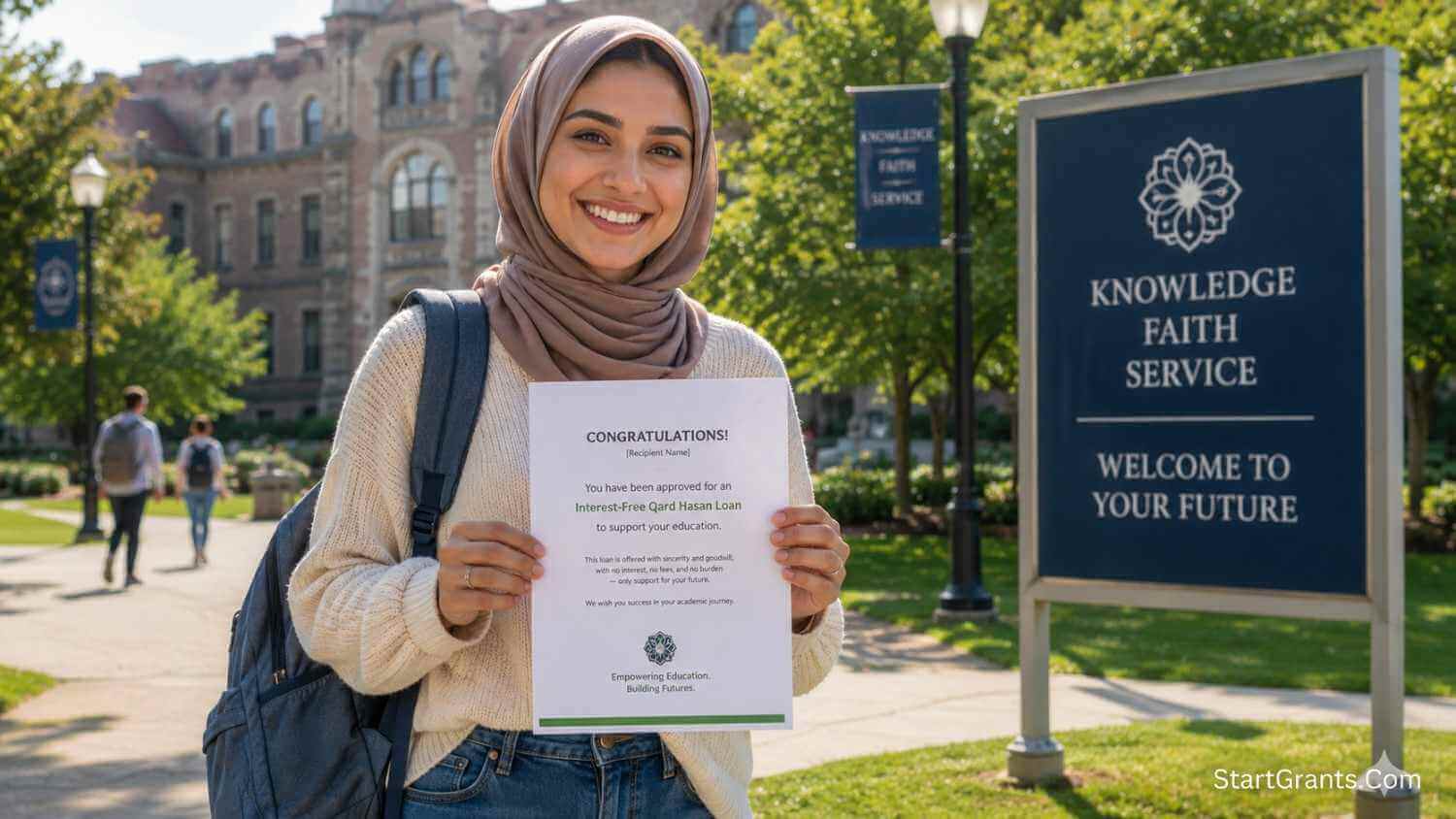
Muslim students must carefully separate Halal “gift aid” (Pell Grants) from Haram interest-bearing student loans when reviewing their federal financial aid packages.
Hardship, Zakat, and Avoiding Payday Loans
If a Muslim family is facing eviction or cannot afford groceries, the desperation can sometimes lead to taking out predatory “payday loans” or high-interest personal loans. This must be avoided at all costs. The preservation of faith and avoiding Riba is paramount.
Instead of turning to commercial debt, individuals facing severe hardship must utilize the Islamic social safety net: Zakat. Muslims who are struggling to meet basic needs inherently qualify as recipients of Zakat. Before taking a loan, individuals should contact local Islamic centers or national organizations like ICNA Relief or the National Zakat Foundation (NZF), which distribute Zakat funds directly to Muslim families in crisis for rent, utility, and food assistance.
Navigating Mandatory Personal Insurance (Gharar)
Many government housing programs or university enrollments mandate that the individual carry personal health or renter’s insurance. Traditional commercial insurance is problematic in Islam due to the presence of Gharar (excessive uncertainty). While cooperative Takaful options are still severely limited in the U.S. personal market, Islamic scholars generally permit taking the minimum required commercial insurance under the principle of Dharurah (necessity) if it is legally mandated by the state or university, though individuals should actively seek the most ethically structured plans available.
Conclusion
Applying for free government grants as an individual requires separating internet myths from bureaucratic reality. The government will not fund your lifestyle, but it provides robust, targeted safety nets for education, housing crises, and utility emergencies through official portals like Benefits.gov.
For the Muslim community, navigating this system is an exercise in spiritual discipline. By fiercely protecting your personal finances from Riba—rejecting federal student loans in favor of Halal grants and Qard Hasan, and turning to Zakat instead of payday loans during hardships—you ensure that your path to financial recovery remains spiritually pure and blessed.
Frequently Asked Questions (FAQs)
Q1: Is there a government grant to pay off my personal credit card debt?
A: No. The federal government does not issue grants to individuals to pay off unsecured consumer debt like credit cards or personal loans. Websites offering this service are almost universally scams designed to steal your identity or charge you fraudulent “processing fees.”
Q2: Do I have to pay back the Pell Grant?
A: No. The Federal Pell Grant is considered “gift aid” and does not have to be repaid, provided you maintain your enrollment status. If you drop out of college early in the semester, the government may require you to return a portion of the unearned funds.
Q3: How do I know if a website offering a grant is legitimate?
A: Legitimate federal grant programs are always hosted on secure `.gov` websites, such as Grants.gov, StudentAid.gov, or Benefits.gov. Furthermore, the U.S. government will NEVER ask you to pay a fee to apply for a grant. If a site asks for a credit card to access an application, it is a scam.
Q4: Why can’t a Muslim student accept a Federal Subsidized Student Loan?
A: While “subsidized” means the government pays the interest while the student is in school, the loan will eventually begin accumulating compounding interest once the student graduates. In Islamic finance, any contract that stipulates the payment of interest—regardless of when it begins—is classified as Riba and is strictly prohibited.
Q5: If I cannot afford my rent, is it Halal to take Zakat instead of a loan?
A: Yes, it is highly encouraged. If you cannot afford basic necessities like rent or food, you fall into the categories of the poor (Al-Fuqara) or needy (Al-Masakin), making you rightfully eligible to receive Zakat. It is far better to seek Zakat from an Islamic charity than to engage in Haram interest-bearing loans.