
Last Updated: | Author: Munir Ardi
A free eye exam may be available through a public benefit, nonprofit program, community health center, school referral, or local charity. There is no single federal program that guarantees a free routine exam and glasses to every applicant, and each source has different age, insurance, income, residence, or referral rules.
This guide focuses specifically on finding free or low-cost vision care. For a broader comparison of hospital assistance, prescription help, and specialized medical programs, visit our Medical Bills and Prescription Assistance hub.

Free-exam programs differ by age, location, insurance status, and the type of eye care needed.
Start With Your Existing Coverage
Before applying to a charity, check whether Medicaid, CHIP, Medicare Advantage, an employer plan, a Marketplace plan, a school program, or a tribal health program already covers the service. Ask separately about the exam, refraction, lenses, frames, contact-lens fitting, diagnostic testing, and medical treatment because they may be billed differently.
Medicare
Original Medicare does not cover routine eye exams for eyeglasses or contact lenses. That does not mean Medicare never covers eye care. Coverage may apply to certain medically necessary services, and some Medicare Advantage plans offer additional routine vision benefits. Verify the exact benefit with Medicare and the plan before scheduling.
Medicaid and CHIP
Children enrolled in Medicaid are entitled to medically necessary vision services through the Early and Periodic Screening, Diagnostic, and Treatment framework. Adult Medicaid vision benefits vary by state and plan. Contact the member-services number on the insurance card and ask whether the provider must be in-network or whether prior authorization is required.
Programs That May Provide a Free Eye Exam
| Program or route | Who it may help | What to know |
|---|---|---|
| EyeCare America | Eligible uninsured or underinsured adults age 18+ | Online eligibility screening; medical eye care, not a guaranteed eyeglass benefit |
| InfantSEE | Infants 6–12 months old | One no-cost assessment through a participating AOA optometrist, regardless of income or insurance |
| Local Lions club | People whose local club offers vision assistance | Funding, eligibility, referrals, and services vary locally; assistance is not guaranteed |
| Community health center | People seeking local low-cost care | Not every center provides optometry; call about services and sliding-fee policies |
| School or Head Start referral | Children who fail screening or need follow-up | Ask the nurse or family liaison about local exam and eyeglass partners |
EyeCare America
EyeCare America, a program of the American Academy of Ophthalmology, connects eligible adults with volunteer ophthalmologists for medical eye exams at no out-of-pocket cost. Its current patient page begins eligibility screening at age 18. Insurance, previous eye care, residence, and other program rules can affect eligibility.
The program is designed for medical eye care. Do not assume it pays for routine refraction, eyeglasses, medications, hospital services, or every test or procedure. Complete the official screening to learn what applies to you.
InfantSEE
This InfantSEE program provides one no-cost comprehensive eye and vision assessment for infants between 6 and 12 months old through participating American Optometric Association members. Family income and access to insurance do not determine eligibility for this assessment.
Local Lions Clubs
Lions clubs support vision projects, but there is no universal national voucher that every applicant automatically receives. Use the official Lions club locator, contact the local club, and ask whether it currently assists individuals with exams or prescription eyewear. A club may refer applicants to another local organization or may have no individual-assistance fund available.
Community Health Centers and Local Clinics
Use HRSA’s Find a Health Center tool to locate nearby federally supported health centers. Vision services are not offered at every site. Call before visiting and ask about optometry, referrals, sliding-fee discounts, documents, and whether an appointment is required.
Free Exam Does Not Always Mean Free Glasses
An eye-health examination, a refraction for an eyeglass prescription, and prescription eyewear are separate services. Ask the program exactly what is included. If you already have a current prescription but cannot afford glasses, New Eyes may be another route. Its current application page explains the eyeglass assistance and prescription requirements.
Compare the complete price rather than the frame price alone. Lenses, progressive designs, coatings, high-index materials, shipping, adjustments, and return policies can change the final cost.
Your Right to an Eyeglass Prescription
Under the FTC Eyeglass Rule, an optometrist or ophthalmologist generally must provide a copy of the eyeglass prescription immediately after a refractive examination, whether or not the patient asks, and cannot charge an additional fee for that prescription. Digital delivery requires the patient’s affirmative consent to the delivery method.
The draft previously suggested that federal law always requires pupillary distance, or PD, on the prescription. That is not accurate nationwide. The FTC explains that some states require PD; it encourages a provider who measures PD to provide it, but federal prescription content can depend partly on state law.
If the Exam Finds an Eye Disease
A routine vision benefit or eyeglass voucher may not cover glaucoma treatment, retinal imaging, injections, surgery, or prescription medicines. Ask for a written care plan, diagnosis, billing codes, and estimated charges before non-emergency treatment when possible.
- For prescribed drops or other medicines, review our Prescription Drug Assistance guide.
- For a hospital or facility bill, use our Hospital Bill Financial Assistance guide. Charity care is an application process, not a law that automatically erases every bill.
Sudden vision loss, severe eye pain, a new curtain-like shadow, chemical exposure, or a serious eye injury may require urgent medical attention. Do not delay emergency care while waiting for a charity-program decision.
A Muslim Perspective
Protecting one’s health and vision is important. A charitable exam, donated glasses, or no-cost public service generally does not create a repayment obligation. Still, StartGrants cannot determine that every assistance arrangement, insurance product, financing contract, or use of zakat is permissible for every person.
If a clinic offers financing, read the contract carefully for interest, deferred-interest terms, late fees, and the consequences of missed payments. Consider available no-cost programs, a transparent payment plan, community assistance, or saving for a non-urgent purchase before taking on expensive debt. A qualified scholar familiar with U.S. healthcare finance can advise on religious questions, and the organization distributing zakat should determine eligibility under its own policy.
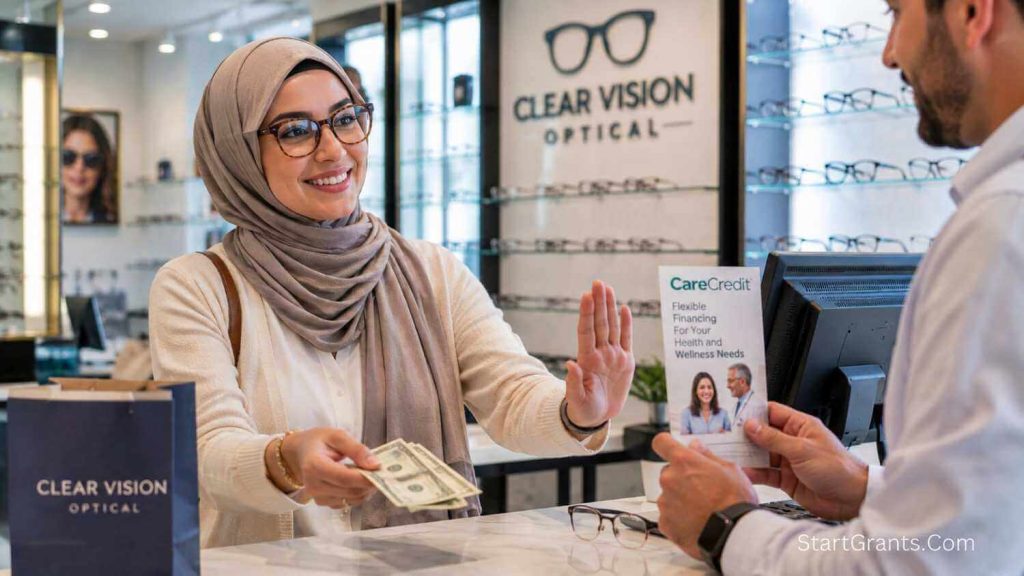
Compare charitable assistance, coverage, cash prices, and written financing terms before paying for vision care.
Frequently Asked Questions
Where can I get a free eye exam?
Possible sources include EyeCare America, InfantSEE for eligible infants, Medicaid or CHIP, a local Lions club, a school referral, or a community health center. Availability and eligibility differ.
Does Original Medicare cover routine eye exams?
No. Original Medicare does not cover routine eye exams for eyeglasses or contact lenses. It may cover certain medically necessary eye services, and some Medicare Advantage plans offer additional vision benefits.
Is EyeCare America only for seniors?
No. Its current patient eligibility page says people age 18 and older may qualify for a medical eye exam at no out-of-pocket cost. Applicants must complete the official eligibility screening.
Does InfantSEE provide a free exam for every child?
InfantSEE provides one no-cost assessment for infants between 6 and 12 months old through participating providers, regardless of family income or insurance access. It is not a continuing eyeglass benefit for children of every age.
Will a Lions club automatically give me a voucher?
No. Vision assistance is organized locally. Contact the nearest club to ask about its current services, eligibility rules, referrals, and available funding.
Does a free eye exam include free glasses?
Not necessarily. The exam, refraction, frames, and lenses may be separate benefits. Ask the program and provider what is included before the appointment.
Must an eye doctor give me my eyeglass prescription?
Generally, yes. The FTC Eyeglass Rule requires the prescription after a refractive examination without an extra prescription fee, subject to the rule’s limited government-provider exception.
Must pupillary distance appear on every eyeglass prescription?
No federal rule requires it in every state. Some states require pupillary distance, and the FTC encourages providers who take the measurement to give it to the patient.
What should I do if an exam finds a serious eye condition?
Ask the provider about urgency, covered services, expected charges, and financial assistance. Sudden vision loss, severe pain, chemical exposure, or serious injury may require immediate care.
Disclaimer: StartGrants.com is an independent information portal and is not affiliated with Medicare, Medicaid, EyeCare America, InfantSEE, Lions Clubs International, VSP Vision, New Eyes, an eye-care provider, insurer, government agency, or religious authority. Program availability and coverage can change. This article is not medical, insurance, legal, financial, or religious advice. Verify current terms with the official program and seek urgent professional care for an eye emergency.