
Last Updated: | Author: Munir Ardi
If you cannot afford a hospital bill, first confirm that the amount is correct, then request the hospital’s current Financial Assistance Policy and application. You may also need to correct an insurance claim, appeal a denial, invoke surprise-billing protections, or arrange an affordable payment plan. Financial assistance can reduce or forgive eligible charges, but it is not automatic and no federal rule guarantees a particular discount.
This article focuses on the general hospital-bill workflow. For the broader relationship between hospital bills, prescription costs, and specialized assistance, begin with our Medical Bills and Prescription Assistance guide.
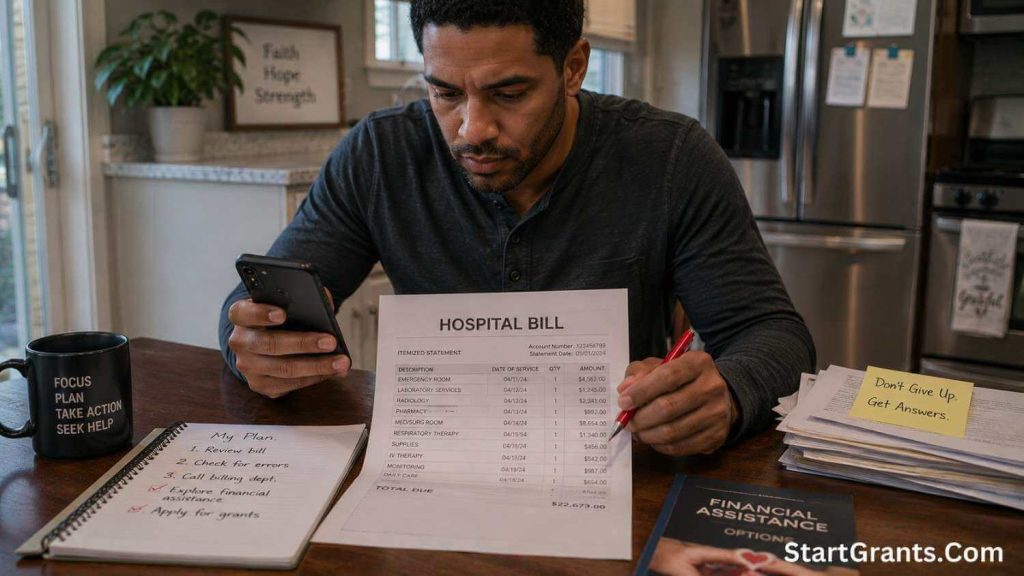
First, Identify Every Bill and Billing Entity
One hospital visit can create separate bills from the facility, emergency physician, surgeon, anesthesiologist, radiologist, pathologist, laboratory, ambulance provider, or other professional group. Approval under a hospital’s Financial Assistance Policy may not automatically cover an independent provider.
Create a list showing:
- The name of each facility or provider issuing a bill.
- The patient, account number, and date of service.
- The billed charge, insurance adjustment, insurance payment, prior payment, and claimed balance.
- Whether the provider appears in-network or out-of-network.
- Whether the hospital’s FAP lists that provider as covered or excluded.
CMS explains that a medical bill is not the same document as an Explanation of Benefits (EOB). Its guide to reading a medical bill recommends checking the patient information, provider, dates, services, adjustments, insurance payments, and patient responsibility. If you used insurance, compare the bill against the EOB before paying.
Request an Itemized Bill and Correct Errors
Ask the billing office for an itemized statement if the bill only shows a summary balance. The statement may include descriptions or billing codes, but a patient should not diagnose coding fraud from a code alone. Ask the provider to explain unfamiliar charges and request correction of duplicate services, incorrect dates, wrong insurance information, payments that were not credited, or services you did not receive.
If the insurer has not processed the claim, ask the provider whether it submitted the correct member information and billing data. If the EOB says the claim was denied, determine whether the reason involves prior authorization, medical necessity, missing information, network status, coordination of benefits, or a filing problem.
People covered through plans subject to federal appeal protections may have the right to an internal appeal and, in qualifying cases, external review. Follow the deadlines and instructions in the denial notice. The official HealthCare.gov insurance-appeal guide explains the distinction.
Ask for the Hospital’s Financial Assistance Policy
Section 501(r) requires covered tax-exempt hospital facilities to establish a written Financial Assistance Policy and an emergency medical care policy. It also imposes rules concerning limitations on charges and billing and collection practices. The requirements apply facility by facility; they do not establish one national income cutoff or require every hospital to forgive every bill.
The official IRS Section 501(r) overview identifies these requirements. A hospital’s own FAP should specify:
- Income, household, residency, insurance, or other eligibility rules.
- Whether free care, discounted care, or both are available.
- Which emergency and medically necessary services are eligible.
- Which providers are covered by the policy and which are excluded.
- Required documents and acceptable alternatives when a document is unavailable.
- How and where to submit an application.
- How the hospital calculates charges for eligible patients.
- The reconsideration or appeal process, if offered.
For-profit hospitals, government facilities, freestanding clinics, ambulance providers, and independent medical groups may not be governed by §501(r) in the same way. They may still offer discounts, hardship programs, or payment plans under their own policies or state law.
Financial assistance for insured patients
Having health insurance does not universally qualify or disqualify a patient. Some FAPs help eligible insured patients with deductibles, coinsurance, or other balances; others impose additional conditions or exclude particular services. Apply under the current written policy instead of relying on a general statement from a call-center representative.
Use the Correct Provider-Specific Application
Large hospital systems maintain separate eligibility rules, applications, regional forms, covered-provider lists, and contact channels. This general guide does not replace those policies.
- For bills issued by Cleveland Clinic facilities or covered providers, use our Cleveland Clinic Financial Assistance guide. That page owns the Cleveland Clinic, HCAP, application, documentation, timing, and contact queries.
- For bills issued through Intermountain Health, use our Intermountain Health Financial Assistance guide. It explains the Intermountain application path, regional materials, participating facilities, and provider-coverage questions.
Do not send one hospital system’s application to another. Confirm the legal name on the bill and check whether separate physician, ambulance, or laboratory charges require separate applications.
Hospital-Bill Assistance Routes Compared
| Route | What it addresses | What to request | Important limitation |
|---|---|---|---|
| Billing correction | Incorrect patient, date, service, payment, adjustment, or insurance information | Itemized bill, explanation, and corrected statement | Requesting an itemized bill does not itself reduce a valid charge. |
| Insurance appeal | A denied or incorrectly processed covered claim | Denial reason, internal appeal, and external review information | Deadlines and rights depend on the plan and applicable law. |
| Hospital FAP | Eligible emergency or medically necessary hospital charges | Policy, application, covered-provider list, and written decision | No universal income limit or guaranteed discount applies. |
| No Surprises Act | Certain unexpected out-of-network bills or qualifying estimate disputes | Insurer/provider review, complaint, or eligible dispute | It does not cover every service, plan, or ordinary deductible. |
| Negotiated discount or payment plan | A valid balance remaining after other reviews | Written settlement or affordable no-interest terms | Discounts are not guaranteed; financing may include interest or fees. |
Check No Surprises Act Protections
The No Surprises Act protects many people with private health insurance from certain unexpected out-of-network bills involving emergency care, non-emergency care associated with a visit to an in-network hospital, hospital outpatient department, or ambulatory surgical center, and air-ambulance services. Exceptions exist, and ground ambulance services are generally outside these federal balance-billing protections unless another law applies.
CMS maintains the official Medical Bill Rights portal and the No Surprises Help Desk at 1-800-985-3059.
If you were uninsured or chose not to use insurance, providers generally must give a good-faith estimate when qualifying care is scheduled in advance or when you request one. CMS says its patient-provider dispute process may be available when:
- You did not have or did not use insurance for the care.
- You received a qualifying written good-faith estimate.
- The initial bill is dated within the previous 120 calendar days.
- A provider or facility charged at least $400 more than its estimate.
The process has a $25 administrative fee and additional requirements. Review the current CMS medical-bill dispute instructions before filing. A bill reflecting an ordinary deductible is not automatically a No Surprises Act violation.
What Happens When a Bill Is in Collections?
Do not assume that merely requesting an itemized bill or starting an incomplete application automatically freezes every collection action. For covered tax-exempt hospitals, §501(r) contains specific notice, application-period, and extraordinary-collection-action procedures. The effect depends on timing, whether the application is complete, the type of action, and the hospital’s compliance process.
Contact both the hospital and collection agency. Ask the hospital in writing to:
- Confirm whether the account remains eligible for FAP review.
- State whether collection activity will pause while the application is reviewed.
- Recall or adjust the account if assistance is approved.
- Send a written determination and corrected balance.
When a third-party debt collector contacts you, confirm the collector’s identity, request the required validation information, preserve all correspondence, and dispute inaccurate information promptly. The CFPB debt-collection resource explains general consumer rights. State laws may provide additional protections.
Credit-reporting policies and legal requirements can change. Do not rely on broad promises that a particular medical debt can never appear or will automatically disappear. Review your reports, dispute inaccuracies through the appropriate channel, and seek legal help promptly if you receive court papers.
Negotiate Only After Other Reviews
If the bill is correct and financial assistance or insurance does not resolve the full balance, ask whether the provider offers:
- An uninsured or prompt-pay discount.
- A settlement based on documented hardship.
- An affordable in-house payment plan.
- A reconsideration process after a change in income or household circumstances.
There is no universal 30%, 50%, or other guaranteed reduction. Obtain every offer in writing and confirm whether the payment will satisfy the account in full, how it will be reported internally, and whether any outside collection account will be updated.
Review medical credit cards and third-party loans separately from hospital assistance. A promotional 0% period may use deferred interest, causing interest to be charged under the agreement if the balance is not paid as required. Check the annual percentage rate, fees, late-payment provisions, default terms, and whether financing affects eligibility for assistance before signing.
A Muslim Perspective on Hospital Bills
Muslim patients may prefer to seek bill correction, insurance resolution, financial assistance, charitable support, and a genuine no-interest payment arrangement before using interest-bearing credit. A hospital discount or forgiveness is different from a loan, but the written agreement still determines whether repayment, interest, fees, a lien, or recapture applies.
Avoid declaring every hospital program automatically permissible or every form of insurance impermissible without reviewing the actual facts. Contemporary scholarly conclusions can differ, particularly where employment coverage, legal requirements, necessity, dependents, or serious health risks are involved.
Possible avenues include a hospital FAP, a documented no-interest installment arrangement, help from family, a written qard hasan, or assistance from a mosque or zakat committee under its own rules. Do not delay emergency treatment while arranging a preferred payment method. A qualified Islamic-finance scholar can assess religious questions, while a consumer attorney, insurance specialist, or financial adviser can evaluate the contract and legal consequences. This article does not issue a fatwa.
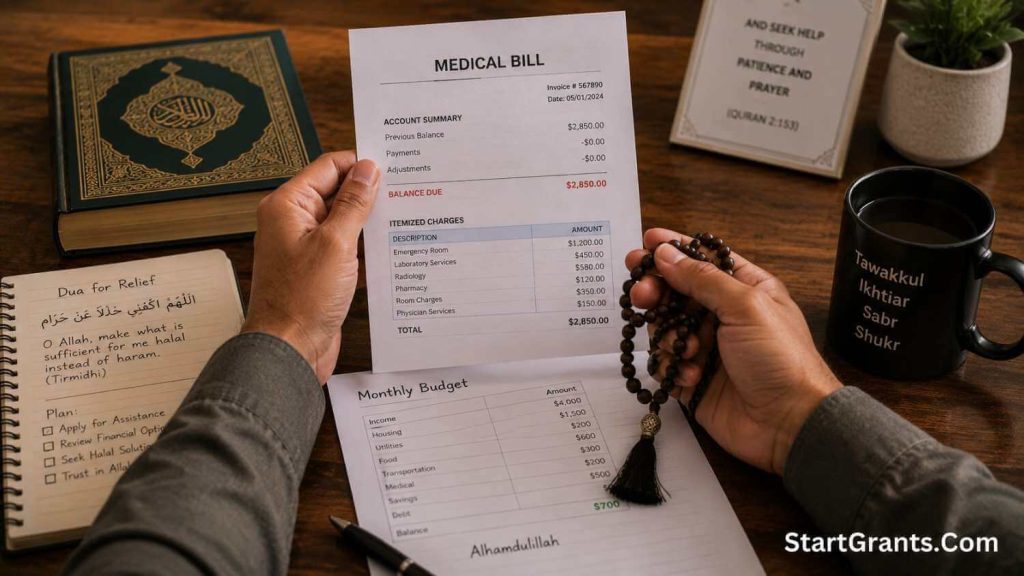
Save This Hospital-Bill Assistance Checklist
Frequently Asked Questions
Can insured patients apply for hospital financial assistance?
Possibly. Some hospital policies assist eligible insured patients with deductibles, coinsurance, or other balances. The hospital’s current policy determines the income rules, covered services, providers, and documentation requirements.
Does requesting an itemized bill automatically lower the balance?
No. An itemized bill helps identify the services, charges, payments, adjustments, and possible errors. A valid balance does not automatically decrease merely because an itemized statement was requested.
Does every nonprofit hospital use the same income limit?
No. Section 501(r) requires covered tax-exempt hospital facilities to maintain a Financial Assistance Policy, but it does not establish one national income limit or discount percentage.
Can I apply after a hospital bill goes to collections?
Contact the hospital immediately. Eligibility depends on the hospital’s policy, the federal application-period rules where applicable, state law, timing, and whether the application is complete. Request written confirmation of any collection pause or account recall.
Does submitting a financial-assistance application automatically freeze collections?
Not in every situation. Covered tax-exempt hospitals must follow specific federal billing and collection procedures, but the result depends on timing, completeness, and the type of collection action. Ask for the account status in writing.
What if my hospital bill does not match my Explanation of Benefits?
Contact both the provider and health plan. Confirm the claim, network status, adjustments, insurance payment, and patient responsibility. Request a corrected bill or follow the plan’s appeal process when appropriate.
Can I dispute a self-pay bill that exceeds the estimate?
You may qualify for the federal patient-provider dispute process if you did not have or use insurance, received a qualifying good-faith estimate, act within the deadline, and a provider or facility charged at least $400 more than its estimate.
Do Cleveland Clinic and Intermountain Health use the same application?
No. They are separate health systems with different policies, applications, covered facilities, provider lists, documentation rules, and contact channels. Use the program associated with the organization that issued the bill.
Is a hospital payment plan always interest-free?
No. Some in-house plans may be interest-free, while medical credit cards, outside financing, or other arrangements may charge interest or deferred interest. Read the complete written terms before enrolling.