
Last Updated: June 2026 | Author: Zee
Quadriplegia (tetraplegia)—the partial or total loss of use of all four limbs and torso—is one of the most financially catastrophic medical conditions a family can face. Whether caused by a severe spinal cord injury (SCI), ALS, or an advanced neurological disease, the first-year medical costs routinely exceed $1 million. Standard health insurance quickly hits lifetime maximums or denies coverage for the highly customized technology required to keep a paralyzed individual alive and engaged with the world.
Before assembling your funding strategy for paralysis, you must establish your federal baseline by visiting our command center for disability and mental health grants. Crucially, a quadriplegic individual cannot survive without 24/7 physical assistance. The financial ruin often falls upon the spouse or parents who must quit their jobs to provide care. Therefore, it is absolutely critical that you simultaneously deploy our blueprint on securing financial assistance for caregivers of disabled individuals so the family does not face bankruptcy while providing care.
You cannot fight paralysis with standard mobility tools. You need Complex Rehab Technology (CRT), environmental control units, and accessible transportation. Here is your 2026 tactical guide to finding financial help for quadriplegics.
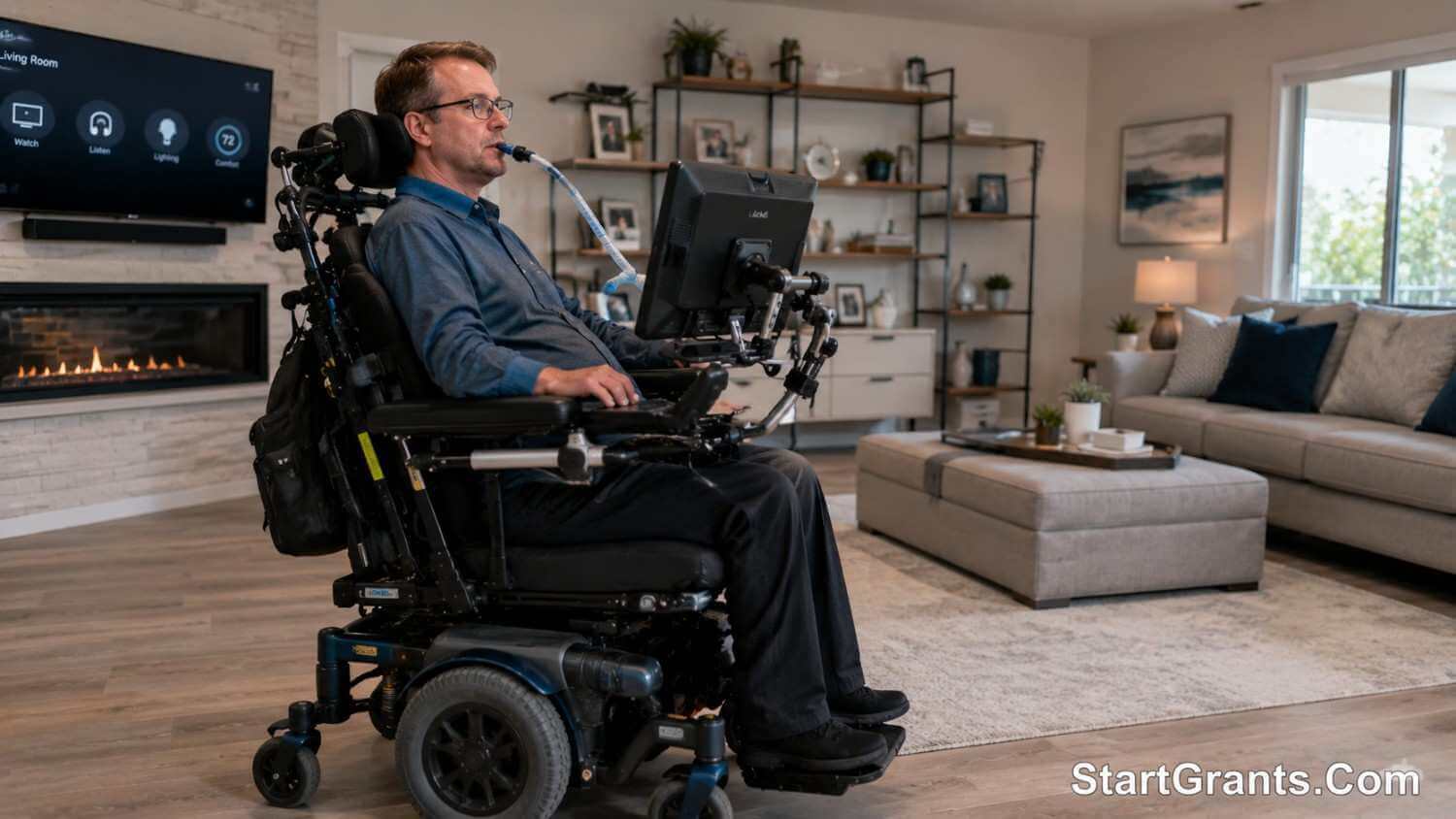
Quadriplegia requires Complex Rehab Technology (CRT), such as sip-and-puff or chin-controlled power wheelchairs. Government and philanthropic grants are critical to funding this life-saving equipment.
Phase 1: Funding Complex Rehab Technology (CRT)
A standard power scooter is useless for someone without upper body mobility. Quadriplegics require Complex Rehab Technology (CRT)—highly customized power wheelchairs equipped with tilt-in-space mechanisms (to prevent deadly pressure sores) and alternative driving controls like sip-and-puff, chin joysticks, or eye-tracking systems. These chairs can cost upwards of $40,000.
If you have Medicare or Medicaid, you must work with a certified Assistive Technology Professional (ATP). Medicare will cover CRT under Part B, but the documentation requirement is brutal. The ATP and your neurologist must definitively prove that this specific, customized chair is the only way you can perform activities of daily living inside your home. If Medicare denies a specific high-tech add-on (like a seat elevator), you must immediately appeal to your state’s Medicaid HCBS Waiver, which often covers what Medicare deems “non-essential.”
Phase 2: The Christopher & Dana Reeve Foundation
When public insurance fails, you must turn to the ultimate philanthropic authority on paralysis. The Christopher & Dana Reeve Foundation is the premier organization dedicated to curing spinal cord injuries and improving the immediate quality of life for paralyzed individuals.
Their Quality of Life Grants Program distributes millions of dollars annually. These grants are specifically awarded to non-profits and individuals to fund projects and equipment that foster independence. This includes funding for specialized adaptive sports equipment, home accessibility modifications, and even accessible transportation initiatives.
Pro-Tip: Philanthropic Paralysis Grants
Watch this official overview from the Reeve Foundation to understand the exact eligibility requirements and how to qualify for Quality of Life grants to fund your specialized equipment and home modifications:
Phase 3: The VA Specially Adapted Housing (SAH) Grant
If your quadriplegia is connected to your military service, you have access to the most powerful housing grants in the United States. Paralyzed veterans cannot live in standard homes; they require widened hallways, ceiling track lifts, and roll-in showers.
The Department of Veterans Affairs offers the Specially Adapted Housing (SAH) Grant. As of recent updates, this grant can provide over $100,000 to severely disabled veterans to buy, build, or modify a home to accommodate their paralysis. Additionally, the VA offers the Automobile Allowance and Adaptive Equipment Grant, which provides funds to purchase a wheelchair-accessible van and install specialized driving or passenger equipment.
Phase 4: The Muslim Perspective (Extreme Ibtila, Caregiving, & Zakat)

Severe paralysis is an immense physical test, but it does not paralyze the soul. The continuous, loving care provided by family members is an act of profound worship, supported by the community through Zakat.
For a Muslim family, the sudden onset of quadriplegia is a seismic event that tests the very limits of human endurance and faith. It requires a profound, community-wide Islamic response.
1. The Highest Degree of Sabr
Losing the ability to move one’s body is an extreme Ibtila (trial). However, Islamic theology reassures the patient that the soul—the true essence of the human being—remains entirely intact and free. The Prophet Muhammad (PBUH) stated that no fatigue, nor disease, nor sorrow befalls a Muslim, even if it were the prick of a thorn, except that Allah expiates some of their sins for it. The continuous patience (Sabr) demonstrated by a quadriplegic Muslim elevates their spiritual rank immeasurably.
2. The Jihad of the Caregiver
The family members who bathe, feed, and reposition the paralyzed patient in the middle of the night to prevent bedsores are engaging in a relentless, silent Jihad. This act of caregiving is a towering form of worship. The community must recognize that these caregivers are physically and emotionally exhausted.
3. Zakat for Complex Technology
No family should resort to predatory interest loans (Riba) to buy an $80,000 accessible van so their paralyzed son or daughter can leave the house. Paralyzed individuals lacking funds for CRT and home modifications are the absolute priority for Zakat under the category of Al-Gharimin (debtors). Local Masjids must aggressively mobilize Zakat funds to purchase environmental control units, ceiling lifts, and adaptive vans. Reintegrating a quadriplegic Muslim back into the physical community—allowing them to attend Friday prayers—is a communal obligation (Fard Kifayah).
Conclusion: Assembling the Ultimate Care Package
Surviving quadriplegia requires treating your financial strategy like a high-stakes engineering project. The costs are too high to rely on a single source of income.
You must aggressively utilize Medicaid HCBS Waivers to cover the extreme costs of in-home nursing and CRT that Medicare refuses to pay. Veterans must immediately file for the SAH housing grants, and civilians should actively petition the Reeve Foundation for Quality of Life funding. Furthermore, securing state caregiver stipends for the family members providing 24/7 care is non-negotiable to prevent total household bankruptcy.
Frequently Asked Questions (FAQs)
Q1: Will Medicare pay for an accessible wheelchair van?
A: No. Medicare does not consider vehicles or vehicle modifications to be Durable Medical Equipment (DME). To fund a modified van, you must rely on VA Grants (if you are a veteran), state Vocational Rehabilitation agencies (if the van is required for you to get to work), or philanthropic grants from organizations like the Help Our Military Heroes (for vets) or the Ralph Braun Foundation.
Q2: Can a quadriplegic person drive a car?
A: Yes, depending on the exact level of the spinal cord injury. Individuals with C5-C7 injuries often retain some shoulder and bicep mobility. With highly customized adaptive technology—such as zero-effort steering, electronic gas/brake systems, and joystick driving controls—many quadriplegics are evaluated by Certified Driver Rehabilitation Specialists (CDRS) and successfully return to driving.
Q3: What is an Environmental Control Unit (ECU)?
A: An ECU is a smart-home technology system designed for individuals with severe paralysis. It allows a quadriplegic patient to control the lights, television, thermostat, doors, and telephone using their voice, eye movements, or a sip-and-puff switch. Funding for ECUs is often provided by Medicaid Waivers and state Assistive Technology programs.
Q4: How can I pay for 24-hour nursing care at home?
A: 24-hour in-home care is rarely covered by commercial insurance or standard Medicare (which only covers intermittent, short-term care). To fund round-the-clock care, you must qualify for a Medicaid Home and Community-Based Services (HCBS) Waiver, which diverts funds that would normally pay for a nursing home to pay for private duty nurses in your own house.
Important Disclaimer: StartGrants.com is an informational directory, not a medical or legal advisor. Funding for Complex Rehab Technology is highly complex and requires exhaustive medical documentation. Always work alongside a certified Assistive Technology Professional (ATP) and a specialized hospital social worker to submit your equipment claims.